
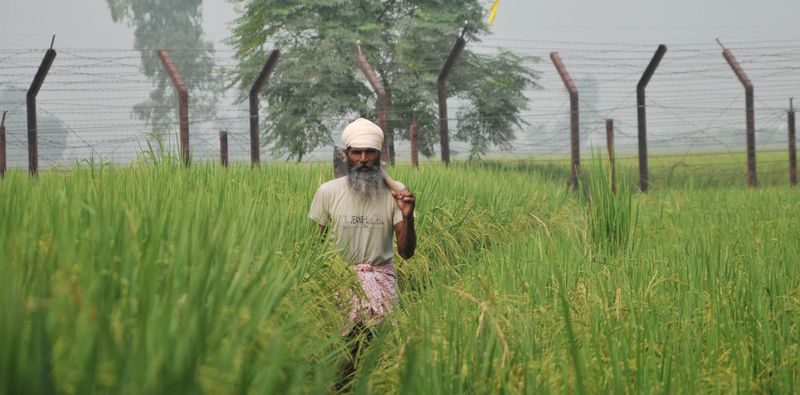
While the survey is only a first step, the challenge lies in balancing security concerns with livelihood rights of Punjab border resident
The barbed fence, erected during the militancy years in the late 1980s, does not run along the Zero Line — the actual international boundary — but up to 3 km inside the Indian territory in some stretches. Photo: Vishal Kumar
A fresh push by the Centre to conduct a social impact survey on shifting the barbed fence along the Indo-Pak border has rekindled hope among thousands of farmers in Punjab who have, for decades, tilled land trapped in a bureaucratic and security limbo.
The barbed fence, erected during the militancy years in the late 1980s, does not run along the Zero Line — the actual international boundary — but up to 3 km inside the Indian territory in some stretches. As a result, vast areas of fertile farmland were left between the fence and the border, effectively placing them in a restricted zone.
Across the six border districts of Amritsar, Tarn Taran, Gurdaspur, Pathankot, Ferozepur and Fazilka, around 21,600 acres in 220 villages fall into this category. In Amritsar district alone, 3,801 acres remain beyond the fence. Punjab shares a 553-km-long border with Pakistan.
Border Security Force (BSF) officers say the fence cannot be erected at a uniform distance from the Zero Line as it depends on factors such as terrain and defence strategy. However, at places where it is much farther away, shifting the fence could immensely help farmers.
Restoring access
The Union government has asked district administrations to assess the social and economic impact of potentially shifting the fence closer to the Zero Line. If implemented, this could restore easier access to farmland, improve productivity and income, reduce dependence on security clearances, and address long-standing grievances of border residents.
For farmers, cultivating land beyond the fence is not just difficult but often unviable. They are allowed entry only during fixed hours, typically from 10 am to 4 pm, and even that window shrinks in winter due to fog or heightened security alerts. “At least two hours are lost in security checks every day,” says Arjan Singh, a farmer from Hoshiarnagar near Attari.
The problems do not end there. Labourers avoid working in these areas due to restricted hours and often charge more. Combine harvester operators are also reluctant because of the time lost at security points. Installing new tubewells is nearly impossible and requires special permissions.
Ranjit Singh from Tarn Taran district sums up the economic hit: “The 8 acres across the fence give me less yield than 5 acres on this side.” Even land prices are significantly lower, and finding buyers is nearly impossible.
Patchy compensation
Initially, in 1998, the Centre started giving an inconvenience allowance of Rs 2,500 per acre to farmers. Later, in 2015, after the Punjab and Haryana High Court intervened, the compensation was increased to Rs 10,000 per acre.
Despite this, payments are often delayed, are irregular, and inadequate compared to the losses incurred over the years. Veteran farmer leader Rattan Singh Randhawa of the Border Area Sangharsh Committee says, “Even now, farmers are waiting for compensation for 2024. Every year, it is another battle we have to fight.”
Calculated decision
A retired BSF officer highlights that the fence’s position well inside Indian territory was never an error, but a calculated decision rooted in security strategy. “It helps in maintaining a clear observation zone,” he explains.
Natural constraints, including rivers, uneven terrain and flood-prone stretches, also played a decisive role in fixing the alignment of the fence, he says. “More importantly, this buffer creates a crucial window of response; any movement detected between the Zero Line and the fence can be tracked, assessed, and intercepted in time, giving security forces the advantage of preparedness rather than reaction.”
Policy movement
The issue has remained on the fringes of political discourse. Randhawa points to a stark reality: “If urban residents protesting against the lack of basic civic amenities don’t get attention, how can poor border farmers expect priority?”
While the survey is only a first step, it signals policy movement. Experts say shifting the fence, though sensitive from a security point of view, could be a game-changer if done carefully. Surjit Singh of Boora Kona village in Tarn Taran, who has also pursued related cases in courts, says, “We demand that the fence be shifted to around 50 metres from the Zero Line. If this happens, thousands of acres of land would come within the fence, and things would automatically improve.”
The challenge lies in balancing national security concerns with livelihood rights. Any decision to shift the fence will require coordination between the civil administration, security agencies, and local communities.