
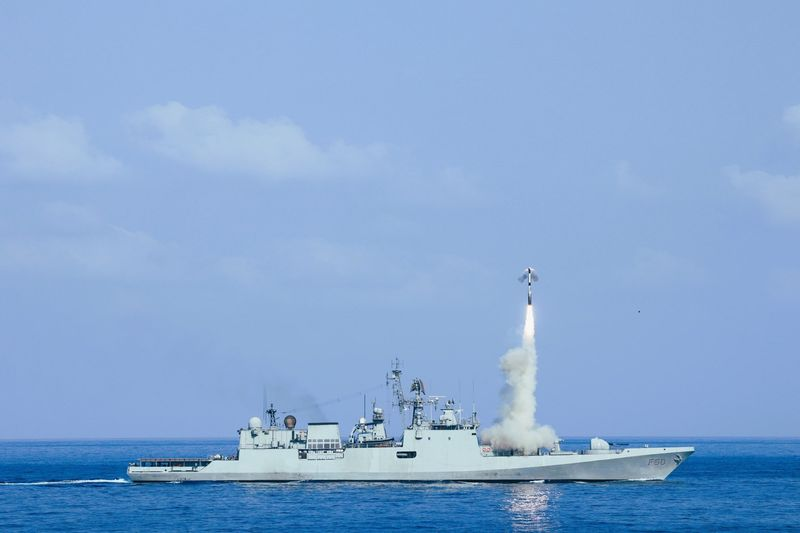
India’s missile export business is now along two tracks. One is a maritime strike option of BrahMos, which has been opted by Southeast Asian countries. The other is the Akash air-defence system, sold to three buyers, one in the Caucasus and two in Central Asia.BrahMos missile is a product of a joint venture between India’s DRDO and Russia’s NPO Mashinostroyeniya, formed in 1998. It has found eager customers in a cluster of countries around the South China Sea: Indonesia, the Philippines, and Vietnam. All three have opted for the anti-ship variant of the missile launched from coast. The BrahMos has a variant that is fired from a ship onto a land target, which has not been exported so far. The Philippines and Vietnam are locked in a running maritime territorial dispute with China in the hydro-carbon rich South China Sea. Indonesia also has small coast on the same sea, but is not part of the dispute.
The export of “fire-and-forget” BrahMos to ASEAN nations — especially those with overlapping maritime claims in the South China Sea — highlights a major shift.
The Philippines was the first to start the procurement from India and signed a $375 million contract signed in 2022 and deliveries commenced in 2024. Last month, it even carried out joint exercise with the US forces on ‘tracking warships’ for BrahMos anti-ship missile strike.
Indonesia and India signed an MoU in July this year, seeking coast-based batteries of the BrahMos missile with abilities to hit target 290 km at sea. A battery includes launchers, radars and the missiles. It was the third missile contract New Delhi has in the region what China perceives as its own ‘backyard’. Earlier Vietnam had inked a deal for $620 million. It includes the supply of mobile coastal defence missile batteries, comprehensive operator training for Vietnamese personnel, and long-term logistics and maintenance support.
Indonesia sits astride four major straits – the Mallaca, Lumbok, Sunda and Ombai–Wetar – which connect the Indian Ocean and the Pacific Ocean. All the four are major shipping arteries — all important for China.
Defence Secretary Rajesh Kumar Singh, last week said: “BrahMos is a kind of benchmark for our export story. We’ve got contracts or agreements to sell from The Philippines, and Indonesia and Vietnam”.
Success of Akash
Akash is the country’s most significant indigenous defence export. It is a layered air-defence system, not a single missile. It includes launchers, radars, command-and-control and support infrastructure.
Defence Secretary Rajesh Kumar Singh said “Armenia was the first customer, which has taken multiple batteries. Thereafter, we’ve also exported it to Tajikistan and Turkmenistan.” While the missile has additional orders from Indian armed forces but Defence Ministry is confident of getting orders from other countries.
India and Armenia, a country that shares a border with Turkiye, have discussed expanding their defence partnership in August this year. India is already a supplier of rockets, weapons and air defence systems to Armenia.
Akash is not merely an export of individual missiles, but represents a larger indigenous air-defence system involving launchers, radars, command-and-control elements and associated support infrastructure.
The original Akash system reaches roughly 25-30 km, while the Akash-NG is designed for up to 50 km. BDL builds the missiles and BEL supplies electronics, which shows a broad domestic industrial base behind the system.
India’s export strategy
BrahMos carries more geopolitical weight and higher contract values. Akash arguably shows more about the health of India’s industrial base. India is selling to partners who face maritime or aerial threats, bundle training and support, and offer technology transfer to deepen ties. India exported military equipment to 80 countries and it was worth Rs 38,424 crore.