
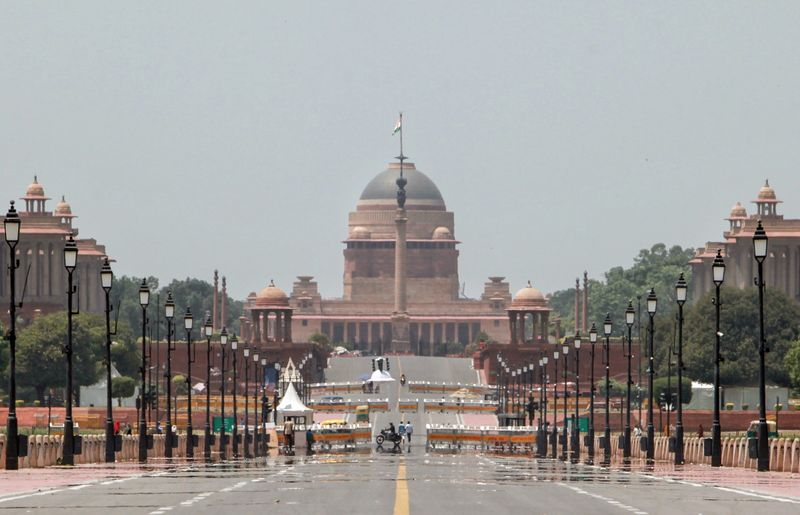
Prime Minister Narendra Modi and the ruling dispensation are determined to do away with India’s “thousand years of slavery”. As part of this project, the Union Government has been redeveloping the Central Vista in the heart of New Delhi, the city that the British built after they decided to move the capital of the Raj from Calcutta in 1911. It took them 20 years to build the new capital, which was inaugurated in 1931.
At the head of the Vista, up on Raisina Hill, was the principal seat of imperial power — the imposing Viceroy’s House. Down the hill were North and South Blocks which housed the secretariat of the Raj. And then came a vast rectangular space — the Great Place — at whose northern end a circular Central Legislature was constructed. From the gates of the Viceroy’s House through the centre of the Great Place was a grand 3 km-long road — Kingsway — flanked by lawns and ponds. Kingsway culminated in the All India War Memorial. Beyond that was the large traffic roundabout with a canopy above the statue of King George V.
The Kingsway lawns were bounded by Queen Victoria Road to the north and King Edward Road to the south. On these roads were located the residences of the Executive Councillors. The Imperial Records Department building was constructed on Queen Victoria Road. The only princely state to be given the privilege of having a residence on King Edward Road was Jodhpur. No princely state had a house on Queen Victoria Road. Away from the Vista, on a radial road to the south of the Viceroy’s House, the second most imposing house in the new capital was built. This was Flagstaff House, the residence of the Commander-in-Chief.
A couple of “temporary” constructions were built on the two roads during the Second World War. Thus, on Queen Victoria Road, a Central Vista mess for the Air Force came up and an Army mess was built on the lawns of the Jodhpur House.
As India became a Republic, it was only natural to change the names of the buildings on the Vista. Thus, the Viceroy’s House (Government House from 1947 to 1950) eventually became Rashtrapati Bhavan. The Central Legislature building became the Parliament building and Flagstaff House began to be called Teen Murti House, the residence of India’s first Prime Minister. The Imperial Records Department became the National Archives and the War Memorial was popularly called India Gate. George V’s statue was taken down.
As space requirements increased after Independence, new construction was done for government offices. Thus, the National Museum, Krishi Bhawan and Shastri Bhawan were built on Queen Victoria Road, which was renamed Rajendra Prasad Road, and Udyog Bhawan and Nirman Bhawan on King Edward Road, which was renamed after Maulana Azad. Vayu Bhawan and Rail Bhawan were also built.
For some of these buildings, the houses of the Executive Councillors were brought down. In time, the only one which remained was that of the Vice President of India. Later, the Indira Gandhi National Centre for the Arts and the Jawaharlal Nehru Bhawan were also constructed. In all these changes, an attempt was made to retain the integrity of the Vista.
During his tenure as PM, Modi has been radically changing the Vista. Thus, a new Parliament building and Secretariat buildings have been constructed. North and South Blocks have been abandoned and will be converted into museums. A new Vice President’s residence has been built and a new Prime Minister’s House is under construction. Several post-Independence and pre-Independence buildings have been brought down. A grand War Memorial has come up in front of the National Stadium, near India Gate. And, Netaji Subhas Chandra Bose’s statue is now under the canopy where once stood that of George V.
Yet, while the reconstruction of the Vista is in progress, can Modi’s ambitious project be said to be complete as long as the structure which was the crowning edifice of British imperial authority remains the residence of India’s Rashtrapati? The PM has taken keen interest in the construction of the new buildings, which seek to blend — both in their architecture and interiors — India’s ancient traditions with the aspiration of Viksit Bharat.
Certainly, it was important for Modi to change “subsidiary” buildings, but all this may not be enough as long as the apex structure of the Raj remains the seat of the Republic’s power. That is, in itself, incongruous. Can it continue indefinitely in view of the ruling party’s ideology and Modi’s project? Would they not prefer that the Rashtrapati Bhavan become a historical monument like so many in Delhi?
Naturally, the construction of a new Presidential residence will be a project of mammoth proportions. It will also be controversial, but the PM has never shied away from dissent in matters which he considers essential to his ideology and legacy. The second aspect is the need for land. Clearly, unlike the construction of the new Parliament building while the old one has become an adjunct cannot be a model for a new Presidential residence. The present structure’s size and location make that impossible. Hence, land will have to be found in the centre of Delhi.
The steps being taken to cancel leases of imperial institutions and land parcels of adjoining government structures can make sufficient land available for a new Presidential residence. Indeed, while other reasons are being given for some of these lease cancellations, does the actual one lie in wanting a new Presidential residence? A new one which harmonises India’s ancient glory with its current resurgence and the promise of Viksit Bharat will be far removed in nature and spirit from the imperial building where the Rashtrapati currently resides.