
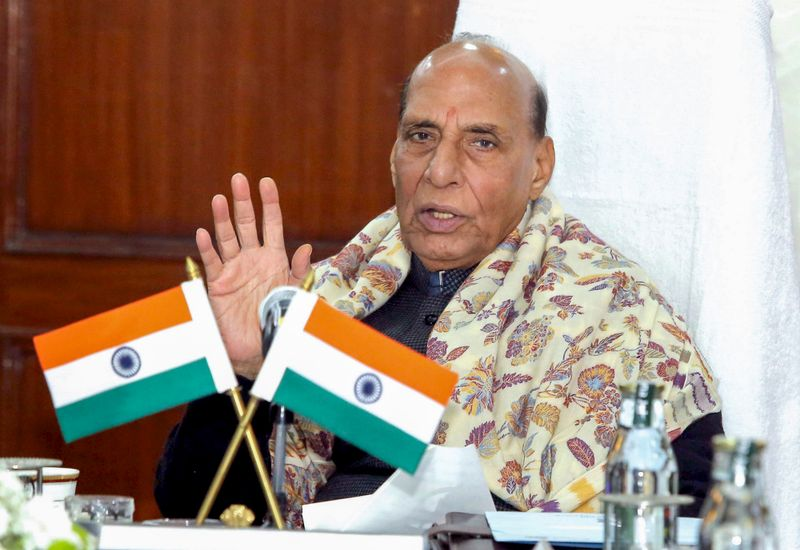
Cites Delhi blast to highlight role of moral education
Defence Minister Rajnath Singh on Friday said that an alarming trend of white-collar terrorism was emerging in the country, wherein highly-educated people are engaging in anti-social and anti-national activities.
Singh pointed at the November 10 car bomb blast near the Red Fort in Delhi, where the perpetrators were found to be doctors. “Today, an alarming trend of white-collar terrorism is emerging in the country. Highly-educated people are working against society and the country,” Singh said at the 104th Foundation Day event of Bhupal Nobles’ University here.
“The perpetrators of the (Delhi) bomb blast were doctors – those who write ‘Rx’ on prescriptions, yet have RDX in their hands. This highlights the need for knowledge to be accompanied by values and character,” the Defence Minister said.
“The purpose of education is not only professional success but also the development of morality, ethics and human character,” he said.
Singh added that knowledge leads to competence, which leads to prosperity, and prosperity leads to righteousness, and ultimately, true happiness comes only from righteousness. “Any education system that cannot fulfil this objective, which does not impart humility, a sense of character and ‘dharma’ (righteousness) along with knowledge, is incomplete,” Singh said.
“When I talk about religion, it should not be associated with going to the temple, mosque or church for prayer. Religion is a sense of duty. Education devoid of religion and morality will not be useful to society, and sometimes it can even prove fatal. This is why educated people are sometimes found to be involved in crimes,” Singh said.
Terrorists are not necessarily illiterate; they can hold university and college degrees, yet they become terrorists because they lack wisdom, the minister said.
Singh also hailed defence startups for doing remarkable work in the country. “I am confident that in the next 15-20 years, India will become fully self-reliant in weapons,” the defence minister said.
He also said that artificial intelligence, machine learning and other technologies are transforming people’s lives and work, and they must be used positively to drive India’s development.
India is the world’s fourth-largest economy, which is on track to become the third-largest by 2030, Singh said, noting that universities have a big role to play in this journey. He also emphasised the importance of understanding the delicate balance between self-respect and ego, and urged people not to cross the fine line between the two.
“Today, the world is facing problems such as environmental issues, health crises and digital ethics, which cannot be solved with a single discipline. Solutions can only be found through a multidisciplinary approach. Universities must teach the students not only what to think, but also how to think. They must create an environment where students can think holistically,” he said.
Advertisement