
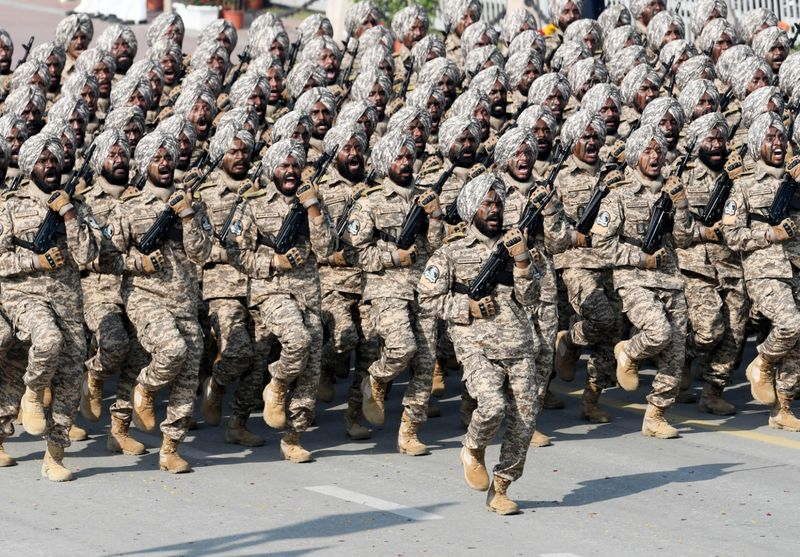
Conceived in 2025, Bhairav battalions are light commando units comprising about 300 troops, to bridge the gap between the traditional line infantry and the Special Forces
As a newly raised Bhairav battalion marched down Kartavya Path on Republic Day this year, it marked the Indian Army’s evolving strategy and doctrinal approach to meet the challenges faced in the contemporary multi-domain battle space.
In a few months, the raising of all the 25 planned battalions is expected to be complete, giving field commanders a powerful tool for high-intensity border operations.
Conceived in 2025, Bhairav battalions are light commando units comprising about 300 troops, primarily from the infantry with embedded elements from support arms, to bridge the gap between the traditional line infantry and the Special Forces.
Specializing in targeted disruption missions, drone operations, surveillance and swift independent actions, these compact, technology intensive and highly mobile units would come under the ambit of Corps and Division Commanders.
These are structured, trained and equipped designed for reconnaissance, rapid-response and hybrid warfare that involves simultaneous operations in multiple domains. Each such battalion also has a dedicated platoon, called Ashni, for drone and loiter munitions operations. Cyber warfare and information warfare are other specialities of these battalions
The SF are trained and oriented on deep-strike and high-risk missions behind enemy lines, while Bhairav units would be engaged in localised tactical operations, rapid border responses, providing field commanders a sword arm at the sharp-end without involving the Special Forces (SF) which are meant for strategic and high stake missions.
Bhairav battalions would be at the disposal of field commanders at the level of Corps and Divisions for employment within their respective areas or responsibility, whereas the missions and deployment of SF are worked out at the level of Command and Army Headquarters to cater to the larger strategic environment at the national level.
The Army has 15 regular SF battalions, a Rashtriya Rifles battalion and two Territorial Army battalions, some of which are deployed in a counter-terrorist environment. An SF battalion consists of about 650 personnel, whereas a regular infantry battalion, of which there are over 400, has 800 troops.
Army officers said that the raising of Bhairav battalions is part of a broader infantry modernisation drive towards proactive, technology-integrated warfare. The concept has been validated during exercises like Akhand Prahar, but this is still an evolving process that may require doctrinal changes and structural realignments to fine tune this idea and meet emerging operational requirements.
In October 2025, Lt Gen Ajay Kumar, the Director General, Infantry, had said that five Bhairav battalions were fully functional and deployed, with four more nearing deployment.
In January 2026, reports said that 15 Bhairav battalions were functional and the remaining 10 or so units would become fully functional in the coming months.
The Fourth Bhairav Battalion that took part in the Republic Day parade in the Capital was affiliated to the Sikh Light Infantry, which draws its manpower from the Mazhabi and Ramdasia Sikh communities.
The regiment in its present form was raised in 1941, though some of its constituent units trace their origins to 1857 as part of the Royal Sikh Pioneers of the British Indian Army.
The Sixth Bhairav Battalion that took part in a public event in Kolkata, for instance, is composed of troops from the north-east. A video on social media showed them singing the regimental song of the Assam Regiment.
Similarly, the Second Bhairav Battalion that took part in the Army Day Parade in Jaipur in January, is reported to be affiliated with the Rajputana Rifles that comprises Rajputs and Jats.
Soldiers in the Bhairav battalions do not wear the title of their parent regiment on their epaulettes. Shoulder titles on their uniforms mention ‘Bhairav’ and a sleeve patch identifies the battalion.
In Hindu mythology, ‘Bhairav’ is a fierce, powerful manifestation of the god Shiv, known as the destroyer of fear, time and evil. Bhairav, implying “fearsome”, is worshipped in India, Nepal, Indonesia, Sri Lanka, Japan as well as in Tibetan Buddhism.
According to sources, most Infantry Regiments would have a Bhairav battalion as part of their overall force accretion. Troops for the Bhairav battalion would be drawn from different battalions of the regiment and each Bhairav battalion would reflect the class composition of the parent regiment.
The Infantry comprises 26 Regiments including the seven different Gorkha Rifles. These regiments recruit soldiers on the basis of caste, community or geographical areas, making a homogeneous demographic and cultural profile.
The exception to this was the Brigade of the Guards that was raised post-Independence and recruited soldiers on an all-India basis, but this has been fully mechanised and is no longer considered as the Infantry.