
The saffron party courted the community on realising that ‘Muslim brotherhood’ was a myth
Radhika Ramaseshan
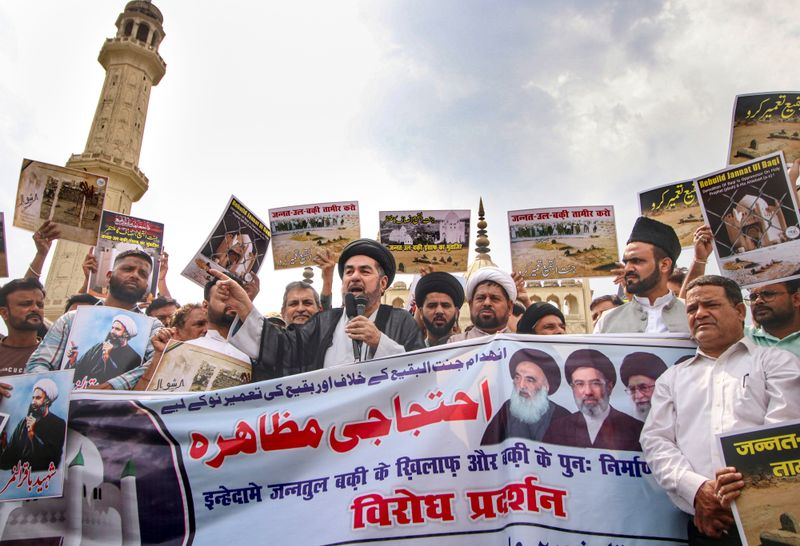
AMID the gloom and doom enveloping the world as Iran holds out against the US and Israel — and Lebanon as well as the West Bank are being flattened like Gaza — comes a flake of news that should be cheered for the sake of humanity and sanity. Thousands of miles from Iran, the Shias of Kashmir, Ladakh, Lucknow, Hyderabad and Bengaluru have risen in spontaneous solidarity for their community in the Middle East. Iran, like Iraq and Azerbaijan, is a Shia-majority country surrounded by Sunni-dominated nations.
The support was not confined to protests — there was an initial spurt in Kashmir and Lucknow — but included donations that were sent to the Iranian embassy in New Delhi to be routed to Tehran. The Shias regard the late Ayatollah Ali Khamenei, the first major casualty of the US-Israel assault, as a spiritual mentor on a par with the Pope. Kashmir’s spiritual affinity with Khamenei is even stronger because he had visited the Valley and Karnataka in 1981, long before he became the Supreme Leader. His trip was part of Iran’s religious and ideological outreach to India after the 1979 Islamic Revolution.
It seemed as though the Shias, based in cities where their population is sizeable, needed no prompting to open their hearts — and coffers. Women sold their jewels to raise cash and gave copper vessels, including the cherished traem, the traditional wazwan platter meant for a diners’ quartet. Children chipped in by breaking open their piggy banks; a report said an 18-year-old girl gave away a two-gram gold biscuit gifted on her birthday by her parents.
Lucknow’s Sunnis — remember that Uttar Pradesh’s capital has occasionally been wracked by Shia-Sunni conflicts — offered “quiet support”, according to a Shia cleric. This implied that they didn’t block the pro-Iran gestures. The Iranian embassy acknowledged the outpouring of help.
No political party — not even the BJP — opposed these acts, even though they seem to have disconcerted active proponents of an India-Israel axis. Indeed, in UP, Shias have had a good relationship with the BJP; this might surprise those propagating the theory of a “Muslim brotherhood” at work during an election. The BJP and its earlier avatar, the Bharatiya Jana Sangh (BJS), assiduously courted the Shias on realising that the “brotherhood” notion was a myth — Sunni voters mattered more to the Congress and the “secular” versions of the Socialists because they vastly outnumbered the Shias. The Shias were bereft of a political leadership.
As per the 2011 Census, Muslims account for about 14.2 per cent of India’s population. Although no separate count of Islamic sects is officially available, a ballpark estimate from academics like Ali Khan Mahmudabad, who heads the political science department at Ashoka University, puts the Shia share at 15-20 per cent of India’s Muslim population. Lucknow has 20 per cent Shia population, which influences election outcomes. In the 1967 Assembly elections, the Lucknow (West) seat, with a large Shia electorate, was won by the BJS candidate, Lalu Sharma, who trounced Congress’ Ali Zahir, a Shia.
Former PM Atal Bihari Vajpayee, who was an MP from Lucknow, and Lalji Tandon, Vajpayee’s constituency minder who was a three-time MLA from an Old Lucknow seat, never missed a soiree hosted by the Shia elite and engaged with the clerics politically. Defence Minister Rajnath Singh, who represents Lucknow, is popular with the Shias despite the community’s misgivings about the BJP.
On the other hand, Shia clerics’ grouse is that CM Yogi Adityanath rarely meets them. Does the Shia-BJP bonhomie, in whatever measure it exists now, mean that the issues that bother Muslims at large are of little concern to the sect?
Part of the reason is that in UP, the Sunni-Shia divide is deep-rooted. It often erupts during Muharram in the form of skirmishes; the joke is that Shias cannot decide who is the bigger adversary: the pro-RSS-BJP Hindus or the Sunnis. There were spells of unity between the sects, visible after the Babri Masjid demolition and the anti-CAA protests, but the camaraderie was short-lived. Those on the periphery or unfamiliar with the heartland’s Muslim politics cannot comprehend that it never works on a simple communal binary.
Paushali Lass, the Germany-based author of Tasting Faith: Jews of India — Unveiling Stories, Sharing Recipes and Preserving their Vibrant Legacy, articulated the fear that Delhi’s deeper engagement with Tel Aviv might be foiled by Muslims here. In a piece in The Times of Israel (March 11), she said the mourning processions in Kashmir and elsewhere depicted Khamenei as a “spiritual guide whose death demands public response”.
“This is not just a symbolic matter. Rather, it is deeply rooted theological loyalty that now finds expression in political activism directed against Israel and the US… Women in chadors vowing martyrdom… anti-Israel chants… signal a form of radicalisation that goes beyond political disagreement to ideological commitment shaped by religious identity and global alliances,” Lass added.
Such comments on the current developments in the Gulf and Iran overlook a vital factor: India’s civilisational links with Iran go back a long way. The connect, celebrated in lore and validated by history, was jeopardised by the growing proximity of the Modi regime to Israel. However, considering the ramifications, the Union government quickly reset the equation.
Pragmatism was spurred by India’s realisation that unless it reached out significantly to Iran and not merely put out anodyne statements or offered token aid, the country was in for a grave fuel shortage. Neither could the political subtext framed by the unrest among Shias be ignored. UP goes to the polls in 2027. The last thing the BJP would wish for is a polarisation of Muslim votes towards its principal opponent, the Samajwadi Party. These circumstances overrode the temptation to put all the eggs in the US-Israel basket, if only to appease the BJP’s hardcore, Hindutva-wedded voters.
A high point in the Delhi-Tehran relationship was the visit of then Iranian President Ali Akbar Hashemi Rafsanjani to Delhi and Lucknow in 1995, the first by an Iranian head of state after the 1979 Islamic Revolution. Then PM PV Narasimha Rao broke protocol to receive the guest at the airport. Rafsanjani later addressed a joint session of Parliament with an ovation which former Foreign Minister and PM IK Gujral described as “unprecedented”.
The Iranian President made it clear that he meant well for India on every score. He endorsed India’s secularism at Lucknow’s Imambara, snubbed a Pakistani journalist who raised questions about the Babri Masjid, and emphasised his virtual neutrality on the Kashmir dispute in a one-on-one with Rao.
Iran’s significance for India cannot be overemphasised. Its interventions at the Organisation of Islamic Cooperation were important. Even if its submissions were not overly pro-India, Tehran stood as a buffer against the Saudi-led cabal which tilted towards Islamabad on Kashmir. After the Islamic Revolution, Shia-majority Iran, which was ringed by Sunni-dominated UAE, needed allies, especially because the US tried hard to isolate the existing regime. Therefore, it extended a hand of friendship to India.
Will the amity stand the test of the global churn?