
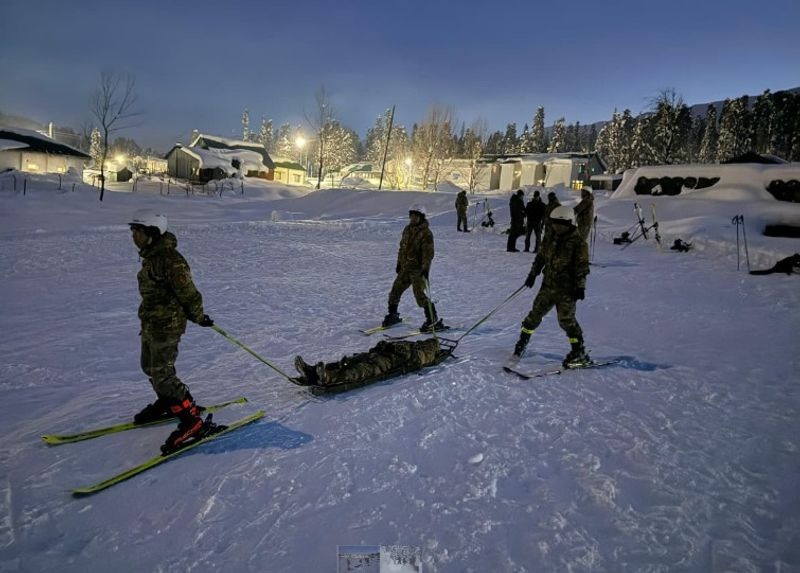
The training curriculum focused on military skiing, casualty evacuation, avalanche rescue and recovery drills and the management of high-altitude sickness
Vijay Mohan
The Indian Army’s High Altitude Warfare School (HAWS) in Gulmarg conducted an intensive two-week training course in extreme high altitude terrain and harsh weather conditions that was tailor-made for members of the Kyrgyzstan Armed Forces. Photo: ADGPI
The Indian Army’s High Altitude Warfare School (HAWS) in Gulmarg conducted an intensive two-week training course in extreme high altitude terrain and harsh weather conditions that was tailor-made for members of the Kyrgyzstan Armed Forces.
The training curriculum focused on military skiing, casualty evacuation, avalanche rescue and recovery drills and the management of high-altitude sickness, according to information shared by the Indian Army.
“The course also enabled a vibrant exchange of best practices between both nations in high-altitude medicine, casualty evacuation and military skiing techniques, further strengthening mutual understanding and reinforcing the spirit of ‘Friends for Life’,” the Army said.
Established in 1948, HAWS specialises in snow-craft and winter warfare. Two major programmes run by the school are Mountain Warfare Course and Winter Warfare Course, which train soldiers in high altitude warfare, counter intelligence and survival skills. Army personnel deployed to Siachen Glacier and to other high altitude forward posts in the Himalayas go through the courses. Soldiers from several friendly foreign countries, including the US, UK and Germany attend these courses.
India and Kazakhstan relations date back to 1992 in the aftermath of the collapse of the Soviet Union and have been elevated to the strategic level based on robust economic ties, mutual trust, energy cooperation and shared security interests. In August 2025, India and Kazakhstan held discussions in New Delhi to enhance their defence cooperation.
Besides cooperation in the field of counter terrorism and cyber security, both countries have also undertaken joint military exercises that was initially named Prabal Dostyk and later rechristened Exercise KAZIND. It focuses on counter-terrorism operations, joint planning, joint tactical drills, specialised weapons training, and more recently an aerial component involving helicopter-borne operations.
Training of military personnel at HAWS assumes significance for Kazakhstan because of its climate and geography. Temperatures in that country can dip to minus 20 degrees Celsius, while mountain peaks located in some parts of the country touch 23,000 ft.