
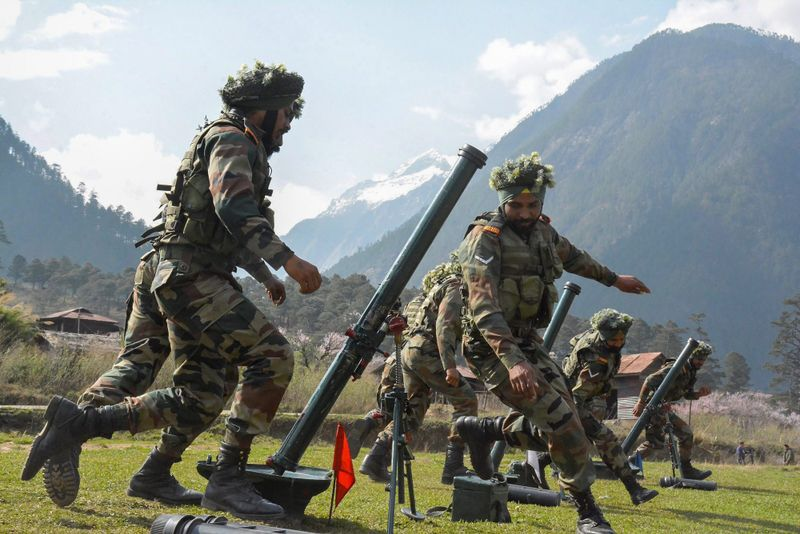
The Army has reduced its reliance on imported ammunition and now secured indigenous sourcing for 90 per cent of its needs. The push for indigenisation is reshaping ammunition preparedness and long-term war-fighting capability.
Almost 200 variants of ammunition and precision ammunition is used by the Army across its weapon systems – which range from a pistol at the lowest-end and Brahmos missile at the highest. This array of weapons includes, rifles, automatic machine guns, anti-tank missiles, artillery guns, rockets like Pinaka and ammunition used by the Army aviation.
Multi-crore orders
As off today, there is an order of around Rs 16,000 crore worth of ammunition on the domestic industry
In past three years, ammunition supply orders worth Rs 26,000 crore placed on indigenous manufacturers
A policy reform and industry engagement with the private sector has resulted in more than 90 per cent of the ammunition being indigenised and is now sourced through domestic manufacturers.
To have a make-in-India option for the remaining imported ammunition, the Army is also working with research agencies, public sector manufacturers and other private players. To give an example, sources said the precision-guided artillery ammunition, the Excalibur, used effectively in Operation Sindoor, is imported from the US. Efforts are on to make a precision ammunition.
Over the last four to five years, procurement processes have been restructured to promote competition and multiple sourcing options. As off today, there is an order of around Rs 16,000 crore worth of ammunition on the domestic industry. In the past three years, ammunition supply orders worth nearly Rs 26,000 crore have been placed on indigenous manufacturers.
Vendor diversification has improved supply resilience, with many ammunition variants now supplied by multiple domestic sources.
India’s security environment is increasingly shaped by uncertainty, rapid technological change and prolonged crises. In this backdrop, military readiness depends not only on advanced weapons but also on the ability to sustain operations over time. For this, the supply chain needs to be localised, sources said.
Ammunition, spares and logistics form the backbone of combat endurance. Recognising this, the Army has placed self-reliance in ammunition production at the core of its preparedness strategy. This was kicked off in the past five years or so and has picked up speed after Operation Sindoor.
For years, ammunition supply relied heavily on legacy production systems in the public sector and overseas sourcing, leaving it vulnerable during global disruptions. Recent conflicts like the longdrawn Russia-Ukraine conflict highlighted a reality — nations that can sustain ammunition supplies domestically are better positioned to maintain operational momentum.
Reacting to the changed global scenario, the Army accelerated indigenisation in line with the national vision of Make in India. The next phase focuses on consolidating gains. Priority areas include strengthening domestic raw-material supply chains for propellants and fuzes, modernising manufacturing infrastructure, accelerating technology transfers and ensuring rigorous quality standards. Together, these measures aim to build a robust and self-sustaining ammunition ecosystem.