
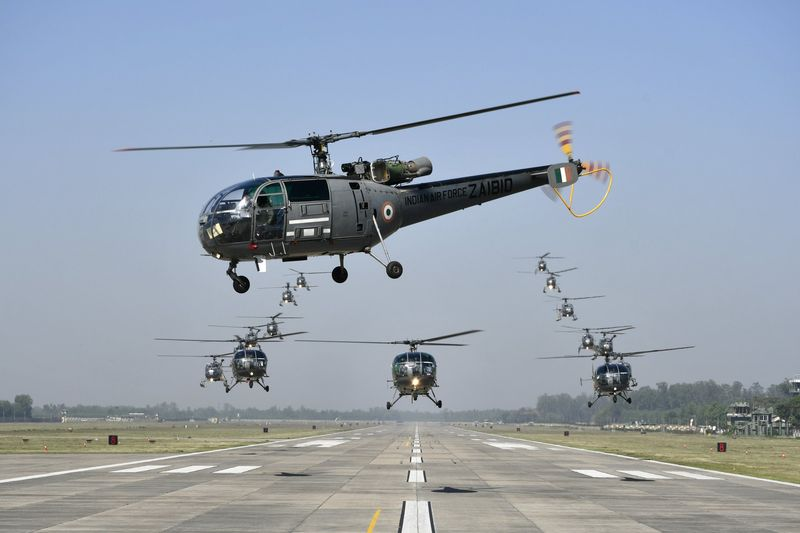
The IAF’s No. 132 Helicopter Unit is among the last few remaining units to operate the vintage Chetak and Cheetah light helicopters
The Indian Air Force’s (IAF) No. 132 Helicopter Unit, among the last few remaining units to operate the vintage Chetak and Cheetah light helicopters, is marking 40 years of its raising in the Western Command.
Also known as the Hovering Hawks, the unit has achieved 100 per cent serviceability for all 16 aircraft in its fleet, which the IAF has termed as an outstanding feat reflecting unwavering professionalism, technical precision and commitment to operational readiness.
“Despite operating a legacy fleet in harsh environment, the unit’s air warriors ensure consistent, high-level mission readiness, overcoming challenges posed by aging aircraft and demanding operational requirements,” the Western Air Command said.
The unit was raised at Udhampur in 1986 as No. 132 Forward Area Control Flight (FACF) to provide airborne forward air control (FAC) support to fighter aircraft as well as undertake liaison roles and search and rescue missions. In October 1997, No. 135 FAC Flight was merged with it.
The unit has played critical roles in major operations, including Operation Safed Sagar in the 1999 Kargil conflict, where it undertook numerous FAC missions over Dras, Batalik and Mashkoh to guide air strikes on enemy positions.
The unit has been operating the Chetak and Cheetah helicopters that are based on the French Alouette SA-316B and SA-315B, respectively, the origins of which date back to the 1960s.
Other squadrons including No. 114 Helicopter Unit called the Siachen Pioneers and No. 131 Helicopter Unit, called Eagle Eyes, still operate these helicopters for extreme high altitude logistics, search and rescue and casualty evacuation. Many Army posts in the Siachen Glacier are dependent on Cheetahs for supplies and troop rotation.
The Army Aviation Corps, Indian Navy and Indian Coast Guard also operate these machines and in some sectors like Ladakh, these are often pushed to the limits of their flight envelope.
The Chetak, which was inducted in 1965, can carry around seven persons and 2500 kgs cargo, while the Cheetah’s capacity is three passengers and 1200 kgs cargo. Also license-manufactured in India by state-owned Hindustan Aeronautics Limited, their combined fleet across all services numbered around 400 aircraft.
Some of these aircraft were also modified and retrofitted with anti-tank missiles and rockets to undertake close air support missions to assist ground troops. These are in the process of being replaced with new light utility helicopters, the acquisition of which has been hanging fire for many years.