
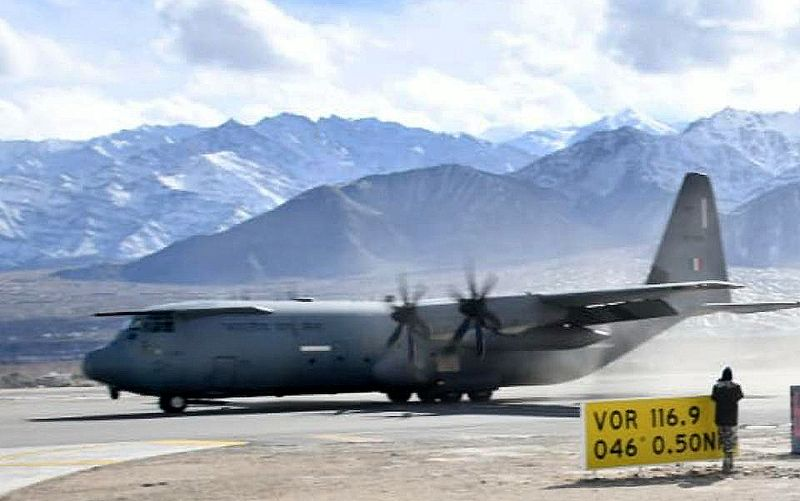
Boosting operational capability in the northern sector, the Indian Air Force (IAF) has constructed a second runway at the strategic Leh airbase in Ladakh to cater to increasing military and civilian air traffic and ensure continuity of operations in case of hostilities along the border.
“From a dusty airstrip in the 1960s to a world-class airfield today, Military Engineering Service (MES) engineers have delivered excellence at Leh Air Force Station, constructing a runway in a record 21 months under extreme cold conditions in rugged high altitude,” the Indian Army has posted on X.
“This remarkable achievement enhances strategic readiness, supports regional development and exemplifies exceptional synergy between the MES, the Indian Air Force and the Union Territory of Ladakh,” the post added.
According to the Western Air Command, the upgraded facilities will enhance regional air connectivity, support tourism growth, and improve accessibility for local communities.
“Executed in coordination with multiple civil agencies, the development enables smoother aircraft ground movement, faster civil departures, and improved overall airfield efficiency,” the IAF said.
The new infrastructure will also facilitate timely Humanitarian Assistance and Disaster Relief (HADR) operations during emergencies and is expected to contribute to Ladakh’s socio-economic development by ensuring reliable, resilient air services in a geographically-demanding region, the IAF added.
Work on the new runway, also being termed as a parallel taxi track project, was approved in 2023 and completed at a cost of around Rs 452 crore. Many IAF bases have a parallel taxi track, a narrower strip that runs along the main runway to facilitate aircraft movement. These can also serve as an additional runway in times of need for IAF aircraft, though operations by civilian aircraft are not permitted.
The need for additional facilities
Military as well as civilian flights at Leh have increased significantly in recent years, but operations remain limited to morning hours due to rarefied air and climatic conditions, IAF officers said.
Earlier, civilian flights to Leh were few and military operations largely restricted to transport aircraft and helicopters. Now, with the prevailing situation along the Line of Actual Control (LAC), operations by fighter aircraft and attack helicopters have increased manifold. Different fighter aircraft, including the Rafale, MiG-29, Su-30 and Apache, from other bases regularly operate from Leh on a rotational basis.
With growing tourism and enhanced military posture, air traffic in and out of Leh is expected to increase further and the need for an additional runway was being felt for some time to ensure uninterrupted operations. From just one civilian flight to Leh in the 1980s, there are now up to 25 flights daily today.
In 2023, a stranded IAF C-17 blocked the runway for two days, suspending operations by fixed-wing aircraft. Such a situation could be disastrous during any volatile situation along the LAC with China as it would hold up combat as well as logistical missions.
The genesis of Leh airfield
Located at an altitude of 10,682 feet close to the Indus river, Leh airbase is strategically crucial for military operations, handling transport aircraft, helicopters and fighter jets.
The first aircraft landing in Leh occurred in May 1948, when Air Commodore Mehar Singh piloted a DC-3 Dakota aircraft onto what was then the world’s highest airstrip. Then serving with No. 12 Squadron, he flew over the the Zoji La and Fotu La passes without navigational aids, de-icing equipment, or cabin pressurisation, touching down successfully on a sandy strip.
Since then, the airfield has expanded and handles all types of IAF transport aircraft, including C-17 and IL-76 heavy-lift freighters. Many fighter squadrons and attack helicopter units regularly position detachments of combat aircraft at Leh for operational reasons.
Special heated hangars have also come to enable helicopter operations in extreme cold weather and hardened shelters, called blast pens, for housing fighter aircraft have been constructed.
Leh is among the four airfields in Ladakh that have paved runways, the other being Thoise, Kargil, and the recently constructed one at Nyoma. Advanced Landing Grounds (ALGs) at Fukche and Daulat Beg Oldie provide logistic support near the NAC. Nyoma, located about 40 km from the LAC at 13,700 feet, has been upgraded from an ALG to a full-fledged airbase, allowing greater operational flexibility.
The Leh airbase, primarily a military establishment owned and operated by the IAF, also has a civilian enclave attached to it. Known as the Kushok Bakula Rimpochee Airport, named after the 19th Kushok Bakula Rinpoche, a Buddhist monk, it handles civilian passengers and commercial flights.