

TWO developments of February 4-5 significantly altered the course of the India-facilitated Mauritius-UK agreement of May 2025 on sovereignty over the Chagos Archipelago.
First, while the US had earlier termed the pact as an ‘act of great stupidity’, its mercurial President Trump has since softened his criticism, saying it was the best deal British Prime Minister Keir Starmer could obtain. He added that the US would militarily thwart any threat to the joint US-UK military base of Diego Garcia in the Chagos Archipelago, whose sovereignty the UK has relinquished for reasons of decolonisation and self-determination.
Second, Maldives President Mohamed Muizzu has disowned his predecessor Solih’s endorsement of the agreement, which forfeited claims to the Special Economic Zone around Mauritius. Earlier, the House of Lords failed to ratify the agreement, which has faced the Opposition’s strategic ire. It reflects that long-term agreements are subject to alteration by regime change and a U-turn in the case of the US.
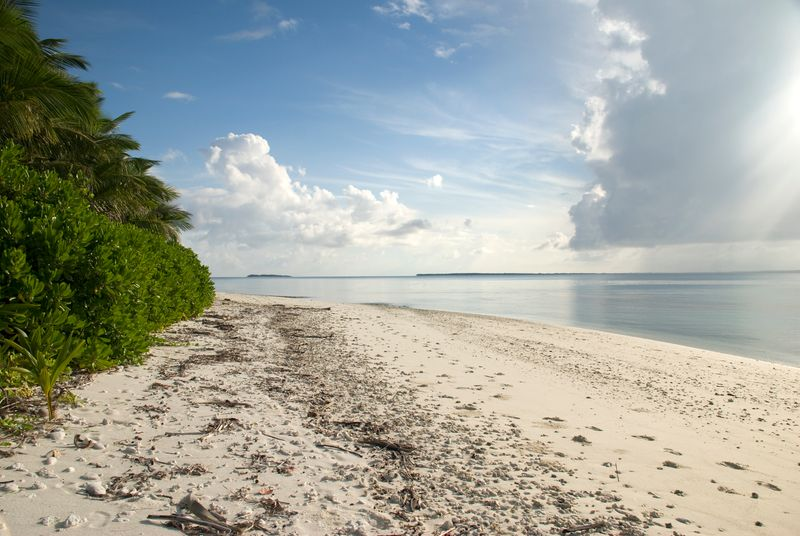
Of the Chagos Archipelago’s islands, Diego Garcia is the crown jewel. It was detached from Mauritius in 1965 prior to the grant of independence and established as a joint UK-US military base. The UK will pay Mauritius 3.4 billion pounds for 99 years, with a provision to extend the lease by another 44 years.
The agreement not being ratified will hurt India’s interests in the Indian Ocean Region as Mauritius had an in-principle agreement with India for the development and surveillance of the Chagos Marine Protected Area as it is ecologically sensitive. India’s relations with Mauritius were reflected when PM Modi called the Chagos agreement as a milestone for its sovereignty. An Indian national has been the NSA in Mauritius since 1984. India has helped Mauritius develop the Agalega Island, a dual-use strategic infrastructure with a 3,000-m runway, deep water jetty, surveillance and monitoring station. It is linked to its Indian Ocean Region Surveillance Network in Madagascar, the Seychelles and Sri Lanka. Access to Agalega is strictly by invitation.
Diego Garcia is the most coveted real estate in the IOR, which the UK has used profitably since the 18th century and the US militarily for the last half a century for operations in West Asia and East Africa. The US has deployed 2,500 military personnel and the UK 100 Marines. It is administered by a diplomat- commissioner based in London. Last November, nuclear-capable B2 bombers struck Houthi targets in Yemen from Diego Garcia, which the US calls ‘indispensable to security.’
France is the other country to have sovereign island territories, like Reunion in the IOR. China has constructed military facilities at Djibouti and is jockeying for dual-use space in Gwadar, Hambantota, Coco Islands and Madagascar.
India has invested heavily in Mauritius, the latest being the 2025 tranche of $680 million for Maritime and Defence Cooperation Agreement. India is building a metro system and a supreme court building and assisting in the revamp of Air Mauritius. Prime Minister Navin Ramgoolam who replaced Pravind Jugnauth has hailed Port Louis ties with Delhi as ‘perpetually beneficial.’
When Mauritius regained its sovereignty last year over Chagos, both India and the UK offered to provide ships to access Diego Garcia to plant the Mauritian flag. Eventually, three flags will fly on the military base. For India, the 2015 Agalega Agreement and last year’s Maritime and Defence Cooperation Partnership are strategic. China has an active Belt and Road Initiative (BRI) and FTA and is modernising Port Louis. South Africa has been an old partner in trade, economics and tourism.
Russia is conspicuously absent from the IOR. One of the reasons the US and the West laughed away Sri Lanka and India’s calls for making the IOR a zone of peace and neutral, nuclear-free region because they said the USSR was in occupation of Afghanistan for a decade overlooking the IOR.
The official renewal of the lease and grant of sovereignty over Chagos will face hurdles. In the May 22, 2025 agreement, the UK formally agreed to cede sovereignty of the Chagos Archipelago and Diego Garcia. Both countries require parliamentary approval and the Peers want to make amendments: referendum by Chagosians on the deal, including on the right to self-determination, human rights and decolonisation. The dispute over the ChagosIislands is rooted in international law as the International Court of Justice in 2019 said that the UK’s separation of the Chagos Archipelago from Mauritius was unlawful and it must end its administration of territory ‘as rapidly as possible.’
A future Mauritian government could lease any of the Chagos Islands to China and Russia. Security safeguards and the sovereignty issue are embedded in the 2025 agreement. The existing marine-protected area is well patrolled by the British Navy; last year, 32 Indian fishermen from Kerala and Kanyakumari were detained and charged with sailing towards Diego Garcia. If the 2025 agreement comes into force, according to Human Rights Watch, some of the 10,000 displaced Chagosians may return to other islands, but Diego Garcia will remain off limits.
The East-of-Suez vacuum of the 1960s caused by British withdrawal has now crowded the IOR, with contestants seeking their share of control in the region. The UK took charge of Chagos in 1965 on the pretext of establishing a communications base in Diego Garcia despite a UNGA Resolution not to dismember Mauritius. Even without Diego Garcia, Mauritius is strategic geography. The recovery of sovereignty over Diego Garcia, when it happens, will make no difference to the UK-US joint military base and for Washington’s long-strike arm.