
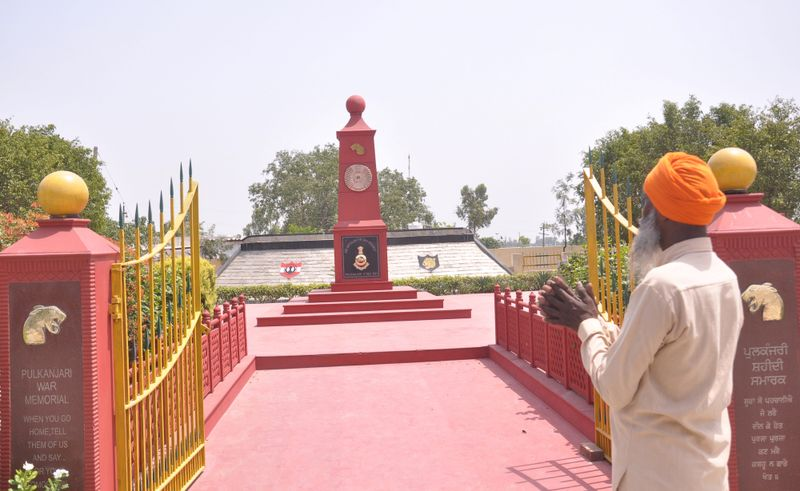
The border village of Pul Moran, popularly known as Pul Kanjri, is not only associated with its rich historical past, but also carries an important chapter from the 1971 Indo-Pak war. Just days after the village was occupied by the Pakistan army during the conflict, the Indian Army’s 2 Sikh Regiment carried out a courageous counter-offensive to recapture the village, a battle that has since become an enduring tale of bravery in the region.
In memory of the soldiers who laid down their lives during this operation, the Army constructed a memorial which continues to inspire future generations. Known as the Pul Kanjri War Memorial, the site honours the sacrifice of 10 soldiers of the 2 Sikh Regiment. Among them, one soldier was posthumously awarded the Maha Vir Chakra and another the Vir Chakra for exceptional gallantry.
Following the withdrawal of the Indian forces from the border post on December 4, 1971, the Pakistan Army took control of Pul Moran village. A few days later, Lt-Col SC Puri took the strategic decision to recapture the Pul Moran border outpost (BOP), which falls under the jurisdiction of Pucca Dhanoan. Under the leadership of Major NS Koak, a contingent of 40 soldiers from the 2 Sikh Regiment launched a fierce and determined assault. On December 17, the troops successfully regained control of the BOP after intense fighting.
According to the inscription on the memorial plaque, the engagement, recorded in military history as the ‘Battle of Pul Kanjri’, resulted in the martyrdom of one Junior Commissioned Officer and nine other ranks. The enemy launched a four-pronged attack, which was effectively repulsed by the Indian troops. The Pakistan army suffered heavy casualties, with one officer and 10 soldiers taken as prisoners of war. A large cache of arms and ammunition was also seized during the operation.
The martyrs honoured at the memorial include Lance Naik Shangara Singh of Chola Sahib village in Tarn Taran district, who was born on January 14, 1945, and was posthumously awarded the Maha Vir Chakra, and Naib Subedar Gian Singh of Punia village in Nawanshahr district, born on August 6, 1937, who got the Vir Chakra posthumously. Other martyrs include sepoy Gurcharan Singh of Siar village in Ludhiana (born December 16, 1952), Tarlok Singh of Bandala village in Amritsar (born November 11, 1951), Surjit Singh of Jhanda Lubana village in Gurdaspur (born November 17, 1950), Didar Singh of Sansowal Kalan village in Ludhiana (born November 30, 1940), and Lance Naik Gurdial Singh of Harchanpura village in Sangrur (born November 30, 1943). Two martyrs hailed from Ruriwala Sarhali village in Amritsa r— sepoy Jagtar Singh (born June 17, 1953) and Naik Sawaran Singh (born May 18, 1942).
Elderly residents of Pul Moran still recall the traumatic days of the war and the bravery of the soldiers who reclaimed the village from enemy control. Villagers recount that when the Pakistan army occupied the area, residents were forced to flee their homes to save their lives.
Lance Naik Shangara Singh remains a revered figure, particularly among the youth of his native village, for his extraordinary act of courage. He reportedly snatched a machine gun from a Pakistani gunner and used it against the enemy before being killed in retaliatory fire. His sacrifice earned him the nation’s second-highest gallantry award. Naib Subedar Gian Singh was also honoured posthumously with the Vir Chakra for his exceptional bravery.