

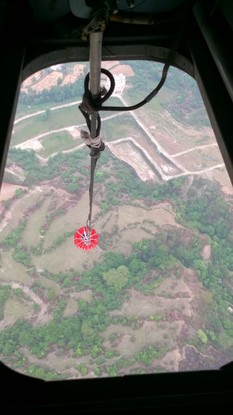
AF’s Mi-17 lifts water from Bhimtal lake in Nainital to spray it over areas affected by the forest fire in Uttarakhand on Sunday. ANI photo


Tribune News Service
Dehradun/New Delhi, May 1
As the raging forest fires continue to engulf vast swathes of land across Uttarakhand, the Indian Air Force today began operations to control the situation even as the Centre said it was taking the incident “very seriously” with all possible firefighting measures.
An Mi-17 chopper made several sorties in Nainital district sprinkling water lifted from a lake to douse the raging forest fires in Almakhan, Kilbari and Nalena areas. Low visibility, however, prevented a second chopper from being deployed in Pauri district for the operations in the hill state. The forest fires have so far killed seven persons, destroyed 2,269 hectares of forested land and spread to sparsely populated remote hill areas.
Teams of the specialised National Disaster Response Force (NDRF), meanwhile, have fanned out in 13 affected areas of three districts of Pauri Garhwal, Almora and Chamoli to tackle the massive blaze.
Home Minister Rajnath Singh reviewed the situation and held discussions with the Uttarakhand Government officials. He also offered all assistance from the Centre.
“With choppers pressed into service and all security agencies, besides locals, involved in firefighting operations, the situation is likely to be brought under control in a couple of days, Principal Conservator of Forest (PCF) BP Gupta said.
With the MeT Department predicting a significant fall in day temperatures after May 2, forest fires may come under control after a couple of days, he said, but added that the administration will have to remain alert for the next 35 days to prevent fresh forest fire incidents. Since the beginning of the forest fire season in the state in February, 922 incidents have occurred so far.
Forest fires are natural during summer but this time they have occurred on a bigger scale as the fire season, which normally begins by February 15 and ends by June 15, started early on February 2. (with PTI inputs)
In Rajasthan, the highest temperature of 46.5°C was recorded at Phalodi town in Jodhpur district, followed by Sri Ganganagar (46.3), Churu (46), Bikaner (45.8), Barmer (45.2) andJaipur (43.3).
IAF joins Uttarakhand fight, number of forest blazes falls
EHRADUN: The air force flew three helicopters on Sunday to contain raging forest fires in Uttarakhand, which have gutted more than 2,300 hectares of lush Himalayan forestland over the past fortnight and claimed at least seven lives.
ARVIND MOUDGIL / HTFire rages close to a residential area in a village in Pauri district on Saturday night.
But one of the Mi-17 helicopters could not take off till afternoon because of a thick smoke over the Garhwal region. It managed seven sorties after 4pm.
The choppers for the Kumaon division were in action since 7am, collecting water from the Bhimtal lake and emptying the load over wildfires in Nainital and Almora districts.
The air support helped the field teams of firefighters from the state forest and fire departments, army, National Disaster Response Force (NDRF), and village volunteers.
“The forest department hopes the fire will be brought under control in the next 2-3 days as the meteorological office has predicted rain,” additional chief secretary S Ramaswami said.
The joint effort has paid off, bringing down the number of blazes from 160 on Saturday to 112 on Sunday.
The state reported 1,082 forest fires in the past two-and-a-half months.
But about 35 major fires in the popular tourist and pilgrim destinations of Rudraprayag, Pauri Garhwal, Chamoli, Almora, Nainital, and Dehradun hills remained a worry.
Piyoosh Rautela, the executive director with the state’s Disaster Mitigation and Management Centre, said as many as 135 NDRF personnel were working in 139 locations.
Strong winds, a prolonged dry spell, hazy conditions, and treacherous mountain slopes posed a serious challenge to the firefighters trying to stop the fires from spreading. Reports said the wildfire has already spread to neighbouring Himachal Pradesh.
The haze has brought down visibility and making breathing difficult. “The thick smoke is posing problems in the operation,” Garhwal division divisional forest officer Ramesh Chandra said.
People from villages within a licking distance of flames have been evacuated. But the worst sufferers are animals and nesting birds in Corbett tiger reserve, Rajaji tiger reserve and Kedarnath wildlife sanctuary, where about 550 hectares were reduced to ashes in this season’s forest fires. In New Delhi, home minister Rajnath Singh reviewed the situation in Uttarakhand, which is under central rule since March 27.Union environment minister Prakash Javadekar said the Centre was making all efforts to control the forest fires. “The government will study the reasons and prepare an action plan accordingly.” Local environmentalist Vijay Jardhari of Tehri probably knows the reason. He said wildfires have become common because villagers and forest officials have discarded traditional preventive measures.
“There was a trend to make fire lines outside forests since the British-era. This is not done religiously now … which is why uncontrolled fire is becoming commonplace,” he explained.
A fire line is made by clearing waste such as tree leaves and other biological inflammable material from within a forest and its edge. The fires generated political heat too as the Congress, which was ousted from power in the state, accused the BJP-led NDA government of doing little to check the crisis.
Cong ress spokesperson Randeep Singh Surjewala said the fire situation spiraled out of control because there is no state government to tackle it. He taunted environment minister Javadekar for conducting a “press conference in air-conditioned rooms in Delhi to douse fires in Uttarakhand”.

