
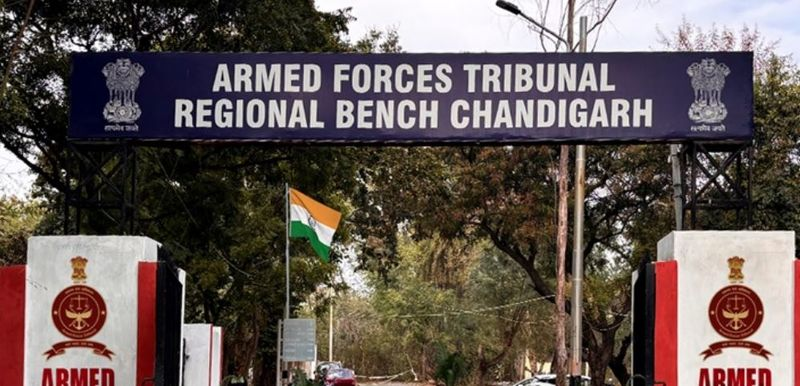
Terming desertion to be a serious offence in the defence services, the tribunal has held that such acts need to dealt with firmly and swiftly to ensure discipline in the rank and file
Terming desertion to be a serious offence in the defence services, the Armed Forces Tribunal (AFT) has held that such acts need to dealt with firmly and swiftly to ensure discipline in the rank and file.
Observing that a soldier deserted from his unit to avoid serving in counter insurgency operations in Jammu and Kashmir, the tribunal’s Chandigarh bench has upheld his dismissal from service by a summary court martial conducted in 2015.
“Such indiscipline deserves to be punished immediately to convey the correct message to the environment. Other soldiers of the battalion had to be conveyed that indiscipline of the nature of desertion for avoidance of operational duty would be promptly punished,” the tribunal’s bench comprising Justice Sudhir Mittal and Lt Gen (Dr) Ranbir Singh, said in their order of January 15.
The soldier was serving in 152 Infantry Battalion (Territorial Army), the main body of which was located in Srinagar. Being in low medical category, he was left in the rear at Ludhiana. In July 2014, he had sought leave to get his mother treated, which was refused and instead he was directed to proceed to the location of the main body.
Instead of moving to Srinagar, the soldier went home. After a lapse of a period of 30 days, a Court of Inquiry was conducted and he was declared a deserter. Accordingly, an apprehension roll was issued.
He was apprehended by the civil police from Hisar in January.2015, and handed over to a local Army unit from where he was collected by an escort party from his unit that took him to the battalion headquarters, which had by then moved to Sonamarg.
The bench observed that the soldier had claimed that he sought leave because his mother was unwell. The leave application was dated July 4, whereas the certificate relied upon by him shows that she was admitted to a local civil hospital on July 7, which showed that leave was sought on a false basis as he could not have had a premonition three days earlier that his mother was going to be unwell.
The bench also did not accept the soldier’s contention that he had no intention to desert and had voluntarily surrendered before the police. The bench rejected a certificate purportedly signed by the officer-in-charge of the police station concerned saying that he had surrendered, on the grounds that it did not bear any date and was partially filled. The signature of the officer-in-charge had been forged as was evident by comparing the same with the signature on certificate stating that he had been apprehended.