
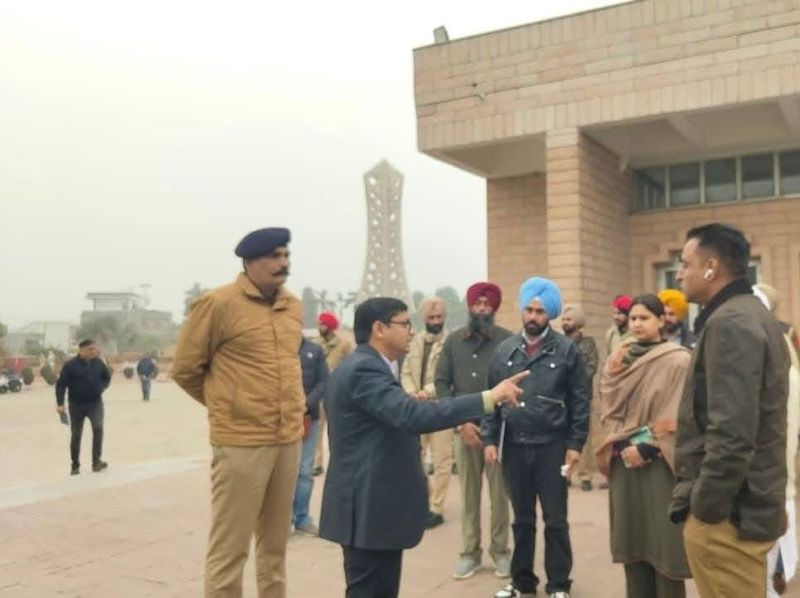
Namdhari Kuka Smarak, constructed in about seven acres of former defence land along the Jarag road to Khanna, lies in memory of the supreme sacrifice of 66 Sikhs executed by the British in 1872.
The memorial features a 66-feet- tall Khanda with 66 holes, each representing a martyr. The youngest among the group was Bishan Singh, just 12 at the time. A large dome-shaped meditation hall, a museum-cum-library and a prayer hall have also been constructed at the venue, now considered to be of profound historical significance. It attracts visitors wanting to pay homage to martyrs on January 17 every year. A state-level function is held at the memorial annually as a tribute to the martyrs.
The Sikhs were executed via cannon on January 17 and 18, 1872, under orders of British Empire representative, Deputy Commissioner John Lambert Cowan. The execution came over an attack on a fort at Malaudh in Ludhiana district and another in the erstwhile state of Malerkotla. A total of 49 Sikhs were executed on the first day, and the remaining on the second.
The execution continued despite orders that read: Avoid any hasty action. The orders were received mid-action.Cowan had also misguided his superiors in British Government, labelling the Kuka Sikh’s resentment as a “revolt” that could disturb the tranquility.
Though Cowan was dismissed for violating orders to keep the detainees in custody, he tried to justify his actions saying “I acted from no vain motive or from cruelty or a desire to display authority. The punishment was imperatively necessary to prevent the spread of an insurrection.”
Satguru Ram Singh founded the Kuka sect on April 12, 1857, at Bhaini Sahib in Ludhiana district. He roped in and encouraged the people for the freedom of the country. Singh was a pioneer among those who used non-cooperation as a weapon to free India from the British rule. His movement included boycott of government services, foreign goods, educational institutes and courts of law. A “Kuka Platoon” was created in Kashmir during the late sixties. Earlier, three Namdhari Sikhs were hanged on August 5, 1871, and two in Ludhiana on November 26, 1871. This came after attacks on slaughterhouses in Amritsar and Raikot.
On January 15, 1872, a group of 200 Kuka Sikhs, led by Hira Singh and Lehna Singh, attacked Malerkotla. They surrendered following loss of lives on both sides.
Ignoring orders from his seniors to detain them pending trials, Cowan ordered to blow them in groups of seven. They were tied to cannons and blown.
Given a chance to save his life by denouncing the sect, 12-year-old Bishan Singh chose otherwise. Enraged, he even pounced on Cowan. His hands were chopped by Cowan’s soldiers before he was killed.
Waryam Singh, who was asked to return as he was too short to reach the cannon, brought stones and sand from nearby fields to prepare a platform to stand on.
Satguru Ram Singh and prominent chiefs, known as subas, were arrested and exiled as the Malerkotla attack had given the British Government a reason to snub their movement.
Followers’ repeated requests to include the function in the calendar of national functions have fallen on deaf ears of successive governments.
The administration, led by Deputy Commissioner Viraj S Tidke and Senior Superintendent of Police (SSP) Gagan Ajit Singh, is busy making arrangements for comfort and safety of visitors to the function scheduled for the next weekend.