
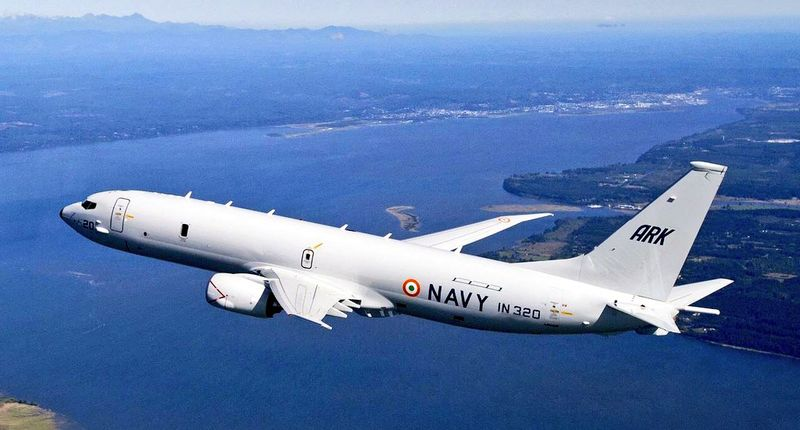
The Indian Navy today marks the Golden Jubilee of its long-range surveillance over the sea, known in military parlance as long-range maritime reconnaissance (LRMR) operations.
The milestone coincides with the 50th anniversary of the commissioning of Indian Naval Air Squadron (INAS) 312, the ‘Albatross’, and commemorates five decades of airborne vigil in support of India’s maritime security.
Over the past five decades, the Navy’s LRMR aircraft have supported Operation Cactus, launched to prevent a coup in the Maldives; Operation Vijay during the Kargil conflict in 1999; Operation Parakram, launched in December 2001 following the attack on Parliament; and Operation Sindoor in May last year.
The aircraft also aid anti-piracy patrols and search-and-rescue missions. The economic stakes are high, too. Around 85-90 per cent of India’s crude oil and about 50 per cent of its natural gas arrive by sea. Security is especially important with sea routes at the Strait of Hormuz and the Bab-el-Mandeb under stress.
Over these 50 years, the reconnaissance capabilities of the aircraft have been augmented with long-range drones and dedicated satellites. Together, all three provide a composite picture to naval commanders.
The Navy’s need for long-range maritime operations was an outcome of the 1971 war against Pakistan. The requirement for shore-based maritime patrol aircraft capable of working alongside ships and helicopters led the Navy to assume responsibility for long-range maritime reconnaissance.
On November 18, 1976, INAS 312 was commissioned at INS Hansa, Goa, with five Super Constellation aircraft made by Lockheed Martin. These aircraft were part of the Indian Air Force fleet and were transferred to the Navy.
The induction of the Soviet-origin Ilyushin Il-38 in 1977 strengthened the Navy’s maritime reconnaissance and anti-submarine warfare capabilities. The Tupolev Tu-142M, inducted into INAS 312 in 1988, extended the Navy’s patrol reach across the Indian Ocean Region.
The induction of the Boeing P-8I at INS Rajali, Arakkonam, in 2013 marked a further advance, bringing enhanced capabilities in wide-area intelligence, surveillance and reconnaissance, anti-submarine warfare and maritime strike.
Today, P-8I aircraft of INAS 312 at INS Rajali, Arakkonam, and INAS 316 at INS Hansa, Goa, continue to maintain vigil over the Indian Ocean and beyond, safeguarding India’s maritime interests.
The Navy said, “The Golden Jubilee honours generations of naval aviators, mission crews, maintainers and support personnel whose dedication and professionalism have built and sustained this capability over five decades”.
Last month, Defence Minister Rajnath Singh, while addressing the Navy Commanders’ Conference 2026, asked the Navy to elevate its monitoring and response mechanisms to a new level.
He called for a significant upgrade of India’s maritime surveillance architecture. “The growing volume and complexity of maritime traffic requires enhanced analytical capabilities,” the minister had said.
He cited congestion at sea, deception and grey-zone activities as issues that have made the maritime domain more complex than ever.