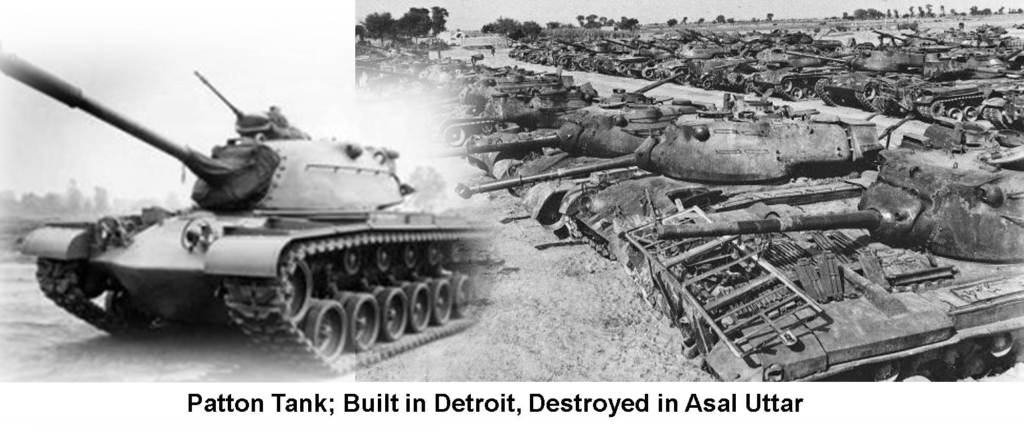
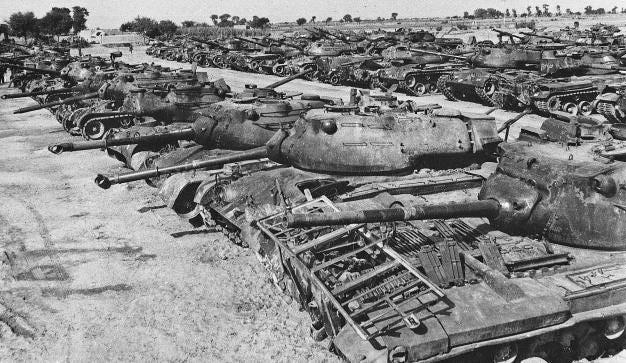
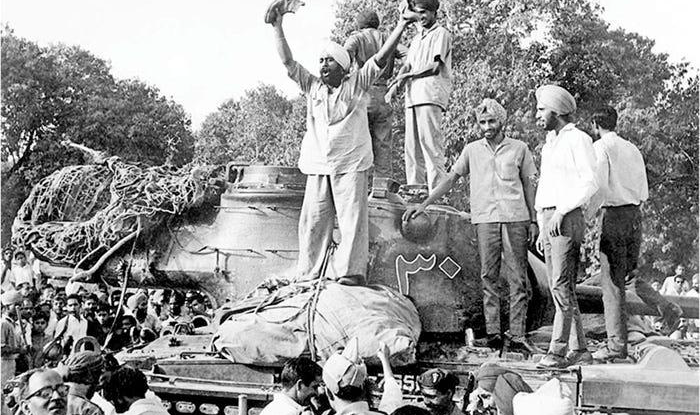
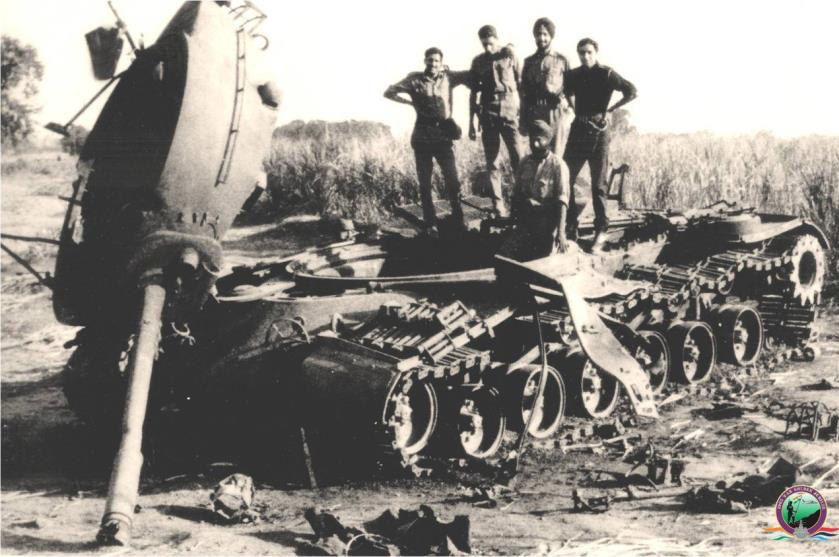
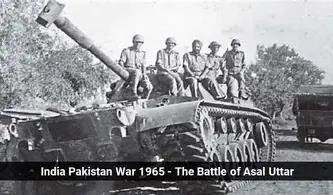
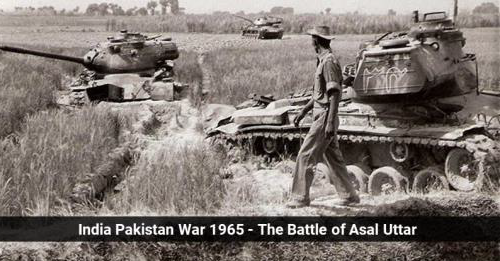
In the battle lasting 8 to 10 Sep, the pride of Pakistan’s army, their Armoured Division was humbled by the Indian Army. Pakistan lost 97 tanks including 72 Pattons. Indian losses were comparatively negligible.
On 6 Sep, Indian 4 Mountain Division comprising 7 & 62 Mountain Brigades and 9 (DECCAN) Horse – was tasked to capture Kasur. Contesting 4 Mountain Division was Pakistan’s 11 Infantry Division with three Infantry Brigades. After initial gains, 4 Division was forced to withdraw and take defences at Asal Uttar on 7 Sep. Pak 1 Armoured Division launched a counter offensive on 8 Sep. Pak Attack Plan: Two Infantry Brigades of 11 Infantry Division with 5 Armoured Brigade to establish a bridgehead in area Mastgarh-Bhura Kohna, advance on Khem Karan-Bhikhiwind axis to protect the flank and also isolate 7 Infantry Division located at Firozpur. 1 Armoured Division to break out with:
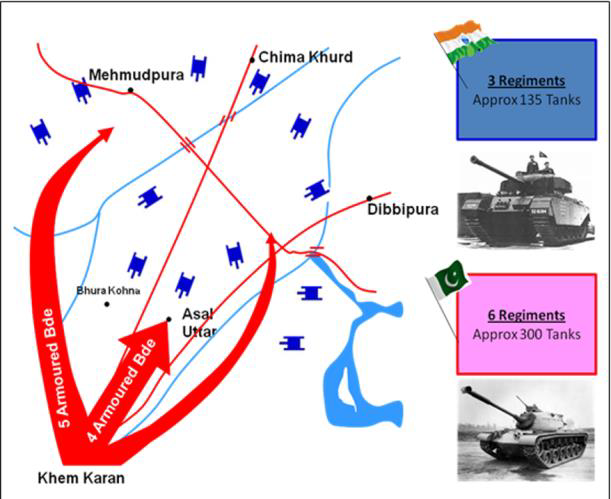
3 Armoured Brigade – two Armoured Regiments and a Mechanised Infantry Battalion in APCs head Northeast and capture Jandiala Guru, cutting off Amritsar. • 4 Armoured Brigade – two Armoured Regiments and a Mechanised Battalion to advance along Kasur-Khem Karan – Valtoha – Nabipur axis – secure Harike bridge over the Beas and advance towards the GT Road to capture the Beas Bridges (Both Rail and Road) astride the GT road thereby cutting off the Indian 11 Corps from rest of India. Pak 1st Armoured Division was equipped with modern American M 47 & M 48 Patton tanks and M113 Armoured Personal Carriers (APCs). Pakistan had Six Tank Regiments with approx 300 Tanks. India had Three Regiments with approx 135 Tanks. Patton Tank had a 90 MM Main Gun implying heavier rounds and longer range than Indian Tanks with smaller gun of 75 MM. The Patton Tanks had a thicker armour plate and superior fire control systems. 4 Mountain Division was supported by 2 Independent Armoured Brigade. General Gurbaksh Singh General Officer Commanding 4 Mountain Division directed his Artillery to unleash heavy fire on the enemy, slowing them down. Pak 1 Armoured Division was unable to breach the Indian defences despite its overwhelming superiority.
4 Mountain Division was supported by 2 Independent Armoured Brigade. General Gurbaksh Singh General Officer Commanding 4 Mountain Division directed his Artillery to unleash heavy fire on the enemy, slowing them down. Pak 1 Armoured Division was unable to breach the Indian defences despite its overwhelming superiority. Terrain as a Force Multiplier – flat agricultural fields, primarily sugarcane cultivation. During the battle, India strategically flooded these fields, creating swampy conditions that immobilized Pak tanks. 4 Division’s defence at Asal Uttar was prepared like a horseshoe, which allowed them to effectively trap and counter the enemy forces.
9 (DECCAN) HORSE less a squadron deployed to deal with Pakistani tank assaults. The third squadron was protecting artillery gun areas in the depth. 2 (Independent) Armoured Brigade – • 3 CAVALRY deployed behind, covering area ChimaDibbipura. • 8 CAVALRY, deployed on the flanks forming a horseshoe to ambush Pakistani tanks. On 8 Sep, Pakistan carried out Recce in Force with a Combat Group consisting of two squadrons of Chaffee (light) tanks, a squadron of Pattons and some Mechanised Infantry.
The squadron of Deccan Horse concealed in tall sugar cane waited. A fierce tank battle ensued, and the enemy withdrew with 11 tanks lost; struck down with sniper like precision. Minor skirmishes continued and the day long enemy armour assaults along with infantry had no worthwhile success. The attack continued during the night and at least five assaults were beaten back by the valiant 18 RAJPUTANA Rifles supported by very accurate Artillery fire including guns firing in ‘direct fire’ role.
At this stage, 2 (Independent) Armoured Brigade was ordered to deal with Paki tanks trying to bypass the defended sector by making out-flanking movements. Indian tanks were cleverly sited behind tall sugarcane so that the Pak tanks could not see them till it was too late. Pak 4th and 5th Armoured Brigades made at least five, attacks between them. At the very first, 5th Brigade overran Khem Karan. Subsequently, every attack was defeated by the Indian Army with aplomb. The commanders were brilliant. They flooded the terrain, channelised the tanks to killing areas using guile and tactical brilliance. The well-trained Indian tank crews were superior in manoeuvre and gunnery and defeated a superior enemy tank due to their high standards of training and individual skills. Additionally, the Infantry Regiments played a key role, utilizing antitank weaponry and sharp shooting skills. On 9 Sep, Pak Air Force and Artillery tried to soften the targets followed by tank assaults. They achieved no success, and it was expected that having failed to overrun the defended sector, Pakistan would make a final effort to break out by making outflanking thrusts.
On 10 Sep, CQMH Abdul Hamid of 4 GRENADIERS armed with a jeep-mounted recoilless gun, displayed extraordinary courage by taking out several Pakistani Patton tanks, one after another. He refused to retreat even under heavy enemy fire. He was killed in action. and posthumously awarded the Param Vir Chakra, India’s highest military honour. By mid-day, the Pakistani Combat Group which was attacking 4 GRENADIERs was also trying to make a northern outflanking movement. A squadron of 3 CAVALRY lay in wait. As the Pakistani tanks appeared, they were hit by well camouflaged tanks which took the Pakistani combat group by complete surprise. The tanks of Deccan Horse also fired on Pakistan’s tanks from the flank as they were heading east. The Pakistani combat group was pulverized by this sledge and hammer beating.
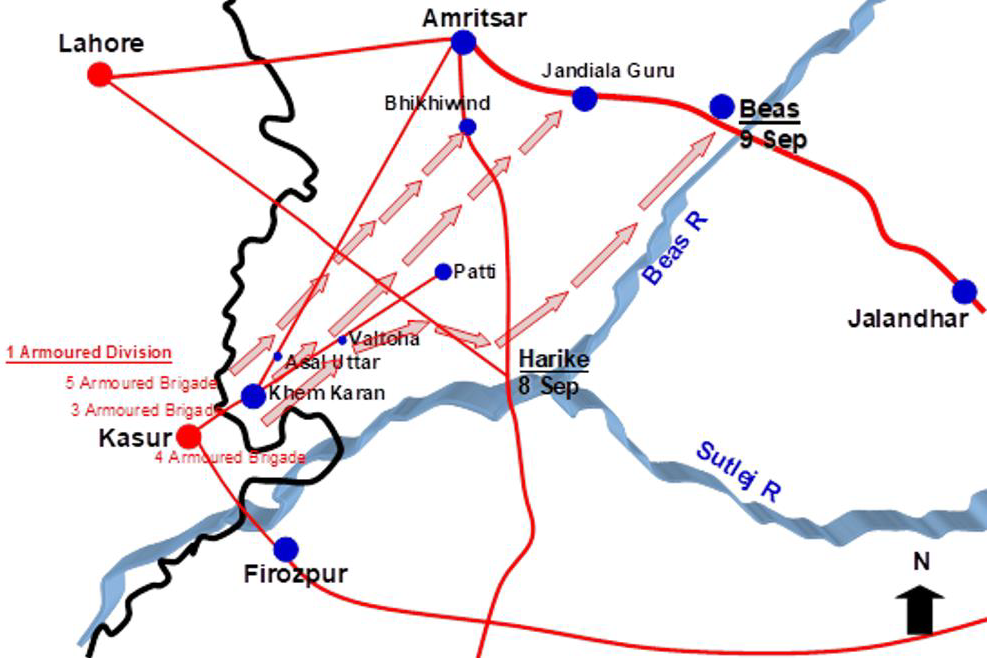
Foiled in the northern hook, Major General Nasir the Pakistani Divisional Commander tried a wider southern out-flanking move and sent 4 Armoured Brigade with 4 Cavalry in lead with a Mechanised Infantry Battalion following. The Centurion tanks of 3 CAVALRY were ready and waiting. The Shermans of Deccan Horse also fired upon from the northern side. Some areas had been cleverly flooded. The Pakistanis were channelized into the mouth of a semi-circle with Indian tanks firing from three directions. It was an ideal trap and to complement this, the divisional artillery was ready to bring down maximum concentration of fire into this area. A better part of Pak 4 Cavalry Regiment was shot to pieces in a boldly planned and executed ambush. Major General Nasir, watching the battle from his helicopter was disappointed. He came down and moved forward on Khem Karan – Bhikhiwind road to push his troops into a last-ditch effort. He spoke to the Brigade Commander and the CO 4 Cavalry to bash on regardless.
His radio signals were intercepted and at 6 PM, Nasir and his reconnaissance group came under heavy artillery fire in which Brigadier Shammi, the Artillery Brigade Commander of the Pak Armoured Division was killed and General Nasir wounded.
With that it was curtains for the Pakistani offensive.
In the battle lasting 8 to 10 Sep, the pride of Pakistan’s army, their Armoured Division was humbled by the Indian Army. Pakistan lost 97 tanks including 72 Pattons. Indian losses were comparatively negligible.
Lieutenant Colonel AS Vaidya, CO of Deccan Horse was awarded the Maha Vir Chakra and so were Major General Garbaksh Singh, Brigadier Theogaraj and Lieutenant Colonel Salim Calib, CO of 3 CAVALRY. 2 (I) Armoured Brigade had defeated a superior but clumsy opponent in the largest tank battle fought since the World War II.

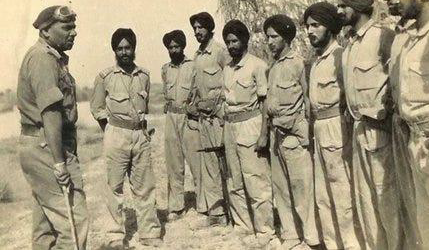
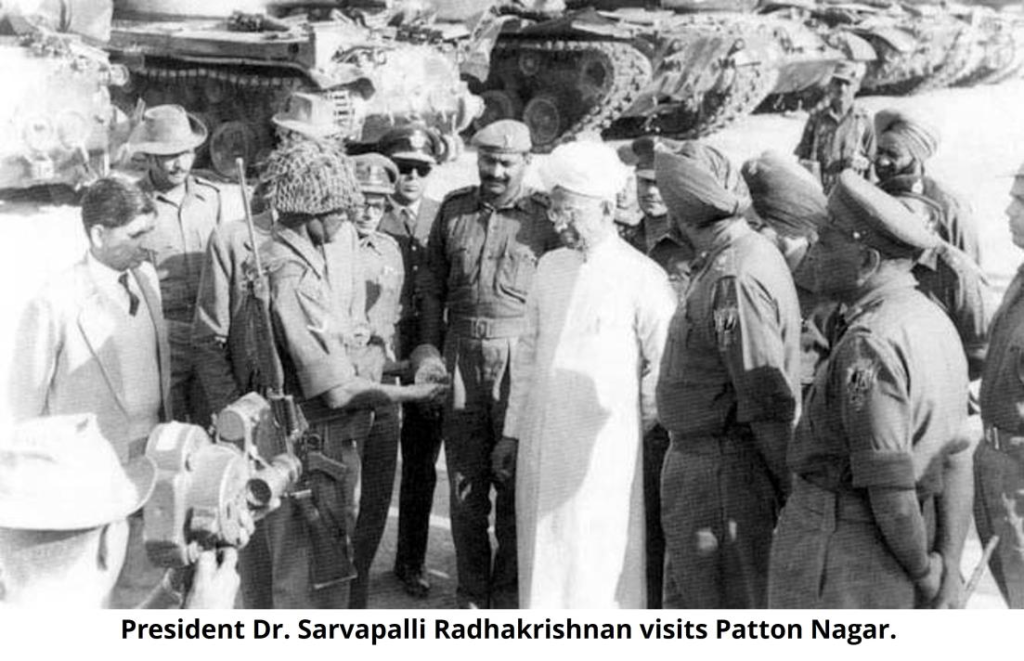
Brig T.K. Theograj, Commander 2 (I) Armoured Brigade speaking to the tank crews.