
New Delhi must strategise to enforce stability in its neighbourhood
Admiral Arun Prakash retd
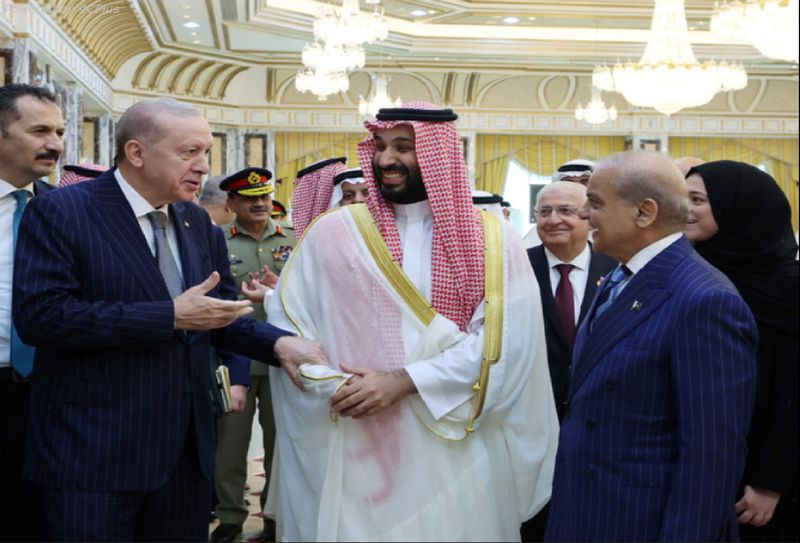
The Mecca Joint Defence Agreement signed by Türkiye, Saudi Arabia and Pakistan on August 7 continues to be in the spotlight. Against the backdrop of the ongoing US/Israel-Iran conflict, its geopolitical and military ramifications are being closely examined in the context of West Asia. For India, however, strategic prudence demands that this pact be viewed through the lens of Operation Sindoor.
Following India’s May 2025 missile strikes against Pakistan’s terror infrastructure, the latter avoided a prolonged, conventional escalation by engaging in high-intensity drone and electronic warfare before seeking an early ceasefire. During this conflict, while the bulk of Pakistan’s hardware and technical support came from China, Türkiye’s supply of unmanned aerial vehicles and electronic warfare devices underscored Ankara’s willingness to back Islamabad against New Delhi. Four months after Op Sindoor, Pakistan formalised a mutual defence pact with Saudi Arabia, guaranteeing that aggression against either country would be considered aggression against both.
On the diplomatic front, Pakistan, notwithstanding its severe domestic political fragmentation and fragile economy, has adroitly leveraged recent security crises into political capital. Its alignment with Washington and its high-risk role as a key mediator between the US and Iran have demonstrated Islamabad’s knack for exploiting its geopolitical weight.
India’s post-Uri surgical strikes (2016) and post-Pulwama airstrikes (2019) showed that while New Delhi could call Pakistan’s nuclear bluff, it had yet to re-establish effective conventional military deterrence. The destruction inflicted on Pakistan’s military by Op Sindoor was intended to project “deterrence by punishment”, but before its efficacy could be confirmed, the Mecca Agreement may have disturbed the balance of power in the subcontinent and given encouragement to hotheads in Islamabad.
India’s strategic planners must now formulate doctrines and acquire capabilities tailored to this emerging reality. Deterrence relies on certitude: India’s response must guarantee punishment so swift and so severe that neither of its two adversaries (China and Pakistan) ever doubts the cost of provocation and the accompanying loss of face in the international arena.
Rebuilding credible conventional deterrence will require heavy investment in creating war reserves for extended conflicts by quickly absorbing technological, logistic and operational lessons from the Ukrainian and Iranian battlefields. Awaiting urgent redressal is our government’s flawed and lethargic decision-making mechanism that has resulted in severe capability gaps in recent decades. Examples: the progressive erosion in the IAF’s combat aircraft strength; the inordinately delayed development of an indigenous jet engine that will impact its 5th- and 6th-generation aircraft projects; imposition of the ill-conceived and debilitating Agniveer recruitment/training scheme on the military; slippages in the Navy’s diesel submarine and aircraft carrier projects, and many others.
India’s uniquely hazardous security predicament is embodied in having two nuclear-armed adversaries as well as strained relations with others in the neighbourhood. Moreover, while its own defence-industrial base may take a decade or more to reach maturity, it remains substantially import-dependent. The ongoing geopolitical turmoil should leave us under no illusion that dependence on external sources for military hardware can be perilous for national security.
Thus, the urgent question that needs New Delhi’s focus is not whether India can prevail in a two-front confrontation, but how it can find a “breathing spell” of stability/tranquillity to allow uninterrupted progress towards technological self-reliance. The threats posed by China and Pakistan are qualitatively different, and each deserves the closest attention of our highly regarded diplomatic corps.
For Islamabad, Kashmir is not merely a territorial dispute; it serves as a pivot on which the military establishment’s domestic credibility rests. A settlement of Indo-Pak disputes by eliminating the so-called “existential threat” posed by India would demolish the military’s raison d’être. As for Beijing, it views the unresolved Line of Actual Control as a strategic lever to keep India geopolitically boxed into South Asia. The settlement of territorial issues would permit India to bring strategic focus on maritime capabilities and the Indo-Pacific, where China is most vulnerable.
India cannot match China’s defence spending or technological prowess overnight, but it can manage the border to avoid unintended escalation. Achieving this demands three priorities: active diplomatic and military contact, relentless infrastructure building, and a forward-leaning military posture that will ensure that — unlike the past — any future Chinese incursions incur painful costs. On this front, the goal is steady stabilisation for the long haul.
With regard to Pakistan, India should maintain a firm military posture and a zero-tolerance policy on terrorism, while quietly exploring back-channel diplomacy to test whether the Generals can be incentivised to shun cross-border terrorism. With senior RSS leaders such as Mohan Bhagwat and Dattatreya Hosabale signalling support for people-to-people dialogue, such outreach is unlikely to trigger domestic backlash and could pave the way for a viable modus vivendi on the western front.
This dual-track approach rests on a clear strategic calculus: while Pakistan remains bogged down by economic distress, tensions on the Durand Line and ethnic unrest, its enhanced international standing and newly minted security alliances could embolden renewed adventurism. India must strategise to enforce stability in its neighbourhood.