
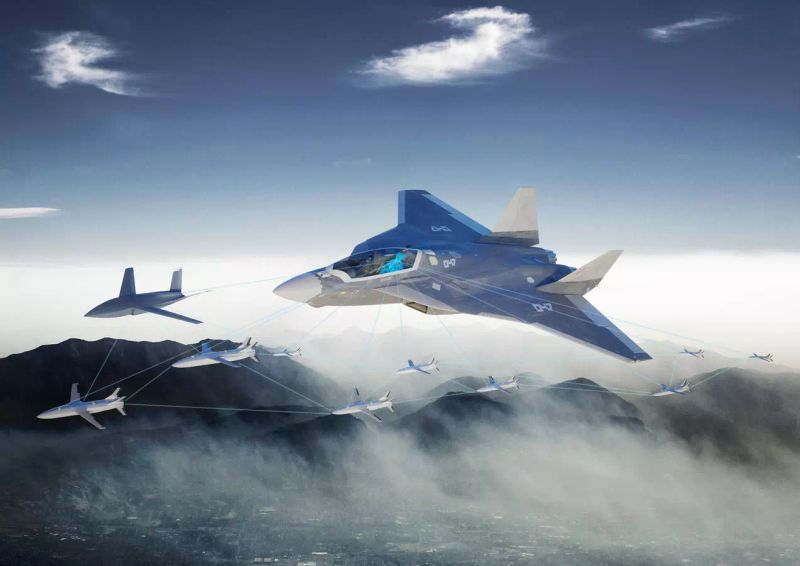
The Ministry of Defence has informed the Parliamentary Standing Committee on Defence that it has “initiated efforts in a concerted manner” to partner with France in the upcoming sixth-generation fighter aircraft development programme, which in military terminology is known as the Future Combat Air System (FCAS).
The French Government is spearheading the programme
The Committee, in its report tabled in Parliament on Friday, said that the “Ministry of Defence has initiated efforts in a concerted manner to co-join the sixth-generation fighter aircraft development programme, spearheaded by the French Government.”
Advertisement
The Committee’s report was on the ‘Action Taken by the Government on the Observations and Recommendations contained in the Twentieth Report of the Standing Committee on Defence’.
The Committee was informed by the MoD that two consortia are working on sixth-generation aircraft. One is a consortium comprising the UK, Italy and Japan, while the other comprises France and Germany, with both developing next-generation fighter aircraft.
The Committee was also informed that the Indian Air Force will try to join forces with one of the consortia and begin considering a sixth-generation fighter at the earliest, with a view to ensuring that India does not lag behind.
The 31-member committee, headed by BJP MP Radha Mohan Singh, has asked the Ministry of Defence to provide a detailed status report on the development and acquisition of sixth-generation aircraft, along with a roadmap, if any, and a tentative timeline for acquisition.
The Standing Committee, in its report, said it had asked the MoD to chalk out a trajectory for the technical upgradation of aircraft on top priority to enhance their combat capability, while expediting the planning process for the development and acquisition of sixth-generation aircraft. This, it said, would eventually enhance India’s air-domain capabilities in today’s highly air-centric modern warfare.
The Committee has also sought a status update on the indigenous fifth-generation aircraft, the Advanced Medium Combat Aircraft (AMCA). The MoD has asked three consortia to submit proposals for manufacturing five AMCA prototypes.
The Advanced Medium Combat Aircraft (AMCA) has been designed, and discussions on its production are currently underway. The Committee also said that, in view of technological advancements in fighter aircraft and to meet the present security scenario, technical upgradation of aircraft is required on top priority to enhance their combat capability.
A ‘generation’ of aircraft is defined by the capabilities that allow a pilot to maintain decision superiority over an adversary. Onboard sensors and technologies make it difficult for enemy radars to track a fifth-generation aircraft, which is backed by millions of lines of software code.
The classification of a generational shift occurs when a technological innovation cannot be incorporated into an existing aircraft through upgrades and retrospective fit-outs.
First-generation subsonic jet fighters emerged from the mid-1940s to the mid-1950s; second-generation jets from the mid-1950s to the early 1960s; third-generation jets from the early 1960s to 1970; and fourth-generation jet fighters from 1970 to the late 1980s. Fourth-and-a-half-generation jet fighters followed, while fifth-generation fighters emerged in the 2000s, with the US F-22 Raptor entering service in 2005.