
Nirupama Subramanian
The young generation has moved to a zone beyond Hindu/Muslim tropes
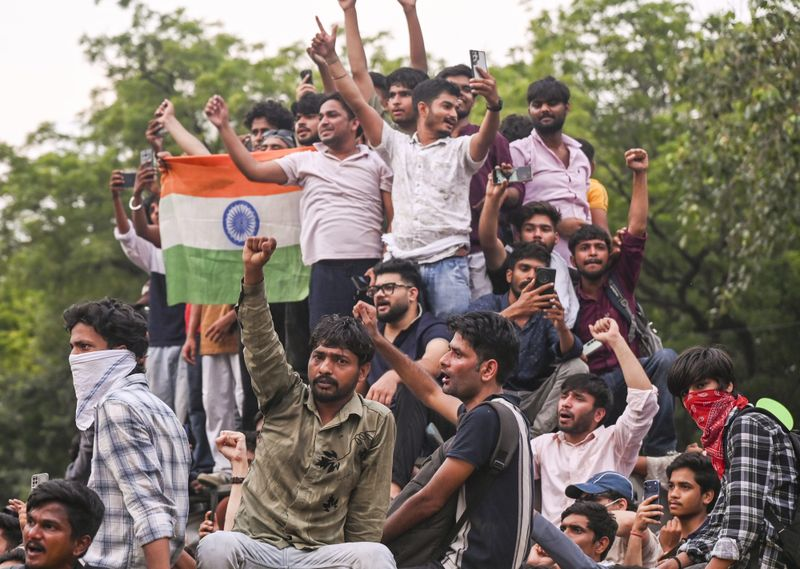
WHAT began with the Chief Justice of India’s words about people struggling to survive Naya Bharat, grew into an extraordinary protest by a new generation of Indians — and ended with the resignation of Education Minister Dharmendra Pradhan — has touched people in all corners of the country in ways that will become apparent only in the coming months, perhaps even over the years. But some conclusions are inescapable.
First, the aura of Prime Minister Narendra Modi has somewhat faded, and he seems less invincible than just two weeks ago. Even though his Instagram account has gathered followers by leaps and bounds since his midnight selfie reel last week, the fact remains that the BJP’s “strong government” reputation has taken a knock, and that Pradhan had to be sacrificed to protect the Prime Minister’s image from further damage.
The use of an AK-47 by a police officer on protesters in Patna and the firing of “anti-riot guns” loaded with pellet rounds in Delhi — three persons were injured by the pellets, one of them in his eye — has evoked country-wide horror at the government’s resort to such tactics against unarmed and largely peaceful protesters.
But even that did not deter the protesters. For a generation that grew up in the “era of Modi” and knew little, and cared even less, about previous governments, the language used both in irreverent social media posts as well as during the month-long agitation at Jantar Mantar Ground Zero was unnervingly direct and fearless. Shocked as the government is at the “ashleelta”, or unparliamentary language, of the students, fact is, it is the ruling party’s troll armies that have normalised such language in the last 12 years against critics. Presstitutes, anyone? And remember how a BJP MP was let off lightly after a communal slur against a fellow parliamentarian in the House?
Politics
A government that made an example of Disha Ravi, and continues to keep Umar Khalid in jail without a trial, has swiftly agreed to withdraw cases against protesters across the country, after a statement by the CJP that it would return to the streets if this promise — a condition for the withdrawal of the Jantar Mantar dharna — was not kept. It shows how rattled the government was, and how urgently it wanted to bring this episode to a close.
Second, GenZ has shown that unlike its parents’ generation, it has moved to a zone beyond Hindu/Muslim tropes. In the past, protests have been broken up by the use of communally divisive tactics. The anti-Citizenship Amendment Act protesters were depicted as radical Islamists, while protesting farmers were vilified as “Khalistanis.” In the large gathering at Jantar Mantar, the majority were clearly Hindus, and their stories, posted in reels on social media, or narrated in interviews, indicated that they had no time for the casual anti-Muslim bigotry that runs rampant across parts of North India; or for the intrusive ideological demands that the ruling party has often made on their personal relationships and food habits. For them, this government has simply failed to secure their future. They are worried not just about NEET, but about ever being able to find gainful employment and the general direction their lives are taking.
In interviews or in their own social media posts, several of those who attended the protests or wanted to express solidarity long-distance confessed that their parents had voted for the BJP, but that did not deter them from making common cause with those at Jantar Mantar. Many such parents accompanied their children to the site and to the July 20 march. Neha Bora, an articulate leader of AISA (All India Students’ Association), said in an interview that her parents did not agree with her political views and voted for a party that she was opposed to. Asked if that was the BJP, she nodded. Children of some BJP leaders were posting messages of solidarity with the protesters, embarrassing their parents.
Moreover, the Delhi Police’s cruel violence on the young protesters, many of them with parents who swore by the BJP, has made more apparent the shifting challenge from a demographic that the party once took for granted — a shift already visible with the shock that accompanied the ‘chanda chori’ from the Ram Mandir in Ayodhya.
Third, GenZ clearly has eyes on the country’s institutions and seems keenly aware about the role it is playing in its refurbishment. They have turned Chief Justice of India Surya Kant’s dismissive language about them — “cockroaches” and “parasites…had no employment and fail to get into the profession… and attack the system” — from a satirical meme to a weapon of mass mobilisation. The CJI has been forced to backpedal on his own remarks. After he declined to watch a video of how the protests unfolded, stating that the court’s time should not be “wasted”, he castigated Delhi Police yesterday, saying that excesses against protests cannot be justified under any circumstances.
IndiaNews Portal
Fourth, several mainstream TV channels, which have not stood up to professional scrutiny for upholding their independence, discovered they were not welcome at the protest site — it is true, too, that in a few cases the protesters have inexcusably used violence against some reporters of these channels, including not allowing some of them even near the Jantar Mantar site. On the whole, “godi media”, a Hindi phrase that indicates a visceral contempt for parts of the media that have refused to remain objective, has passed into the lexicon — it should show the media the mirror.
Finally, a word about Tamil Nadu. Even though several metros nationwide held sympathy marches with the Delhi students, Tamil Nadu’s GenZ has remained strangely untouched. Chief Minister C Joseph Vijay, who was elected four months ago, is the first Indian politician to benefit from what was plainly a GenZ protest vote against established political elites. But he has seemed lost for words and disconnected from what was happening in Delhi. For days, the CM made no statement on the Delhi protests, even though it was about something that has been at the core of a Centre-state struggle for several years.
Vijay’s only remarks came after the leaders of the Congress, a coalition partner in the state, were arrested. He condemned the arrests and reiterated the long-standing demand for abolition of NEET, but he did not echo the Congress demand for accountability from the government. He was also unmoved by the Delhi Police’s violence against the protesters.
Young people from Mumbai to Kolkata, Bengaluru to Patna and Prayagraj, were out on the streets protesting. But in Chennai, except for a small group that gathered daily chanting “Hum leke rahenge azadi” at the office of the CPI, which is also in the ruling coalition, and a separate, smaller anti-NEET protest by film director Pa. Ranjith, the Delhi vibe was missing.
SocialIssues & Advocacy
Vijay and his fan clubs were more preoccupied with the July 23 release of his movie Jana Nayagan. For those at Jantar Mantar who praised Thalapathy Vijay as a rare politician who understood the country’s youth, his silence and that of Tamil Nadu’s GenZ , would have come as a disappointment.