
When children witness war and become victims, they reproduce the same when they grow up
Latika Gupta and Aastha Sharma
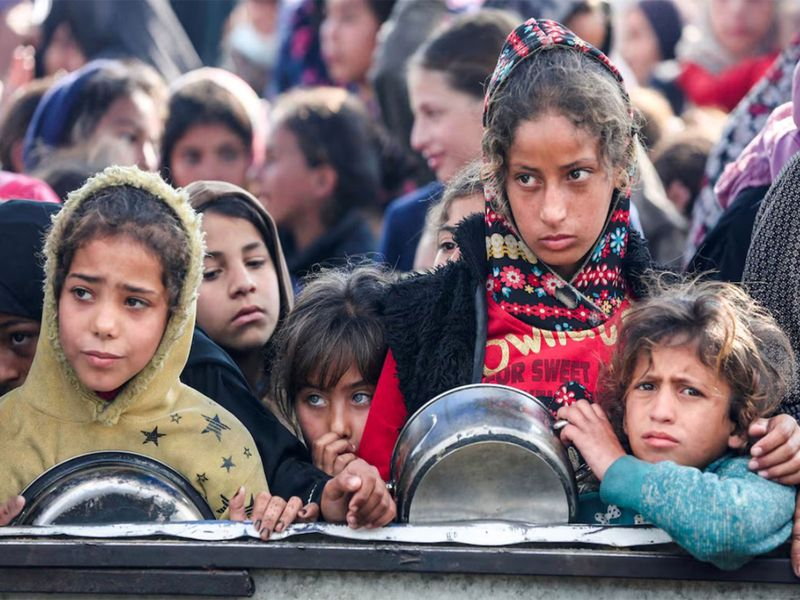
THE central plot of the film The Voice of Hind Rajab is a complex telephonic conversation between the volunteers at Red Crescent (the equivalent of the Red Cross in Muslim-majority countries) and Hanood, a little girl who was trapped inside a car surrounded by bodies of her relatives. She was petrified and constantly asked the woman on the call to come and take her to safety. The volunteer struggled for words capable of comforting a terrified small girl.
In one scene, she gently tells Hanood that others are sleeping as they are tired and need rest. Adults often attempt to soften human reality for children, but Hanood responds, “They are dead, all of them are dead”. There is no hesitation, no confusion rather a quiet statement of a fact.
In that single sentence, the fragile architecture of childhood collapses. It wasn’t a scripted dialogue. It was the real voice of Hanood and her repeated requests and arguments that someone should come and save her. The film brings home a well-known point that children do not witness violence politically.
Hanood did not ask who is killing or who ordered the tank to kill her family. She was only concerned with anyone coming and saving her. The film makes the audience dive in the emotional world of a child, where the greatest violence lies not only in bullets but in the gradual collapse of trust and the belief that adults can protect her.
The volunteer can comfort, but cannot rescue. Her family cannot protect her. The tragedy, therefore, is not simply that a child is exposed to death before her time, but that the very structures of adulthood entrusted with preserving childhood are rendered incapable of fulfilling their fundamental responsibility. Violence thus signifies not only the premature end of childhood but also the failure of adulthood itself, a profound rupture in the moral and social order.
In Hanood’s story, adults are neither absent nor indifferent; they are tragically powerless. The brutality of killing remains largely outside the frame, but its impact becomes immediate through the child’s voice. Children in the conflict zone are typically spoken about by journalists, governments and humanitarian organisations. By centering Hanood’s voice, this film offers an epistemological transformation. We do not just learn about the violence, we experience its agony through her voice.
The film does not expand the scope of violence by documenting thousands of victims, rather narrows it down by compelling us to be with one frightened child. The film insists that before there is a statistic, there is a child. Before there is a casualty report, there is a frightened voice and psyche. Before history records a conflict, a little girl experiences it.
Towards the end of the film, Hanood’s mother speaks of her ordeal with her brother clinging to her. In that moment, you cannot save yourself from wondering about the little boy. What will he want to do when he grows up? What kind of thoughts will fill up his mind whenever he will listen to the helpless voice of his sister?
It is also the moment when the film pushes you to recall what Italian educator Maria Montessori argued before the United Nations in the previous century and the 14th Dalai Lama is arguing now. The point is that the seeds of war get sown in childhood. His central argument is that children get accustomed to the possibility of violence as a way to resolve conflicts. The brutality in a war may end at some point but it gives rise to its own continuity. The cycle of war goes on because when children witness it and become victims, they reproduce the same when they grow up and the world inevitably reverts to its habit of war.
It is not just the children like Hanood, her brother and cousins who get trapped and face violence as an existential reality every day. It is also the children everywhere including India who are witnessing the use of brute force through an endless stream of breaking news alerts, satellite imagery and sensational social media coverage almost like a spectacle. The spectator children are also internalising the occurrence of extreme violence as a human activity. Paradoxically, despite unprecedented visibility, the real human suffering often becomes invisible.
This emerged as a reality in a study that we conducted with school children in Delhi. We investigated how children construct meaning around conflict and humanitarian crises by taking the case of Palestine-Israel. We interviewed children studying in Grades V and IX of different schools in Delhi. It emerged that about 80% children had heard of Palestine, Gaza and also ‘war’ and ‘dispute’. However, Grade IX children described Palestine and Gaza as religious communities within Israel. Several Grade IX students wrote that “Palestine was a community residing in a place called ‘Hummus’ (sic)” and “Gaza and Palestine are two poor minority communities in Israel”. They had heard about the killing of hundreds of people including small kids. Their sources of information were television (50%), newspaper (30%), social media (30%), family (30%) and friends (20%), but not the teachers. No one mentioned them. They felt sad and pitiful for the children of Gaza and wanted the war to stop but with a faulty understanding that they are the protesting minority within Israel.
The absence of violence is not peace. Even if the episodes of direct violence stop, structural violence continues in the form of idea of violence. If Hanood, her brother and millions of other Gaza children are coping with direct violence, children in other countries including in India are experiencing structural violence. This is what forms the habit of war and gives rise to its continuity. Our study revealed that children are not mute spectators but they lack the understanding and real ideas for imagining a better world. One reason is that their teachers had not considered it as valid knowledge worthy of attention in the classrooms.
The Dalai Lama invests his hope in teachers. He says that teachers make a mistake if they take up teaching simply as a way of making a living. If there is no human love in classrooms, and teachers merely explain each subject without affection or a sense of responsibility then education fails. It is extremely important for teachers to acknowledge that altruism and kindness indicate a mind intent on benefiting others.
If each person possesses the intention to serve others, as we all have to live together in human society, the resulting society will be a much happier one. Teachers should not simply focus on creating individuals who are only well-spoken and efficient, rather educate children to be altruistic, kind and compassionate, to understand the nature of life and make the world peaceful for everyone.
Teachers must teach knowledge by integrating human values of compassion, tolerance and mutual understanding. Children in India need to understand the struggles of their counterparts in Gaza as valid and essential knowledge about this world. It will be a befitting tribute to the teachings of the Dalai Lama, who turns 91 this month and to the spirit of Hanood.