
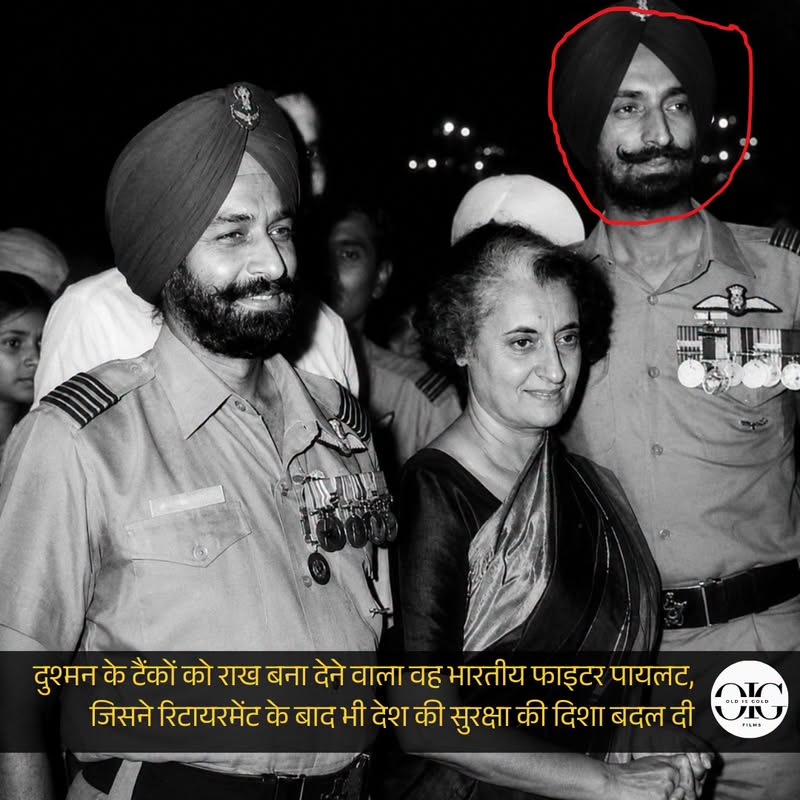
here are some names in the military history of India, whose bravery is not limited to the battlefield, but becomes part of thinking and strategy of future generations. Such a great personality Air Commodore Jasjit Singh. Calling them only a fighter pilot would be injustice to their personality. He was a warrior who challenged the enemy in the sky, showed extraordinary courage in the war, and also tasked to give new direction to India’s defence policy even after uniform.
But the biggest question is, what was it in this officer that he received respect for heroic chakra, lotushan for outstanding services, and strategic thinking all over the world? Why do Indian Air Force, Defence Specialists and Strategic Researchers still read and quote their thoughts? Let’s know the inspiring story of that person whose life became an important chapter of India’s security journey.
Did an ordinary young man make the sky his dream in his childhood?
Jasjit Singh, born on 8 July 1934, spent his childhood in that time when India was fighting for independence. The country was changing and new dreams were taking shape in front of the youth. There was a dream in those dreams—protecting the country. This dream took them to Indian Air Force.
On April 1, 1956 they received commission in Indian Air Force. He was selected in Fighter Stream, considered one of the most challenging and prestigious areas for any young officer. Being a fighter pilot is not just flying a plane. It is the responsibility of fighting death every second, making decisions in a pulse and giving the nation’s security a top priority. Jasjit Singh proved from the beginning of his career that he has the amazing ability to make decisions while staying calm even in difficult situations.
When rising tensions on the eastern border become the first test of their courage
During 1961-62 he served as flight commander in an operational squadron in the eastern region. There was constant tension on India’s borders at that time. This was the era when the Indian Air Force was rapidly moving towards its modern form and the role of veteran pilots was very important.
After some years he was made instructor at flying instructors school located in Tambaram, Tamilnadu. Here they not only taught flying plane, but also explained the importance of war mental preparation, discipline and leadership to new pilots. Going forward in 1968, he received higher military training at Defence Services Staff College, Wellington, which made him stronger towards becoming a skilled strategist.
War of 1971… When they attacked the safest areas of the enemy
The India-Pakistan war of 1971 is counted among the most glorious chapters of Indian military history. In this battle, squadron leader Jasjit Singh showed the courage that left him immortal forever.
They were part of the number 3 squadron of Indian Air Force. During the war they were sent on missions where strong air and ground security of the enemy were present. Entering such areas under normal circumstances is considered extremely risky, but Jasjit Singh continuously completed several operational missions regardless of the danger.
They accurately attacked enemy tanks, bunkers and cannons bases. They completed their mission even between heavy shelling and anti-aircraft fire. Not only that, they also took the responsibility of ensuring the service of aircraft, so that more fighter jets can participate in continuous war. This was the identity of not just a pilot, but a true military leader.
What did they do that they got the heroic chakra?
On 17 December 1971, the Government of India honored him with the Veer Chakra for his unique courage and duty.
His letter of honor was clearly mentioned that he completed several missions in the enemy’s heavy protection areas, destroying the enemy’s military resources and introduced exceptional bravery, professional efficiency and supreme dedication to duty.
Heroic Chakra is not just a medal. This is given to the soldier who has shown extraordinary courage for the country regardless of his lives on the battlefield. Jasjit Singh was the full officer of this honor.
Did their greatest achievement start after the war?
Often the story of soldiers ends with the end of war, but Jasjit Singh’s real journey probably started here.
On 20 January 1975, he was appointed the Commanding Officer of the Indian Air Force No. 17 Squadron. After this he was promoted to group captain and got the responsibility of director of flight safety at the air headquarters.
He later worked on very important positions like Director (Offensive Operations) and Director (Air Induction). During these responsibilities, they contributed significantly in strengthening the Indian Air Force strategies not only prepared for current wars, but also considering the potential future threats.
Even after retiring, they did not take the uniform, but responsibility
Most people choose quiet life after retirement, but Jasjit Singh started a new chapter of nation service.
In 1987, he was made the director of the Institute for Defense Studies and Analysis (IDSA). He led this prestigious institution till 2001 and gave India’s Defence Studies a new identity globally. Their research on defense policy, nuclear strategy, air power, regional security and international relations are still considered extremely important today.
He established Center for Air Power Studies (CAPS) in New Delhi in 2001. This institution became the leading think tank doing serious study on Indian air power, defence strategy and national security. He acted as its director till his last minute.
When the pen showed the same strength as his fighter jet
Air Commodore Jasjit Singh was not the only war hero. He was also an excellent author and defense analyst.
He wrote several books on topics such as national security, air power, nuclear policy, defense improvement and strategic balance. His books were read seriously not only by India, but also by foreign defence experts.
He believed that future wars will be won not only by weapons, but by ideas, technology and visionary strategy. Maybe this is why they became dear advisors to soldiers as well as policymakers.
Even the country has not forgotten their contribution
On March 29, 2006, the Government of India honored him with the country’s third highest citizen honor Padma Bhushan. The then president Dr. A.P.J. Abdul Kalam awarded him this honour. It was not just the respect of one person, but the thinking that gave new direction to India’s air power and national security.
4 August 2013… When a warrior left, but his thoughts still fly
Air Commodore Jasjit Singh bid farewell to this world on August 4, 2013. But great people are never limited to their lifetime. His views, his decisions, his books and the institutions they established are still directioning India’s defence system.
Today as the Indian Air Force heads to new technologies, modern fighter jets and future challenges, the thinking of visionary strategists like Jasjit Singh seem more relevant than ever.
Tribute to OLDISGOLDFILMS
India’s history is not only of those who won the war, but also of those who taught the preparation to win the war to the coming generations. Air Commodore Jasjit Singh had such rare personality. They showed courage in the sky, led the war, renewed thinking in strategy and strengthened national security through writing.
OLDISGOLDFILMS pays a humble tribute to him on his birth anniversary today. His life teaches us that a true soldier not only protects the borders but also prepares the foundation for the security of the upcoming India. His courage, his knowledge and his vision will always inspire the countrymen.