
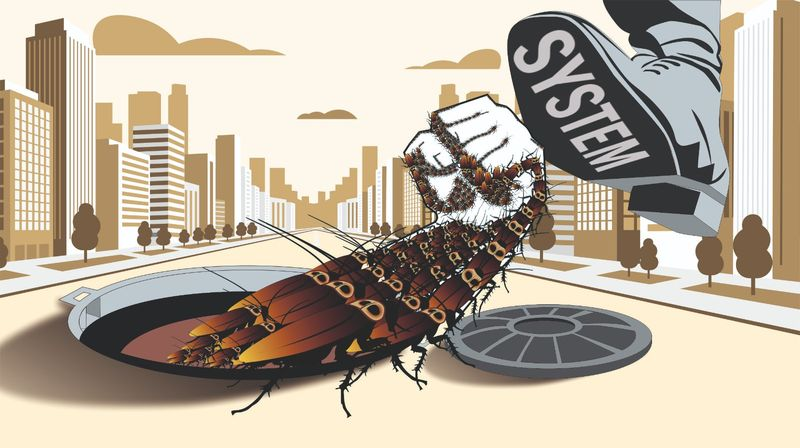
India’s establishment has a habit of waiting for inconvenient energies to dissipate. But the cockroach is among the most resilient creatures
LET me tell you something about India that most people in positions of authority still refuse to accept: this country’s youth is neither stupid nor silent. They are, in fact, ferociously, brilliantly, devastatingly articulate and when you insult them from the highest Benches of the land, they don’t sulk.
They organise. They satirise. And they may make you look like a fool in ways that no editorial, no press conference, and no prime-time debate ever could.
Enter the Cockroach Janta Party.
Chief Justice Surya Kant, in an open court hearing, declared that “parasites” were attacking the system and then, with perhaps rightful and breathtaking condescension, compared unemployed youngsters to cockroaches —those who “don’t get any employment or have any place in the profession” and who “start attacking everyone.” Now, one presumes that a man who has presided over some of the most consequential constitutional matters in recent memory would possess, at minimum, the political instinct to avoid comparing an entire generation of struggling young Indians to insects.
One would be wrong.
The clarification that followed — that the CJI had been misquoted, that he was referring to those with fraudulent degrees, not the youth at large — landed with the grace of a courtroom adjournment that nobody asked for.
The damage, as they say in South Delhi drawing rooms, had been done. But something rather magnificent had also begun.
Within six days of its launch on May 16, the Cockroach Janta Party had amassed over 16 million followers. Let that number sit with you for a moment. Sixteen million.
The CJP’s founder Abhijeet Dipke told the Associated Press quite plainly: “It is the younger people who were actually very frustrated. They didn’t have any outlet. They were really angry at the government.” That sentence is worth printing on the front page of every newspaper in this country — not because it is revelatory, but because it is so obvious and yet so consistently ignored by those who govern us.
India has a youth employment problem that is not a secret but is treated like one. Government data reveals an unemployment rate of nearly 10% among those aged 15 to 29, climbing to 13.6% in urban areas. More than half of Indian Gen Zs have reportedly postponed major life decisions— buying homes, starting families — because of economic anxiety. These are not abstract statistics. These are the young men and women who crammed for competitive exams only to discover that the papers had been leaked. Who graduated to find that the job market had moved on without them. Who scroll Instagram at midnight not for entertainment, but because there is genuinely nothing else to do.
And what did their Chief Justice call them? Cockroaches.
Well. You reap what you sow.
The genius of the Cockroach Janta Party is not merely that it is funny, though it undeniably is.
Its genius lies in the alchemy of reclamation. The party calls itself the “Voice of the Lazy and Unemployed.” Its satirical manifesto demands a ban on post-retirement Rajya Sabha seats for chief justices, 50% reservation for women in Parliament, and a 20-year ban on defecting legislators. These are not the demands of nihilists. These are the demands of people who have been paying attention — who understand the architecture of how power perpetuates itself in this country and who, in the language of memes and irony, are demanding accountability.
Anurag Kashyap, Dia Mirza, Sonakshi Sinha, Kunal Kamra and the usual suspects have followed the CJP’s Instagram page. You may roll your eyes at celebrity endorsement, and normally I would join you. But this is different. This is not brand ambassadorship. This is a signal: that the sentiment animating the CJP resonates well beyond the campus and the hostel room.
Predictably, the establishment’s first instinct was suppression. The CJP’s X account, which had gathered around 2,00,000 followers, was withheld in India. The response from Dipke? A new account, a poster reading “Cockroach is back,” and the immortal line: “You thought you can get rid of us? Lol.” If you needed any further evidence that this generation has absorbed India’s political theatre and is now writing its own script, there it is.
Now, before the usual brigade of credentialed commentators rushes to dismiss this as mere social media froth, let me offer a counter. Every significant political realignment in recent Indian history has had a cultural precursor. The Anna Hazare movement lived on social media before it hit the streets.
Movements do not arrive fully formed; they gather energy from precisely these kinds of cultural flashpoints.
The CJP may never file a nomination paper. It may never contest an election. But it has done something arguably more important: it has given a name, an identity, and a vocabulary to a generation’s rage.
Dipke — who is Dalit, and has faced casteist attacks online since that identity became public — has spoken of wanting the CJP to guide supporters towards concrete activism: filing RTIs, becoming politically engaged, refusing to be invisible. That is not the language of a meme page. That is the language of a movement.
India’s establishment has a well-practised habit of waiting for inconvenient energies to dissipate. Sometimes that strategy works. But the cockroach, as biology will confirm, is among the most resilient creatures on the planet. It survives conditions that would obliterate lesser species.
Perhaps the Chief Justice, of all people, should have known that. Or perhaps he does.