
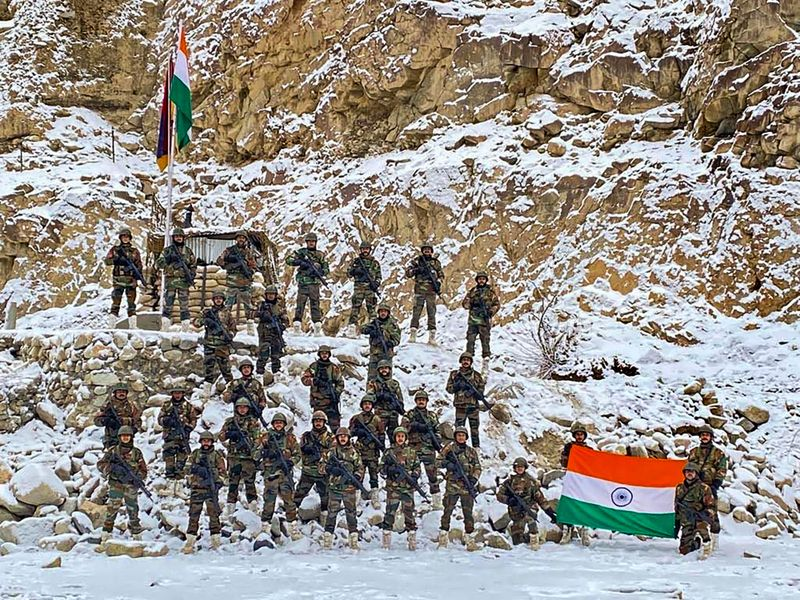
During the intervening night of June 14-15 six years ago, Indian and Chinese troops clashed violently at Galwan on the Line of Actual Control (LAC) in eastern Ladakh, resulting in fatalities on both sides, including the Commanding Officer of the Sixteenth Battalion of the Bihar Regiment, Colonel Bikkumalla Santosh Babu, who was decorated posthumously with the Maha Vir Chakra, the second highest award for gallantry in the face of the enemy.
The battalion was deployed in Galwan during Operation Snow Leopard following the protracted stand-off between India and China that began in the Spring of 2020 and has still not been fully resolved. It was tasked to establish an observation post opposite Chinese positions.
According to the citation for his award, while holding the position, his column faced stiff resistance from the adversary who attacked using lethal and sharp weapons along with heavy stone pelting from adjoining heights. Undaunted by the violent and aggressive action by the overwhelming strength of the enemy soldiers, the officer continued to resist the enemy’s attempt to push back Indian troops.
Despite being grievously injured, Colonel Bikkumalla Santosh Babu led from the front with absolute command and control despite hostile conditions to deter the vicious enemy attack on his position. In the skirmish that broke out and ensuing hand-to-hand combat with enemy soldiers, he valiantly resisted the enemy attack till his last breath, inspiring and motivating his troops to hold ground,” the citation states. Displaying exemplary leadership and astute professionalism, he showed conspicuous bravery in the face of the enemy and made the supreme sacrifice for the nation.
It was after two decades that a Maha Vir Chakra (MVC) was conferred for actions on the battlefield. In fact, the last MVC to be awarded was also to an officer serving with the Bihar Regiment, which was announced in 2000.
As part of Operation Vijay during the 1999 Kargil conflict, Captain Gurjinder Singh Suri, commissioned in the Army Ordnance Corps but was serving as the Ghatak platoon commander with 12 Bihar, was killed in a gun battle in the Uri sector in November 1999 when Pakistani army attacked the Faulad Post.
After the attack was repulsed, the platoon was clearing bunkers during which he killed two enemy soldiers and silenced a machine gun. In the process, he received a burst in his left arm but continuing with the task lobbed two hand grenades into a bunker killing another soldier. At this point, he was hit by an enemy rocket-propelled grenade critically wounding him.
Skilled musketeers of yore
Though amongst the Indian Army’s youngest Infantry Regiments, having been raised in its present form in 1941, its troops trace their martial lineage to 1757, when the 34th Sepoy Battalion was raised at Patna by Lord Robert Clive, the first British Governor of the Bengal Presidency and architect of the East India Company.
Barring the Parachute Regiment that was formed in 1945, the Bihar Regiment is among the last three Infantry Regiments to have been raised as part of the erstwhile by the British Indian Army. In 1941, amidst the Second World War, three infantry regiments came into being – the Assam Regiment in June 1941, the Bihar Regiment in September 1941 and the Mahar Regiment in October 1941.
The Sepoy Battalion was formed by men from only from the Bhojpur region of Bihar and subsequent battalions expanded their recruitment base across the entire Shahabad area that comprises present day districts of Bhojpur, Buxar, Rohtas and Kaimur.
According to the Indian Army’s official website detailing infantry regiments, their success in combat had impressed the local ruler, Mir Kasim, to begin raising units trained in western combat techniques. The Bihari battalions raised by Mir Kasim had not only done well, but also beaten the British in some engagements.
The Bihari or ‘Poorbia’ soldiers as they came to be called because they hailed from the eastern Ganga plains, thereafter continued to be the backbone of the Bengal Infantry of the British, emerging as disciplined soldiers and quick to learn and apply the tactical drills and field craft with initiative.
An essay contained in the book, ‘India’s Princely States: People, Princes and Colonialism’, states that over time, Purbias had emerged as a community of specialist musketeers in context of Malwa armies and rulers in Malwa were keen to enlist Poorbias for the expertise in firearms possessed by them in order to update their military technology.
1857 War of Independence and beyond
As part of the Bengal Native Infantry that comprised personnel from Awadh and Bihar regions, Bihari troops played a significant role in the First War of Independence, 1857, which the British also refer to as the Sepoy Mutiny. In March 1857, at Barrackpore near Calcutta, Sepoy Mangal Pandey of the 34th Bengal Native Infantry, who hailed from Ballia in eastern Uttar Pradesh, attacked British officers, and in May 1857, the war began in earnest from the Meerut garrison. Thereafter, Biharis were not encouraged by the British to join the military until after the First World War.
In 1923, an Indian Territorial Force Battalion, the 11th (Territorial) Battalion of the 19th Hyderabad Regiment (11/19HR), was formed with its headquarters at Danapore Cantonment. The Bihar Regiment was formed in 1941 by regularising 11/19HR and christening it as the First Battalion of the Bihar Regiment.
The newly raised battalion saw action in the Burma Campaign of World War – II, and as part of the Lushai Brigade and captured Haka in October 1944 and Gangaw in January 1945. For its actions, the battalion was awarded two Battle Honours – Haka and Gangaw, and bestowed the Theatre Honour Burma. The Second Battalion, raised in December 1942 participated in Operation Zipper for recapturing British Malaya. A third battalion was raised in 1945.
The Regiment’s first post-Independence raising was in 1960 and at present it has 20 regular battalions, four Rashtriya Rifles battalions and two Territorial Army battalions that draw their manpower from the states of Bihar, Jharkhand, Uttar Pradesh and some pockets of Odisha and West Bengal.
Post-Independence, the Regiment has participated in every war and major operation, including Kargil where it was awarded a Theatre Honour, as well as overseas in Sri Lanka and UN peacekeeping missions. Its roll of honour includes four Ashok Chakra, the highest civilian gallantry award and three Maha Vir Chakra.