
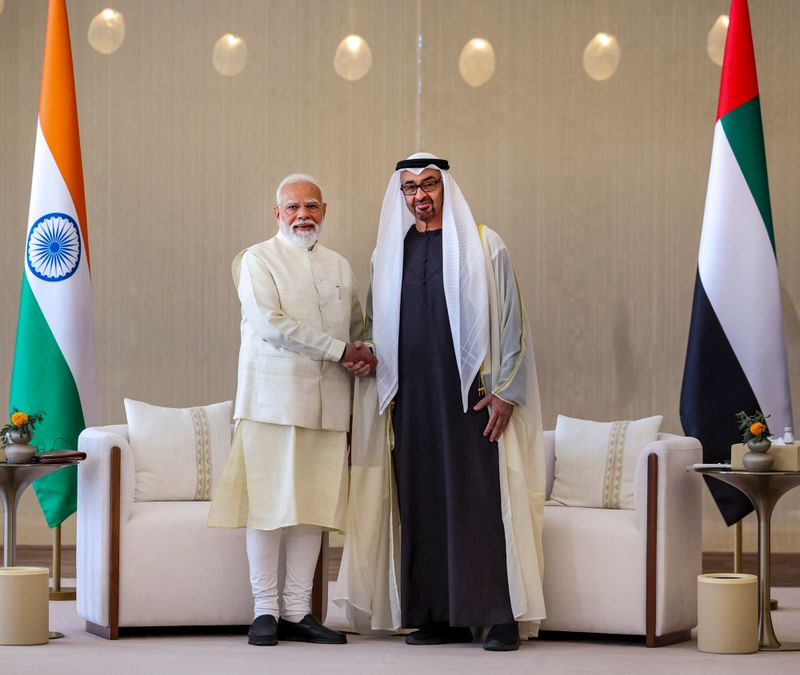
PM Modi’s visit to Abu Dhabi was largely aimed at boosting President Sheikh Mohamed’s morale
PRIME Minister Narendra Modi’s May 15 stopover in the United Arab Emirates (UAE) coincided with the conclusion of US President Donald Trump’s visit to China and the BRICS foreign ministers’ meeting in New Delhi. These developments took place under the shadow of the war in West Asia.
Two questions arise: How did the UAE get embroiled in the ongoing conflict? What was the purpose of PM Modi’s meeting with President Sheikh Mohamed bin Zayed Al Nahyan (popularly known as MbZ)?
Ever since seven emirates formed the UAE in 1971, it has been stuck between Iran, covering the entire northern Gulf coast, and Saudi Arabia — a self-proclaimed regional and Islamic power — in the south. In the 1950s, Sheikh Zayed bin Sultan Al Nahyan — who later became Abu Dhabi’s ruler and the UAE’s first President — confronted the Saudis when they offered him a bribe to grab the Buraimi belt, which was believed to have huge oil deposits. He led Abu Dhabi’s forces in ejecting them.
Sheikh Zayed used native wisdom to steer the UAE towards prosperity by avoiding entanglement in regional disputes like the Iran-Iraq war and the occupation of Kuwait by Iraqi President Saddam Hussein. After Sheikh Zayed’s death in 2004, his younger son Sheikh Mohamed bin Zayed Al Nahyan first became the Crown Prince and then the de facto ruler when the elder son, Sheikh Khalifa, suffered a stroke in 2014. Sheikh Mohamed formally assumed presidency in 2022.
Saudi Crown Prince Mohammed bin Salman had a parallel rise, assuming office in 2017. President Sheikh Mohamed took him under his wing, especially protecting him from US ire over journalist Jamal Khashoggi’s 2018 killing in Turkey.
However, their relationship soured when US President Trump came up with the 2020 Abraham Accords. They envisaged an Arab-Israel alliance to contain Iran, with the Palestinian issue sidelined. While the UAE promptly signed alongside Bahrain, the Saudis demanded that Israel first specify the path to Palestinian statehood. Trump withdrew the US from the Joint Comprehensive Programme of Action (JCPOA), the Iran nuclear deal signed by P5+Germany. That allowed Iran to escalate its nuclear enrichment. Meanwhile, the UAE increased its commercial, technological and military engagement with Israel.
After the October 7, 2023, attacks on Israel and the brutal Israeli retaliation against Gaza civilians, Arab countries’ membership of the Abraham Accords became questionable. Neither the UAE nor Bahrain withdrew. Late Iranian Supreme Leader Ali Khamenei called the UAE a “traitor to Arab states and to Palestine“, declaring that those hosting Zionists were living in “glasshouses”.
The UAE and Bahrain ignored these warnings. Once the US and Israel attacked Iran on February 28, the Iranian Supreme Leader’s “glasshouses” prediction came true. The Gulf Cooperation Council (GCC) has split into three groups, each aligned with the US. One group comprises Saudi Arabia, Egypt, Pakistan and Turkey. Qatar is attempting to be neutral. And then there is the UAE, stuck with the Israel-US axis. India favours the last two.
The Washington Institute for Near East’s 2023 poll revealed that 96% of the Saudis supported severing ties with Israel. The Saudi ruling family, running a country with a population of over 35 million, is more responsive to popular sentiments. The UAE’s nearly 11-million population has only one million locals. Economic and financial benefits are supposed to keep locals appeased. The 2011 Arab Spring uprisings, which ousted the rulers of Libya, Algeria and Egypt, frightened the Gulf ruling families. When the Muslim Brotherhood assumed power in Egypt, the Gulf rulers, especially Emiratis, panicked. Subsequently, they became obsessed with countering the Brotherhood and Islamists in the Arab world.
The UAE’s interventions to support factions in South Yemen, Somaliland, Sudan and Libya were basically focused on containing perceived radical Islam. Saudis and Emiratis initially cooperated but eventually split. Saudis supported old regimes, while the UAE began backing factions. Israel also began using the cover of the UAE to launch intrusions, especially along the Red Sea. Iran-backed Houthis in Yemen opposed the often divided forces backed by the UAE and Saudi Arabia.
Former US President Barack Obama claimed that he rejected the same plan to attack Iran which Israeli Prime Minister Benjamin Netanyahu successfully sold to President Trump. Perhaps PM Modi, who visited Israel days before the attacks on Iran, and the UAE President were similarly misled. Israel’s four-stage operation started with the Iranian Supreme Leader’s assassination, followed by neutralisation of Iran’s missile-launch capability. A popular uprising was then expected, leading eventually to a secular government. This regime change sequence failed miserably. Instead, the Strait of Hormuz became a new obstacle.
Despite the UAE’s discomfort over being geographically stuck between Iran and Saudi Arabia, it hosted about 8,000 Iranian companies. It also provided Iran a trade outlet, bypassing US sanctions, lifting trade to $29.2 billion in 2025. But President Sheikh Mohamed bin Zayed wanted the UAE’s strategic reach to match its wealth. The Emirati sovereign fund exceeds that of Saudi Arabia. Israel was seen as enabling this expanded influence to deter Iran and rival Saudi Arabia. Instead, Israel has dragged the UAE into the current impasse.
Even the US has abandoned talk of Iranian regime change. Trump, who is now insistent that Iran should not have nuclear weapons, is keen to restore navigational freedom in the Strait of Hormuz. If sanctions on Iran are lifted and its energy exports freed, will it normalise Iran-UAE relations? Without that deal, Dubai cannot revert to past success. Netanyahu complicated matters by revealing his secret meeting with the UAE President in Abu Dhabi in March. Does Netanyahu, by damaging the Emirati President’s standing, hope to ensure that the UAE does not abandon the Abraham Accords or cut a deal with GCC neighbours or even Iran?
PM Modi’s visit was aimed more at boosting the UAE President’s morale than creating new strategic openings. The proposed $5-billion investment in Indian infrastructure mostly goes to a private housing development company. The move to enhance Indian strategic petroleum reserves by 30 million barrels is welcome, but it merely implements old proposals. The LPG supply would depend on the Iran-US peace deal.
Considering the fractured GCC and Pakistan’s defence agreement with the Saudis, India is left with the Abraham Accords-compliant faction or “neutral” nations like Qatar. Notably, during his visit to Delhi last week, Iranian Foreign Minister Abbas Araghchi suggested that the Chabahar port awaited India.
The Gulf Sheikhs must begin, like Kuwait, to gradually introduce democratic rights. Discussion and debate minimise the chances of recurrence of strategic mistakes.