
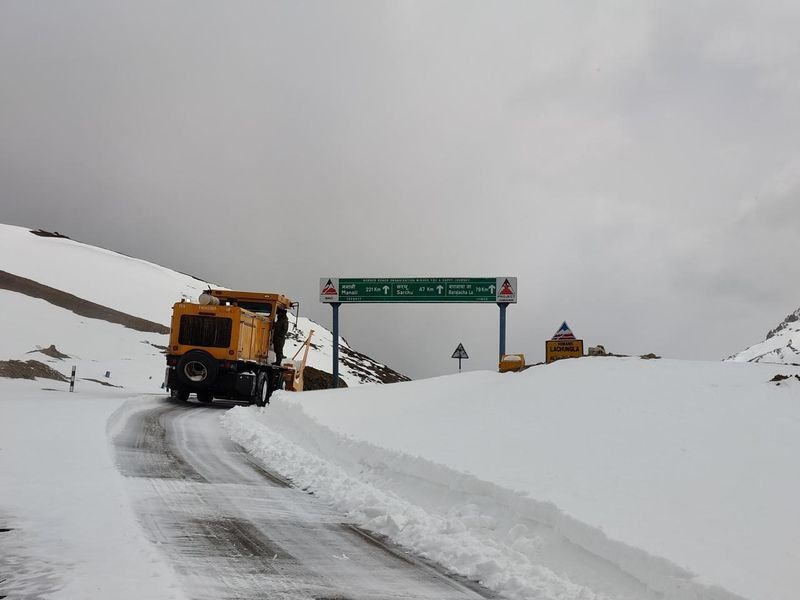
Raised on May 7, 1960, BRO has emerged as India’s largest construction agency and neighbouring countries, such as Afghanistan, Bhutan, Myanmar, Tajikistan and Sri Lanka
From the freezing heights of the Himalayas to the scorching sand of Rajasthan, from the swampy jungles of the north-east to the terror infested plains of Chhattisgarh, the Border Roads Organisation (BRO) has, over the past 67 years, made huge strides in developing road infrastructure under adverse climatic conditions and trying conditions to provide a lifeline to the soldier on the far flung frontlines as well as succour to civilians residing in remote areas.
Raised on May 7, 1960, BRO functions under the aegis of the Ministry of Defence (MoD) and is mandated with the construction and maintenance of roads, bridges and tunnels along the border areas, as well as some naxal-infested areas in central India.
It has emerged as India’s largest construction agency, with operations spread across 19 states and three union territories, including Andaman and Nicobar Islands, as well as neighbouring countries, such as Afghanistan, Bhutan, Myanmar, Tajikistan and Sri Lanka, and a total budgetary allocation of Rs 13,388.13 crore for the 2026-27 fiscal.
Since its inception, BRO has constructed over 64,100 km of roads, 1,179 bridges, seven tunnels and 22 airfields across India’s border areas and in friendly neighbouring countries, forming a key pillar of national security, strategic preparedness and regional development. BRO connects forward-most border posts to the rear echelons.
Expansion over the years
From humble beginnings with just two projects – Beacon in the North and Vartak in the East, BRO now comprises 18 projects. These include nine in north-west India in Jammu and Kashmir, Ladakh, Himachal Pradesh, Uttarakhand and Rajasthan, eight in the north-east in Sikkim, Arunachal Pradesh, Nagaland, Mizoram and Meghalaya, and one in Bhutan.
Each project is commanded by an officer of the rank of Brigadier drawn from the Indian Army’s Corps of Engineers. The BRO’s officer strength comprises a mix of its own cadre and officers on deputation from the Army.
In Arunachal Pradesh, BRO projects such as Vartak, Arunank, Udayak, and Brahmank tackle some of India’s most challenging frontiers, connecting remote villages to the Line of Actual Control (LAC) through critical infrastructure including Sisseri Bridge, Siyom Bridge, Sela Tunnel and Nechiphu Tunnel.
In Ladakh, projects like Himank, Beacon, Deepak, Vijayak, and Yojak maintain vital lifelines to Kargil, Leh and the Karakoram region, covering strategic routes such as the Srinagar–Leh Highway, Darbuk–Shyok–Daulat Beg Oldie Road, Atal Tunnel in Himachal Pradesh and the ongoing Shinku La Tunnel.
The north-east projects like Swastik in Sikkim, Pushpak in Mizoram, Setuk in Assam and Meghalaya and Sewak in Nagaland and Manipur strengthen regional access, while on the western borders, Sampark in Jammu and Chetak in Rajasthan enhance strategic mobility in the plains.
In addition, Project Shivalik ensures reliable access to the Char Dham Yatra in the Himalayas of Uttarakhand, while Hirak extends connectivity into left-wing extremism-affected areas of Chhattisgarh.
Project Dantak in Bhutan, at present BRO’s only permanent overseas formation, plays a key role in reinforcing bilateral ties through the development of an extensive network of roads, bridges and infrastructure in the Himalayan kingdom.
Missions in foreign countries
Dantak, among BRO’s oldest and most enduring missions, which was launched in 1961, has shaped Bhutan’s modern connectivity.
It has built bridges, developed key airports such as Paro and Yonphula and supported telecom networks and hydropower infrastructure, contributing directly to Bhutan’s socio-economic development and symbolising the deep Indo-Bhutan partnership.
In Myanmar, BRO has strengthened regional integration through projects, such as the 160 km India-Myanmar Friendship Road, inaugurated in 2001, which connects Moreh in India to Tamu and Kalewa in Myanmar.
Towards the north-western neighbourhood, BRO constructed the 218 km Delaram-Zaranj Highway (Route 606), providing Afghanistan with direct access to Iran and the Port of Chabahar.
This project enhanced regional trade options and demonstrated India’s commitment to development-led diplomacy.
Further up in Tajikistan, BRO undertook strategic reconstruction at the Farkhor and Ayni air bases, including runway expansion, air traffic control systems, hangars and navigational upgrades, strengthening India’s strategic reach and reinforcing its role as a trusted regional partner.
Role in disaster management
Beyond infrastructure development, BRO plays a crucial role in disaster management and humanitarian assistance, often being among the first responders to rescue victims and restore lines of communication in areas struck by natural disasters.
Road opening parties, avalanche detachments and bridge units work around the clock to clear landslides, rebuild washed-away bridges and reopen mountain passes after cloudbursts, flash floods or earthquakes.
By restoring access to advanced landing grounds and helipads, BRO also enables the Indian Air Force and Army Aviation Corps to fly in relief and evacuate the injured.
Every winter, most passes in the high mountains in the eastern and western theatres close due to heavy snow and every spring, the men and machines of the BRO cut through the towering walls of snow and ice to restore the vital lifelines to areas that have remained cut off from the mainland for months.
In 2026, BRO made history when Zoji La, a treacherous pass on the Srinagar-Leh highway, was kept open for vehicular traffic all through the winter season.
The road ahead
Border infrastructure development received impetus after the 1999 Kargil conflict, and long-term plans were drawn up to ensure the rapid movement of troops to forward areas. Increasing Chinese activity along the northern borders further accelerated the works.
Over the past two years, 356 infrastructure projects executed by the BRO have been dedicated to the nation, setting a significant benchmark in the development of strategic border infrastructure.
To maintain the pace of development, the central government increased the capital expenditure allocation from Rs 6,500 crore in 2024–25 to Rs 7,146 crore in 2025–26. For the current 2026-27 fiscal year, the capital allocation is Rs 7,394 crore.
In FY 2024–25, the Border Roads Organisation (BRO) achieved its highest-ever expenditure of ₹16,690 crore. Continuing this upward trajectory, an expenditure target of ₹17,900 crore has been set for FY 2025–26.
Under the Border Roads Development Programme 2023-28, over 1,000 projects are underway, focusing on all-weather connectivity as well as upgrading some forward airfields.
Key plans include constructing 17 new road-rail tunnels totalling about 100 km, 410 bridges, 73 pending projects and 2,000 km of strategic roads.
As part of BRO’s perspective plan, 470 roads covering about 27,300 km are planned in border areas.
The Trans-Kashmir Connectivity project, spanning about 717 km, has been approved for development to National Highway Double Lane specifications, with paved shoulders.
The alignment will run from Poonch to Sonamarg, strengthening strategic road infrastructure across key mountain passes.
Tunnels are planned at Sadhna Pass, Razdhan Pass, Peer Ki Gali and Zamindar Gali, in western Jammu and Kashmir, to ensure all-weather connectivity.
The project will be executed phase-wise by the BRO, with funding from the Ministry of Defence.
Once completed, it will significantly enhance forward connectivity, improve inter-sector movement and strengthen inter-valley linkages, thereby boosting operational preparedness and long-term regional integration.