
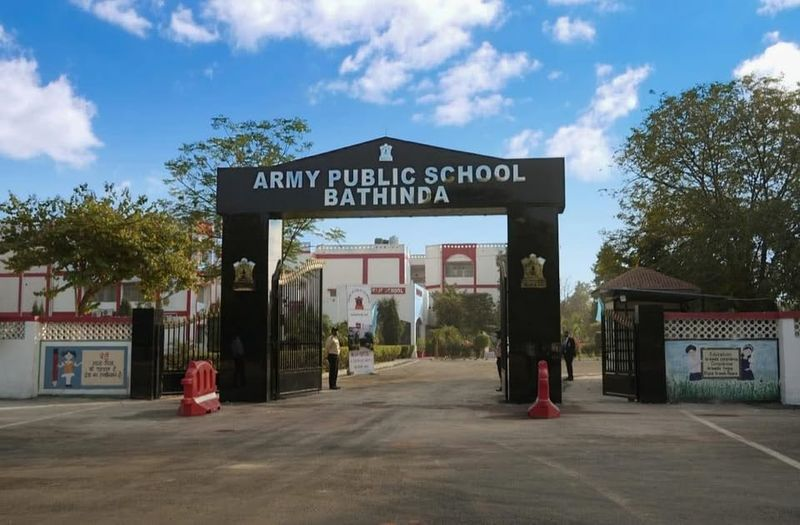
Parents of students studying in Army Public Schools located in Punjab being asked to give their consent if their wards wish to study Punjabi language as an additional subject has ruffled some feathers in the state.
Several Punjab-based political and cultural organisations have termed the move as a conflict with the Punjab Learning of Punjabi and Other Languages (Amendment) Act, 2008, which mandates Punjabi instructions and learning in schools up to Class 10 across the state. They have termed the policy to be against the interests of the state and called for a review of the policy.
“All parents are hereby informed that Sanskrit language is compulsory for the session 2026-27,” Students who wish to tale Punjabi language as additional subject need to bring the consent slip duly filled and signed by parents,” a communiqué sent by one school in Punjab on May 5 states.
According to sources, Sanskrit has already been made compulsory in some Army Public Schools, while the remaining are expected to do so in the coming year. “The pan-India spread of Army Public Schools, coupled with the mid-session transfer of parents, dictates that only standardised language subjects can be taught in our schools in classes VI to VIII,” an officer said. “These languages are English, Hindi and Sanskrit. However, schools may opt to teach a fourth regional language, if sufficient students opt for the same,” he added.
Army Public Schools are run by the Army Welfare Education Society under the aegis of the Ministry of Defence. There are 140 such schools in major military cantonment across the country, where have been established over the years as a welfare measure for Armed Forces personnel to ensure continuity in their children’s education in view of their frequent transfers.
All schools follow National Council of Educational Research and Training (NCER) and are affiliated to the Central Board of School Education (CBSE). In addition AWES also runs 12 professional colleges in medical, technology, hotel management, management, law, dental sciences, education, fashion design and nursing fields.
Punjab Chetna Manch, a political forum, comprising of CPI members, Punjabi writers and political activists, termed the move “arbitrary”. In a joint statement, its representatives Dr Lakhwinder Singh Johal, Satnam Singh Manak, and Gurmeet Singh Palahi argued that the reported structure of language options does not align with the broader spirit of the National Education Policy (NEP) 2020 and the National Curriculum Framework, both of which emphasise multilingual education and flexibility in learning languages, especially mother tongues.
The manch has also written to the Chief Minister, Bhagwant Singh Mann, Education Minister, Harjot Singh Bains, and the Central Board of Secondary Education (CBSE), urging a review and clarification on the policy.
Reacting to the news, Rajya Sabha MP Vikramjit Singh Sawhney, has asked the Defence Minister, Rajnath Singh, to intervene. He urged him to ensure that Punjabi continues to be a compulsory subject in Army Schools in Punjab.
Ramesh Yadav, a scholar and political activist and president of Folklore Research Akademi, said that giving priority to other languages while ignoring Punjabi language in Punjab is a matter of great concern. “It will be unfair to those children whose mother tongue is Punjabi. This decision should be reconsidered keeping in mind the interests of the students and Punjabi should be made a compulsory subject for schools in Punjab,” he said.
The Communist Party of India (Marxist-Leninist) New Democracy members too have strongly opposed the attempts to marginalise Punjabi language in Army Public Schools in Punjab.