
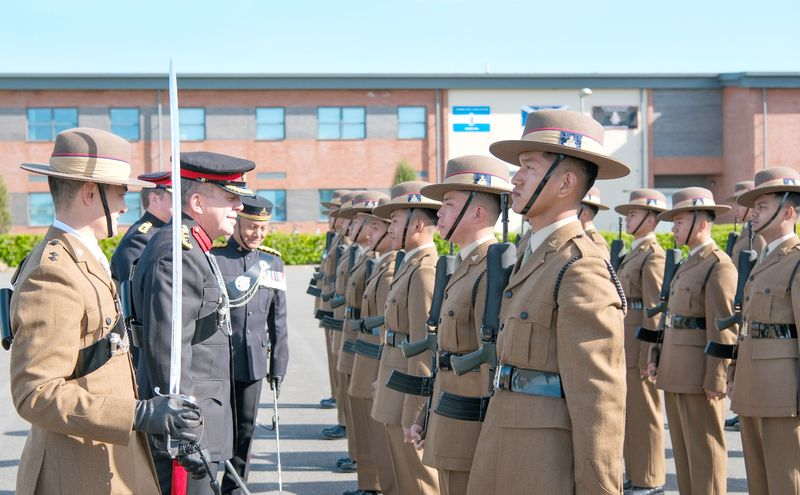
As the impasse over the recruitment of Gorkha soldiers from Nepal into the Indian Army continues, their brethren have opened a new chapter in the United Kingdom, with the British Army raising an Artillery regiment exclusively comprising these hardy mountain warriors.
Christened the King’s Gurkha Artillery (KGA) by King Charles III, the current British monarch, the unit’s ‘Kasam Khane Parade’ for its first batch of 20 directly selected recruits from Nepal was held at Larkhill Camp in south-west England on April 20.
Once fully trained, the Gurkha Gunners will play an integral role in exercises and operations both in the United Kingdom and abroad. Gorkha is spelt as Gurkha in the British Army.
The formation of the 400-strong KGA was announced in 2025 and will be completed over the next four years, with the first transfers of existing Gurkhas taking place this spring, according to the website of The Gurkha Brigade Association. The new unit has initially formed up in Larkhill, at the home of the Royal Artillery. The KGA will grow to form further batteries over the next three-four years.
Terming the new regiment to be a fitting blend of two historic, proud organisations that will offer the British Army ever-greater fighting power and combat effectiveness, the website states that the KGA will deliver close artillery support as part of the Royal Artillery and offer fresh opportunities to the soldiers of the Brigade of Gurkhas, adding even greater depth and diversity to the Royal Artillery.
At present, the British Brigade of Gurkhas comprises 4,000 troops forming the Royal Gurkha Rifles, which is traditional infantry with three battalions, Queen’s Gurkha Engineers, Queen’s Gurkha Signals, Band of the Brigade of Gurkhas, Queen’s Own Gurkha Logistic Regiment and Gurkha Staff and Personnel Support. These troops are recruited from Nepal and all officers assigned to Gurkha units, like their counterparts in the Indian Army’s Gorkha Rifles, are required to learn Nepali language.
The Gorkha Rifles legacy
During the Anglo-Nepalese war of 1814-1816, Gurkhas were first recruited into the British East India Company and for the past over two centuries, have served with distinction in campaigns and operations around the world. Over 2,00,000 Gurkhas served with the British Indian Army in the two World Wars.
The Indian Army’s First Battalion of the First Gorkha Rifles (1/1GR), earlier known as the 1st King George V’s Own Gurkha Rifles, is the oldest Gorkha battalion, raised in April 1815 as part of the East India Company’s Bengal Army.
After India’s Independence in 1947, four of the 10 Gurkha regiments — 2nd King Edward VIIʼs Own Gurkha Rifles, 6th Queen Elizabethʼs Own Gurkha Rifles, 7th Duke of Edinburghʼs Own Gurkha Rifles and 10th Princess Maryʼs Own Gurkha Rifles — were transfered to the British Army. In 1994, the four regiments were amalgamated to form a single regiment, the Royal Gurkha Rifles.
The remaining six regiments allotted to the Indian Army were reorganised as the 1 Gorkha Rifles (GR), 3GR, 4GR, 5GR, 8GR and 9GR. A seventh regiment, 11 GR was subsequently raised in 1948 to incorporate troops from the four British units who opted to remain in India. Each regiment, which is highly decorated, has 5-6 battalions consisting of mostly Nepal-domiciled troops.
India’s recruitment at standstill
A Tripartite Agreement had been signed between India, Nepal and the United Kingdom in 1947, which laid down the terms and guidelines for Gorkhas to serve in the Indian and British Armed Forces. The points contained in the agreement included that Gorkha soldiers would be recruited as Nepali citizens and broadly enjoy the same conditions of service and emoluments as other soldiers in the Indian and British armies.
However, there has been no recruitment of Gorkha troops from Nepal since 2020. After an overall hiatus on intake in the aftermath of the Covid-19 pandemic came the Agnipath scheme that entailed short-term recruitment into the rank and file of the Armed Forces for a period of four years instead to the earlier term of 15 years or more.
Nepal did not agree to the terms of the Agnipath scheme for its citizens, saying that it violated the terms of the tripartite agreement. Nepal has also voiced concern over the re-employability of Gorkha soldiers after their term of four years is over.
The pause in recruitment has strategic implications for India as well as socio-economic concerns for Nepal. The matter has been a point of high-level discussions between the two countries since then.
Prior to this, around 32,000 Gorkha troops served in the Indian Army at any given time. The annual intake from Nepal, according to sources, varied between 1,500 to 1,800 recruits and roughly the same number retired every year.
At the time of Independence, 90 per cent of the troops in Gorkha battalions were Nepal-domiciled with the remaining being Indian-domiciled. This ratio at present is now 60:40, with the intake of India-domicile Gorkhas increasing.
In fact, even before the recruitment crisis had cropped up in 2020, the Army had begun raising units comprising exclusively of India-domiciled Gorkhas, starting with the Sixth Battalion of the First Gorkha Rifles in 2016 at Subathu in Himachal Pradesh. It was after 50 years that a new GR battalion was raised.