

Preamble: The Battle for Dignity
Comrades, quality, cashless treatment is a right earned through service; it is not a request. Empanelled hospitals are partners in delivering this right, not gatekeepers trying to block it. This guide ensures that no veteran or their family is ever intimidated by hospital administration.
For many veteran families, the hardest battle isn’t fought on the border; it’s fought at the registration desk of an empanelled hospital. The gut-punch of being told, “We aren’t taking ECHS today,” or “No beds available for ECHS,” while in pain or distress, is unacceptable.
Thanks for reading Ravjeet’s Substack! Subscribe for free to receive new posts and support my work.Subscribe
This installment of Fire Plan ‘Jeevan Raksha’ is not just an advisory; it is a field manual. It is designed to ensure that every ECHS beneficiary—from a retired flag officer to a sepoy’s family in a remote village—knows exactly how to breach the wall of hospital refusal and secure their rightful cashless treatment.
An empanelled hospital is not doing the veteran a favor. They are under a legally binding contract (Memorandum of Agreement, or MoA) with the Government of India to provide care.
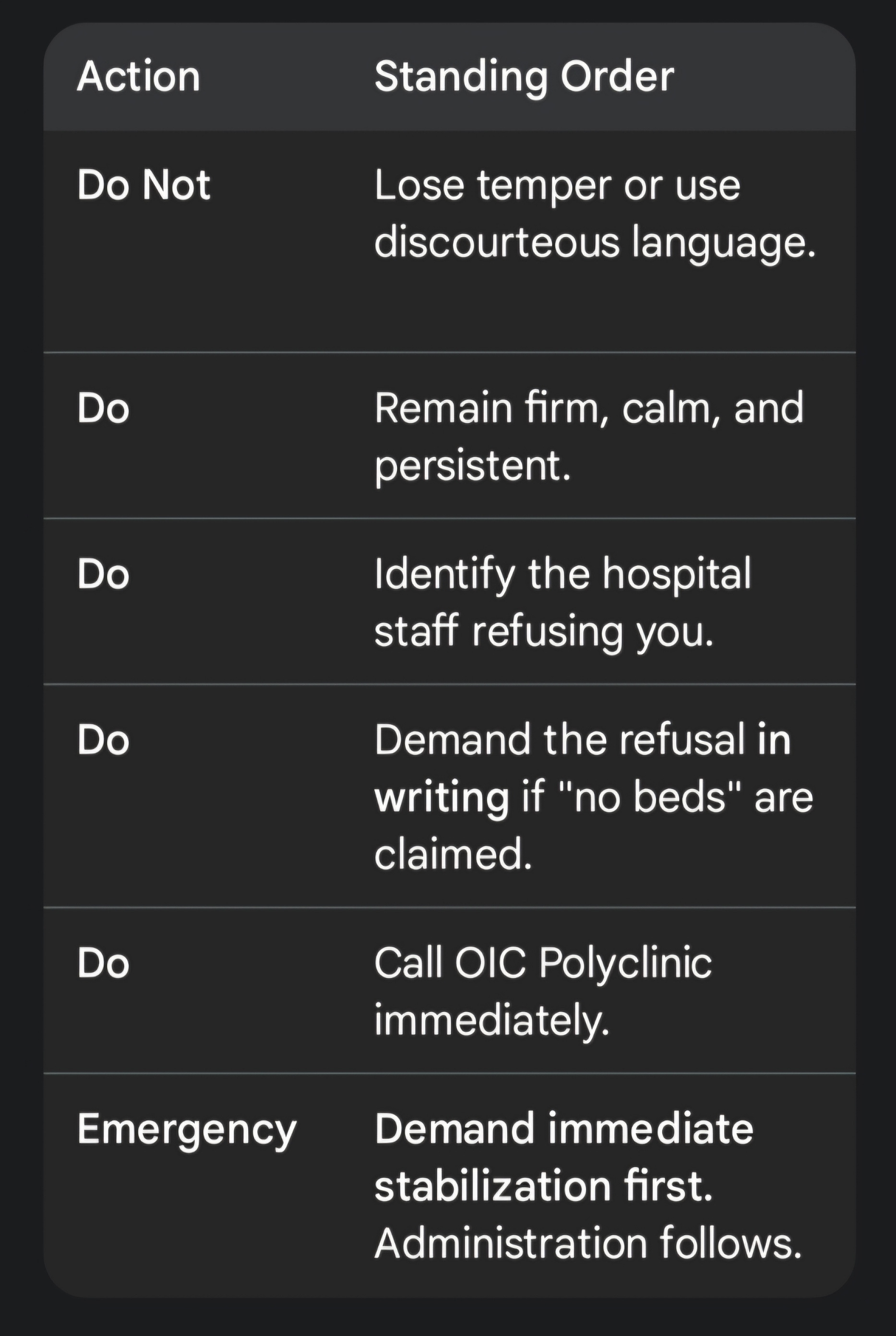
The Standing Order: According to the MoA, an empanelled hospital cannot deny cashless treatment to an eligible ECHS beneficiary. A refusal is a breach of contract. This guide provides the tactical maneuvering space for every beneficiary to defend their dignity and their health.
To help visualize this entire tactical process, below is a summarizing diagram that consolidates the key stages of managing a hospital refusal, from on-site soft engagement to escalating up the chain of command.
Phase 1: On-Site ‘Soft Power’ Engagement
The veteran’s first tactic must be calm, firm, and informed engagement. Do not lose tempo; gain ground through accountability.
1. Verification of Force:
The veteran must always carry their valid ECHS smart card, the referral letter from the Polyclinic (if applicable), and Aadhaar card. Proper documentation is the first line of defense.
2. Demand the Breach Report:
If the desk staff refuses admission, the veteran must steadily ask “Why?” They must not accept a vague answer.
3. Identify the Enemy of Protocol:
The veteran must note the name and designation of the individual issuing the refusal. They should ask, “Who has given you the authority to deny treatment to an ECHS beneficiary?”
4. Cite the MoA:
Mentioning the contract often changes the hospital’s posture. The veteran should state, “I am aware of the MoA between this hospital and ECHS for cashless treatment. Are you officially stating that this hospital is violating that legal agreement?”
OIC’s Tactic: If the hospital claims “no beds are available,” the veteran must ask them to verify this status. If the refusal persists, the veteran must demand the refusal and the specific reason (e.g., “No ECHS beds”) in writing. Hospitals are often reluctant to document their violations.
Phase 2: Immediate On-Site Escalation
If Phase 1 fails, the veteran must escalate the situation immediately, without leaving the hospital premises. Leaving the site breaks the tactical advantage.
1. Activating the Nodal Officer:
Every empanelled hospital is required to have a dedicated ECHS Nodal Officer or a designated Help Desk. The veteran must demand to speak to them instantly. Their mandate is to resolve conflicts between the hospital and ECHS beneficiaries.
2. Engaging Hospital Management:
If the Nodal Officer is unavailable or unhelpful, the veteran must escalate to the Medical Superintendent (MS) or the hospital’s Chief Operating Officer (COO). The veteran must clearly state: “I am an eligible ECHS beneficiary with a valid referral. This hospital is under contract to provide cashless treatment. Your staff is denying service, which is a direct violation of the MoA.”
Phase 3: Activating the ECHS Chain of Command
If hospital management refuses to self-correct, the veteran must deploy the authority of the ECHS administration.
3A: The OIC Polyclinic Call (Priority 1)
This is the most critical action. The veteran must contact their parent Polyclinic OIC immediately.
- The veteran must save the OIC Polyclinic’s official number in their contacts.
- Upon connection, the veteran must state their Rank, Name, and current location: “Sir/Madam, I am at [Hospital Name] and they are refusing ECHS admission/treatment.” They must provide the name of the staff member who refused them and the reason given.
The OIC’s Mandate: The OIC Polyclinic will immediately engage the hospital’s top management or Nodal Officer. This call carries the full weight of the ECHS organization. In an overwhelming majority of cases, intervention by the OIC resolves the denial within minutes, securing admission for the veteran.
3B: The ECHS Toll-Free Helpline (1800-114-115)
If the OIC is unreachable, the veteran must activate the central helpline.
- Call 1800-114-115.
- The veteran must instruct the operator that they need to lodge a formal complaint of “Denial of Service by an Empanelled Hospital.”
- Critical: The veteran must obtain the complaint number. This is vital evidence of the incident.
Phase 4: Tactical Scenarios & Special Operations
The Rules of Engagement change based on the medical scenario. The hospital’s liability is absolute in specific cases.
Scenario Alpha: Medical Emergency (No Excuses)
In a medical emergency, the hospital’s obligation is immediate and unconditional.
The Emergency Standing Order: If an ECHS beneficiary arrives at an empanelled hospital in an emergency state, the hospital MUST admit and stabilize them immediately. They are legally and contractually prohibited from demanding a referral, an ECHS card, or any form of payment before providing stabilizing treatment.
A hospital refusing emergency care violates not only the MoA but also Supreme Court rulings regarding the ‘Right to Life.’
Emergency Tactics:
- Immediate Insertion: Get the patient to the Casualty/Emergency Room (ER) immediately.
- Declare ECHS Status: State clearly, “This is an ECHS patient. This is a medical emergency.”
- Admit First, Document Later: Stabilization is paramount. The 48-hour window to inform ECHS applies only after the patient is out of immediate danger. The veteran must not let administrative hurdles delay medical attention.
Scenario Bravo: Strategic Escalate to SEMO and RC
If the situation involves systemic failure or blatant disregard for the chain of command:
- SEMO (Senior Executive Medical Officer): The SEMO (Commanding Officer of the nearest Military Hospital) holds technical authority over medical services. Blatant refusals can be reported to their office for medical-level intervention.
- Director Regional Centre (RC): The Director RC is the administrative commander of all ECHS operations in the region. They possess the authority to penalize, suspend, or ‘de-empanel’ hospitals that repeatedly violate the MoA.
Phase 5: Post-Incident Intelligence (Securing the Paper Trail)
Even if the veteran is successfully admitted after intervention, the initial attempt to refuse service is a grave violation. A formal, written intelligence report must be generated. Without written evidence, ECHS cannot take disciplinary action.
1. Generate the SITREP:
As soon as the patient is stable, the veteran (or their family) must write a clear, factual SITREP (Situation Report) detailing the encounter. This must include:
- Date and precise time of the refusal.
- Names/descriptions of the hospital staff involved.
- The specific reason given for the denial.
- The ECHS card number of the beneficiary.
2. Submit to OIC:
This written complaint must be submitted formally to the OIC Polyclinic. This document is the ammunition the OIC requires to escalate the issue to the Regional Centre.
3. Utilize Grievance Portals:
The veteran should also file a formal grievance on the CPGRAMS portal or via the official ECHS website. Every registered complaint strengthens the case against non-compliant hospitals.
Veteran’s Battle Card: A Summary
Veterans’ Tactical Handbook: 10 Critical ECHS FAQs
Comrades, in the chaos of a hospital refusal, clarity is your strongest weapon. Use this handbook to cut through the confusion and enforce your rights.
Q1: The hospital receptionist says, “ECHS is closed for the day,” or “No ECHS beds available.” Do I just leave?
Answer: NEGATIVE. This is a soft denial. A bed is a bed. An empanelled hospital cannot legally set a ‘quota’ or separate ‘ECHS ward’ unless specifically authorized in their MoA (which is rare). You must calmly ask, “Are you officially stating that this entire hospital has zero beds available, and if so, will you put that in writing?” Proceed immediately to Phase 2 (Nodal Officer).
Q2: Does “cashless” treatment mean I don’t have to pay for anything at all?
Answer: AFFIRMATIVE, in 99% of cases. The MoA dictates that cashless means zero payment for all treatment, procedures, diagnostics, and medicines included in your authorized package or emergency care. You only pay for non-medical items (e.g., telephone calls, deluxe room upgrades, or food not provided by the hospital diet).
Q3: The hospital is demanding a “deposit” for admission, claiming ECHS payment is delayed. Is this legal?
Answer: NEGATIVE. This is a direct violation of the MoA. An empanelled hospital cannot demand any advance payment or deposit from an ECHS beneficiary for authorized treatment. ECHS bill delays are an administrative issue between ECHS and the hospital; they cannot be passed on to the veteran. If they insist, call your OIC Polyclinic immediately.
Q4: What if I have a valid ECHS card and Aadhaar, but no referral, and it’s a non-emergency?
Answer: You must get a referral. For non-emergency (planned) treatment, an official referral from your parent Polyclinic is your tactical ‘Movement Order’. An empanelled hospital cannot admit you without it for planned procedures. If you go without one, they will correctly treat you as a private patient.
Q5: In an emergency, I went to a non-empanelled (private) hospital. Will ECHS cover it?
Answer: YES, but it’s a different protocol. The rule of ‘Life over Protocol’ applies. You must get the patient stabilized first. ECHS will cover emergency treatment at non-empanelled hospitals, but you must:
- Formally inform your OIC Polyclinic within 48 hours of admission.
- File an Emergency Reimbursement Claim (not cashless).
Q6: I am from Bhopal but am visiting family in Delhi. Can I use ECHS there if I get sick?
Answer: AFFIRMATIVE. ECHS is a pan-India system. Your 64Kb smart card grants you access to any ECHS Polyclinic and any empanelled hospital across India, regardless of your parent Polyclinic.
Q7: Can a hospital force me to buy medicines from outside, claiming their pharmacy is out of ECHS stock?
Answer: NEGATIVE. This is another MoA violation. The empanelled hospital is responsible for providing all required medicines cashless for the duration of your indoor treatment. They must procure the medicine themselves if their in-house pharmacy is stocked out.
Q8: Does ECHS cover the full cost of cancer (oncology) drugs if I have to buy them privately?
Answer: AFFIRMATIVE, 100% Actual Cost. As per the 2026 tactical updates, cancer care is protected. If you must purchase authorized anti-cancer drugs from an external vendor (due to ALC failure, etc.), you are entitled to 100% reimbursement of the actual cost, provided you have a handwritten/digital NA slip and a GST invoice.
Q9: My ECHS card has expired or I lost it. Am I denied treatment?
Answer: Temporary No. If you are in the process of renewing an expired card or replacing a lost one, you must obtain a temporary ‘ECHS slip’ or ‘authorization letter’ from your OIC Polyclinic. This letter, combined with proper identification (Aadhaar/Service Certificate), is accepted as valid for treatment by empanelled hospitals for a limited period.
Q10: Who signs the NA (Not Available) slip if the OIC Polyclinic is on leave?
Answer: The Designated Medical Officer (MO). ECHS operations are continuous. When the OIC is on leave, there is always a designated MO acting as the Officiating OIC. The command chain—and your supply line—does not stop for administrative absences.
Final Word
Every ECHS beneficiary must know that the entire ECHS chain of command stands ready to support them, but the veteran must be the first responder in defending their dignity and their health.
Jai Hind.