
New Delhi must adopt a ‘risk avoidance’ doctrine propelled by thorium, which is not merely an alternative fuel
Manish Tewari
THE convulsions in global energy markets, precipitated by the US-Israeli strikes on Iran and the subsequent choking of the Strait of Hormuz, have again laid bare the profound vulnerability of India’s energy infrastructure. The LPG shortage and over $100-a-barrel oil are not black swan events but the inevitable, cyclical consequence of a persistent failure of strategic vision.
India’s energy policy is a masterclass in ‘loss control’: a reactive exercise in the face of externally induced shocks. We scramble for alternative suppliers, dip into strategic reserves and engage in frantic diplomatic cajoling with a motley crew of nations. It is a doctrine of ‘risk retention’ that perpetually keeps our diplomacy off-balance, our exchequer bleeding and our national security hostage to the whims of global turmoil.
In view of 88% import dependence for crude oil and over 45% for natural gas, even a $10 increase in the per-barrel price adds $15-20 billion to our import bill, a bill that already haemorrhages $150-200 billion annually. The question before us is no longer one of diversification within a fossil-fuel paradigm. The question is, do we continue to manage a crisis or do we architect a sustainable exit from it? The answer, grounded in the immutable laws of physics and geology, lies in our own soil. India must adopt a ‘risk avoidance’ doctrine fuelled by thorium.
Paradoxically, there exists an ironic policy tragedy — the SHANTI (Sustainable Harnessing and Advancement of Nuclear Energy for Transforming India) Act. Albeit it purports to boost nuclear capacity, in reality it’s a Trojan horse that privatises profit and socialises liability while fundamentally undermining India’s three-stage nuclear programme. This programme is a closed fuel cycle designed explicitly to bypass the global uranium cartel.
The first stage, using uranium in Pressurised Heavy Water Reactors, was meant to be the ignition key. The second stage centred on the Fast Breeder Reactor (FBR) as the engine. Expected to be commissioned this year, the 500-MWe (megawatt-electric) Prototype Fast Breeder Reactor (PFBR) at Kalpakkam is a crucial milestone as it is designed to ‘breed’ more fuel (plutonium-239) than it consumes, and crucially, to convert our vast thorium reserves into uranium-233. This is the gateway. The third stage is the thorium-based reactor, and the most promising, efficient and inherently safe design for this is the Molten Salt Reactor (MSR).
By incentivising and fast-tracking uranium-based Light Water Reactor technology, the SHANTI Act locks India into a perpetual cycle of fuel dependence. We will be importing not just the reactors, but the very fuel to run them, trading our reliance on Middle East oil for that on foreign uranium, likely from the uranium cartel of nations. It sidelines the MSRs just as the foundational technologies are maturing.
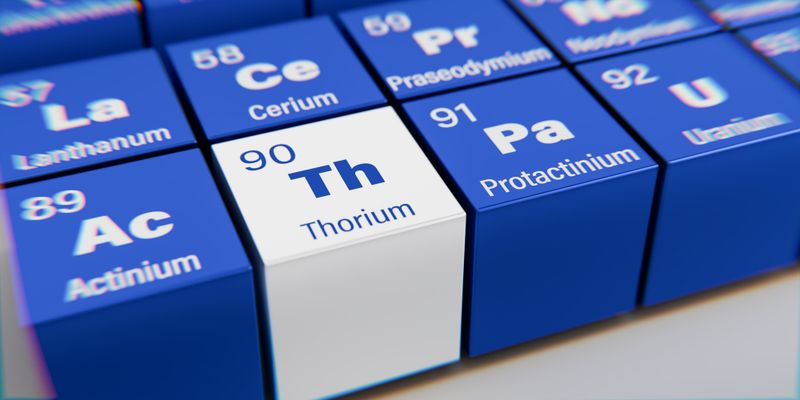
Thorium is not merely an alternative fuel; it is India’s oil. We sit atop the world’s largest proven reserves, around 1.07 million tonnes, comprising a quarter of the global total. Thorium-232 is itself not fissile. It is a ‘fertile’ material. In the crucible of a reactor, it absorbs a neutron to become thorium-233, which decays into protactinium-233 and finally to uranium-233, which is an artificial fissile material suitable for nuclear fuel.
One thousand megawatts of power from a uranium-fuelled reactor requires around 200 tonnes of natural uranium per year. A thorium-fuelled reactor, in a closed cycle, could theoretically produce the same power with less than one tonne of thorium annually. Multiply that by hundreds from our reserves, and the implications for perpetual, self-reliant energy generation are staggering. It is a national energy grid that, once the initial fissile inventory (from plutonium-239 bred in our FBRs) is established, can run on indigenous fuel, recycled and bred in situ, for millennia.
The PFBR is the vital, non-negotiable bridge to the thorium future. The technology for harnessing this white-silver metal is not a distant dream. It is here, evolving and being aggressively pursued by our strategic competitors. The most promising pathway is the MSR. Unlike conventional solid-fuel reactors, an MSR dissolves the thorium (and the bred uranium-233) in a molten fluoride or chloride salt, which serves both as the fuel and the coolant. The advantages are profound and manifold.
First, the breeding cycle occurs within the sealed reactor core, and the uranium-233 produced is contaminated with uranium-232, whose highly energetic gamma decay products make the fuel extraordinarily difficult and dangerous to handle for military purposes. It is, by its very physical nature, a more peaceful fuel.
Second, MSRs operate at atmospheric pressure, eliminating the risk of a catastrophic pressure vessel failure. The fuel is already molten; a runaway reaction causes the salt to expand, reducing reactivity passively, or a freeze plug can melt, draining the fuel into passively cooled dump tanks. The China Syndrome — the worst-case scenario of a nuclear meltdown — is near-impossible.
Third, MSRs can achieve very high burn-up rates, extracting far more energy from the fuel and drastically reducing the long-term radiotoxic waste. The waste stream is smaller and more manageable.
Recognising the strategic potency of this technology, China has made thorium MSRs a national priority. Through its Thorium Molten Salt Reactor project, it is aggressively pursuing a solid-fuel and liquid-fuel demonstration reactor, aiming for commercialisation within a decade.
If China succeeds in perfecting and mass-producing commercial thorium MSRs before India, it will not only achieve its own energy dominance but also corner the global market for this technology, leaving India (the country with the most thorium) as a potential technology purchaser and licensee. The irony would be Shakespearean in its tragedy.
India’s diplomatic and scientific outreach must be leveraged now. To lead, we need not go it alone. The US (with renewed interest in advanced reactors and companies like the Clean Core Thorium Energy exploring thorium-based fuel), Canada (with CANDU reactor expertise), Russia (with experience of fast reactors and closed fuel cycles) and Europe (through its nuclear research consortia) can be vital partners in regulatory innovation and high-assay, low-enriched uranium (HALEU) production for the initial fissile stock.
A successful thorium programme will permanently de-risk the Indian economy from the vagaries of the petro dollar and the weaponisation of energy. India needs a national mission on thorium, on par with the Green Revolution in its ambition and execution. This mission must aim to demonstrate a fully operational, grid-connected thorium-fuelled MSR within the next 10-12 years and to begin commercial deployment by 2040.
This requires establishing a dedicated thorium technology innovation hub, bringing together the Bhabha Atomic Research Centre (BARC), Indira Gandhi Centre for Atomic Research (IGCAR), IITs and the private sector in a synergistic partnership.
A thorium-powered grid, operating at high-capacity factors, provides the perfect, carbon-free baseload partner to other variable renewable energy sources. When the sun doesn’t shine and the wind doesn’t blow, the thorium reactor hums quietly, ensuring grid stability. This is how we truly decarbonise.