
Arab ambassadors in Moscow sought Russian Foreign Minister Sergei Lavrov’s help in bringing peace in West Asia
KP Nayar
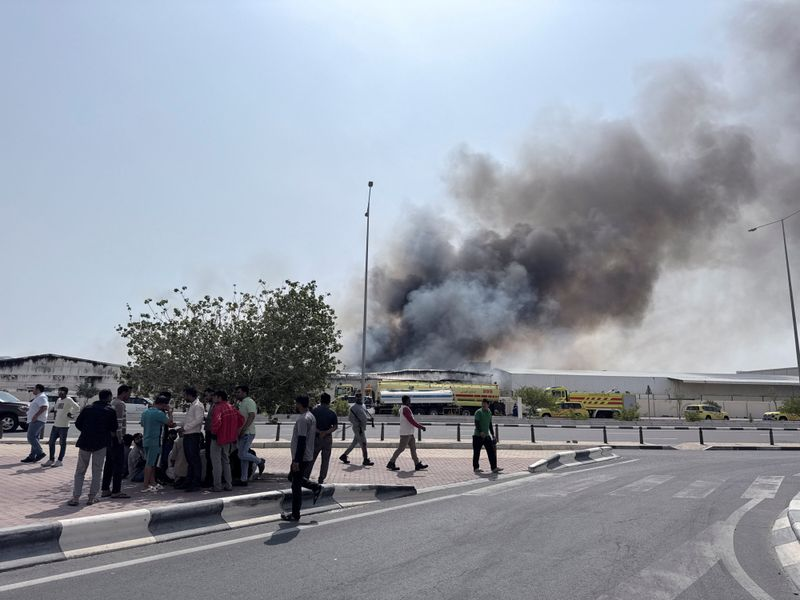
FOR the first time in their post-colonial history, Arab Gulf states are victims of war, not its victors. Quietly, money, including Indian money, is moving to destinations away from economies hit by the war in West Asia. The region’s big sporting event after cricket, the Formula One Grand Prix races in several countries, scheduled for next month are likely to be cancelled. Had Pakistan’s participation in the just-concluded T-20 cricket matches been in the United Arab Emirates as once planned, instead of Sri Lanka, they would perforce have been in jeopardy if Pakistan had advanced to semi-finals. The Gulf has been where the Middle East, North Africa, South Asia (MENASA) turned to for several past decades when their own regions faced turbulence.
Such disruptions to good life aside, geopolitics and geo-economics post the ongoing conflict — howsoever it ends — will be very different for the six Gulf Cooperation Council (GCC) countries. Anger against the US, the protector of the Gulf since Saddam Hussein’s 1990 invasion of Kuwait, is not just simmering. It is boiling over at times. And the censorship-prone governments in the region are not trying to stem the overflow of such feelings.
Ahmed Al-Tuwaijri is a former Dean at King Saud University and a member of the Shura Council (nominated Consultative Assembly) of Saudi Arabia. He wrote recently in the kingdom’s Al Jazirah newspaper (not the Al Jazeera TV conglomerate) of Trojan horses within the Arab world. In an interview to Deutsche Welle television, Saudi writer and political researcher Munif Ammash Alharbi spoke of militias being propped up in Sudan, Libya, Somalia and Yemen to undermine Arab nation-states.
Dubai billionaire Khalaf Ahmad Al Habtoor’s outburst against US President Donald Trump for dragging the Gulf states into war has been widely reported in the Indian mainstream media last weekend. “Who gave you the right to turn our region into a battlefield?” Al Habtoor asked Trump in an open letter. He is no stranger to Trump. The billionaire has met Trump at his Mar-a-Lago resort.
These are not standalone free-thinkers in a region which has suppressed free thinking.
When the royalty in the region also speaks out against Trump, it is clear that the ruling elite has empathy for the Arab street on this issue. Influential Saudi Prince Turki Al Faisal told CNN on Wednesday: “This is Netanyahu’s war. He somehow convinced the (US) President to support his views.”
The grandson of Saudi Arabia’s founder, King Abdulaziz Al Saud, Prince Turki was the kingdom’s chief of intelligence and Ambassador to the United Kingdom and the US. Prince Turki has been consistently outspoken in his opposition to the Abraham Accords, which Saudi Arabia has not joined.
A major topic of conversation at iftar parties of elites in Gulf capitals last week was grievance among regional leaders, conveyed to the US in private, that the Pentagon’s forces had not adequately protected their expensive skylines against Iran’s relentless missile and drone onslaughts.
When US Defence Secretary Pete Hegseth addressed a press conference at the Pentagon to mark “the first 100 hours of Operation Epic Fury”, he was on the defensive against such complaints. “We cannot stop everything (that comes from Iran), but we ensured that the maximum possible defence and maximum possible force protection was set up before we went on offence.” He said the US had spared “no expense or capability” to enhance air defence systems to protect allies in the Gulf.
Frustrated Gulf military leaders have now been reduced to seeking help from Ukraine, which has experience in intercepting Iranian drones, which are used by Russia in the war between the two countries, Ukraine’s President Volodymyr Zelenskyy has acknowledged.
Another topic of conversation is the abrupt absence of US civilians at such iftars because they have left the Gulf. US Assistant Secretary of State Dylan Johnson said on March 7 that 28,000 American citizens have “safely returned” to the US from the war-affected countries. He said many others are in transit homewards. His figure did not include those who have relocated elsewhere in West Asia.
The Arab street is aghast that after plunging the region into a war, the US government is evacuating Americans at such speed although many US citizens may be doing work that is critical for Gulf countries gripped by crisis.
This is in contrast to Indian expatriates doing similar work who have refused the option to leave when the host countries need their services.
Blacked out by international news agencies and by virtually the entire Anglo-Saxon media on both sides of the Atlantic, on March 5, Arab ambassadors in Moscow, in one voice, sought Russian Foreign Minister Sergei Lavrov’s help in bringing peace in West Asia. Their dean, Bahrain’s Ambassador Ahmed Abdulrahman Al Saati, said at an Ambassadors’ Roundtable that “Russia has stronger positions on this issue (the West Asia conflict) and can help put an end to the aggression against our countries.”
Lavrov then did some reality check. He asked Al Saati: “Did you condemn what the US and Israel started doing? Did you condemn the death of 170 schoolgirls?” He went on: “We are against the suffering of the Gulf countries…But we also cannot accept (that) Iran’s actions are deemed unacceptable while everything the US and Israel are doing is beyond discussion. Do you see my point?”
One certainty after this war must be borne in mind. This is a turning point for the Gulf just as Iraq’s occupation of Kuwait changed history in that region. At the request of Arab ambassadors, Lavrov outlined Russia’s “Concept of Collective Security in the Gulf.” He said “the core idea is very simple… Come together and discuss existing problems. Each participating country would set out the threats or the risks to its security as it sees them. Then we could begin with an agreement on transparency in military activities; transparency and perhaps limitations on the number of exercises that each country along the Gulf coast conducts. That would include mutual visits by military personnel and joint economic and trade projects.”
Lavrov promised to send details to Gulf ambassadors. Of course, any such Collective Security process can only start after the end of the war and only if Iran survives as a sovereign state. But the proposal offers promise.