
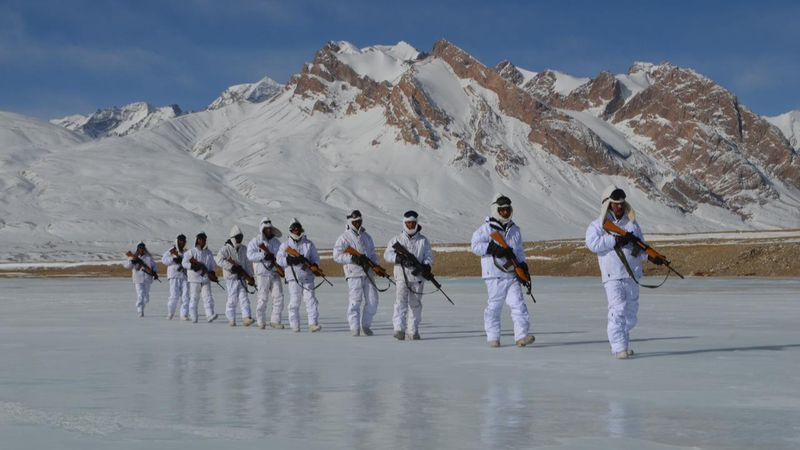
To enhance its operational capability and improve long-range engagement, the Indo-Tibetan Border Police Force (ITBP) has sought 564 new sniper rifles with greater firepower than its current inventory.
The border guarding force, mandated for the management of the Himalayan frontier with China, has projected a requirement of 564 bolt-action sniper rifles. These would be of 8.6 mm caliber with an effective range of over 1,200 meters.
At present, the ITBP primarily uses the legacy Austrian 7.62 mm Styer SSG – 69 for sniping that has been in service for decades. These have a range of about 800 meters.
Though the larger caliber weapon tends to be heavier and more expensive, it offers significantly greater range, kinetic energy, and wind resistance, according to defence experts.
A modern 8.6 mm sniper rifle, along with a telescope and accessories, costs between Rs 8 and 9 lakh apiece. The ITBP, according to sources, has estimated an expenditure of Rs 45-50 crore on the new sniper rifles, depending upon the model, final price negotiation, and other components of the deal, including ammunition, tools, spares, etc.
There are several models of the 8.6 mm or the equivalent .338-inch sniper rifles available in the international as well as domestic market, which can meet the ITBP’s requirements in terms of range and operational environment in high altitude, rugged terrain, and cold weather.
Besides, foreign vendors, two India-based private firms are also marketing 8.7 mm or .338-inch sniper rifles. These are the Saber.338 Lapua Magnum made in Bengaluru and the CSR 338 made in Hyderabad.
The 8.6 mm caliber is already in use with some forces in India, in addition to the traditional 7.62 mm. The Army has inducted the Finnish Sako TRG-42 and the Italian Beretta Scorpio TGT, while the National Security Guard uses the US Barrett Model 98B. Last year, the Central Reserve Police Force procured 200 indigenously manufactured .338-inch sniper rifles from a Hyderabad firm.
Snipers are considered to be force multipliers, and many armies attach a great deal of importance to the role of snipers in the field. They require a very high degree of training, enormous levels of patience, and ultra-fast reactions.
A single well-placed sniper can neutralise a high-value target or pin down a body of enemy troops for a considerable length of time. Much of a sniper’s work involves observation, surveillance, and intelligence gathering.