
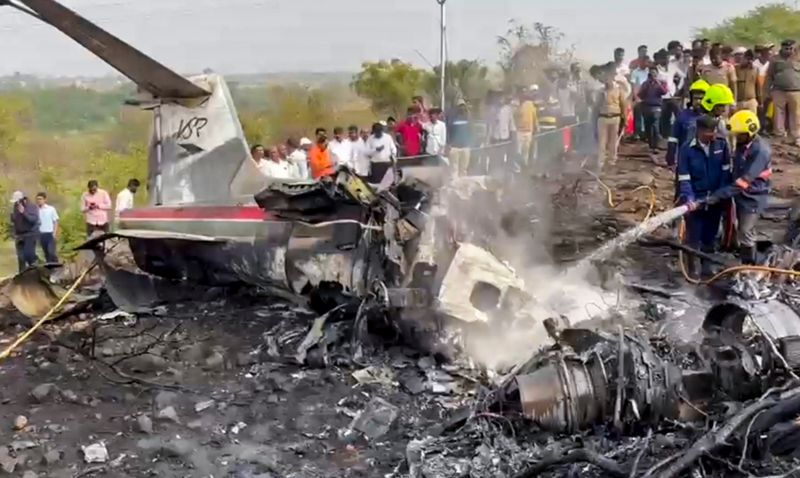
The investigation into the plane crash near Baramati in Maharashtra, which claimed the lives of Deputy Chief Minister Ajit Pawar and four others on Wednesday, is under way, with authorities examining multiple theories behind the accident.
The black box of the ill-fated aircraft has been recovered, and a three-member team from the Aircraft Accident Investigation Bureau (AAIB) has begun probing the sequence of events that led to the crash.
The aircraft involved was a VT-SSK Learjet 45 business jet.
Fresh CCTV footage that emerged on Thursday has drawn significant attention, as it appears to show the aircraft’s left wing dropping suddenly moments before the impact. The footage shows the jet banking sharply to one side mid-air before crashing into the ground, raising questions about a possible loss of control during the final approach.
According to experts cited by Hindustan Times, the video points to three possible theories: an asymmetric aerodynamic stall, an engine failure, or a steep banking manoeuvre following a late visual sighting of the runway.
An aerodynamic stall occurs when an aircraft loses lift due to insufficient airspeed or an excessive angle of attack. In an asymmetric stall, one wing loses lift before the other, resulting in a sudden roll. The Learjet 45 has its engines mounted on the tail, a configuration that has been linked to similar accidents in the past. The US National Transportation Safety Board (NTSB) has recorded multiple fatal incidents involving tail-engine business jets, including crashes of a Phenom 100 in 2014, a Learjet 35A in 2017, and a Challenger 605 in 2021, all attributed to stalls during low-altitude manoeuvring.
The Baramati crash occurred during the aircraft’s second landing attempt, after a go-around on the first approach. Investigators are assessing whether the pilots allowed the aircraft’s speed to drop too low while visually aligning with the runway. CS Randhawa, president of the Federation of Indian Pilots, said that the footage suggests a stall.
“Due to low speed, it appears to me that the aircraft crossed the critical angle of attack, thus the drag increased and the lift reduced, causing a wingtip stall,” he said, adding that data from the flight recorder and cockpit voice recorder would confirm whether stall warning systems were activated.
A second theory under consideration is engine failure. According to the US Federal Aviation Administration, loss of power in one engine can create yaw and roll due to asymmetric thrust. However, experts said that this scenario appears less likely, as there was no mayday call in the approximately 60 seconds between landing clearance and the crash.
A third possibility relates to the lack of navigation aids at Baramati airport, which requires pilots to rely entirely on visual approaches.
Aviation safety expert Amit Singh said that sun glare or poor visibility may have delayed the crew’s sighting of the runway, leading to a late and aggressive banking manoeuvre. “It appears the aircraft was not aligned with the runway and the crew realised it too late,” he said.
Authorities have stressed that conclusions will only be drawn after a detailed analysis of the flight data and cockpit recordings. With inputs from PTI