
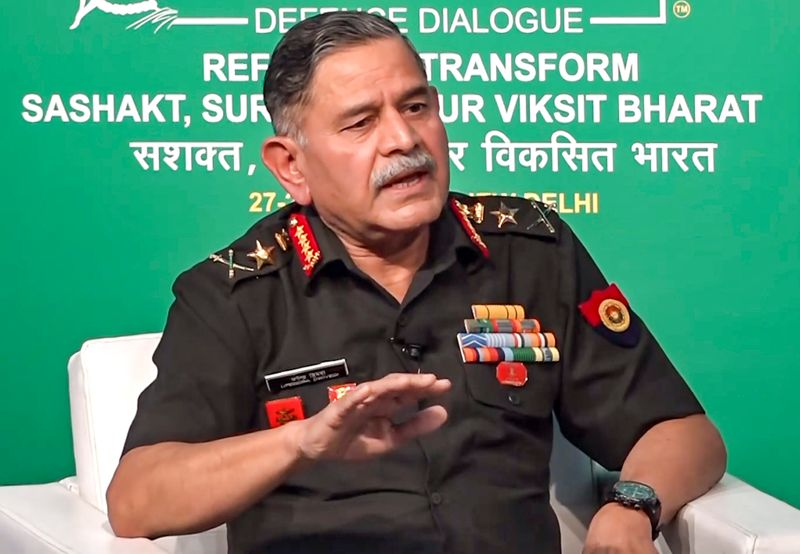
Army Chief General Upendra Dwivedi on Thursday announced that the years 2026 and 2027 will be used to strengthen ‘networking’ of the forces and make them more ‘data-driven’ for battles of the future.
General Dwivedi made the announcement at the Army Day Parade in Jaipur on Thursday, adding that this focus would further improve connectivity, information flow and coordination across the force, enabling timely and well-informed decisions.
The Army Chief also posted a message for the 1.2 million-strong force, stating that 2026 and 2027 have been declared as “years of networking and data-centricity to transform the Army into a data-driven, network-enabled and fully integrated Army with all other stakeholders, so as to win wars in a multi-domain environment.
The phrase ‘networking and data-centricity’ in Armed Forces refers to building a digitally connected military where data flows seamlessly across units, enabling faster decisions, resilient communication, and integrated operations.
Network centricity will alter results in future wars. The side that decides faster, will have the upper hand.
Data-centricity ensures informed decisions, as speed in decision-making requires data, images and satellite imagery to reach faster to commanders on the ground as well as at senior levels.
The two-year focus is part of the ‘decade of transformation’ announced by the Army in 2023. It looks at aligning the force with the changing character of war, cumulative presence of five generations of warfare, two-and-half-front security challenges and the predominant grey-zone warfare. The decade of transformation is progressed under five pillars.
At the parade in Jaipur, the Army Chief also mentioned the previous year –2025—and Operation Sindoor. He said “the bygone year called for sustained vigilance and decisive operational responses across the security spectrum in safeguarding our national sovereignty and interests as showcased during Operation Sindoor”.
This is the second major change announced by the Army Chief in the past two days. Earlier on January 13, General Dwivedi revealed that the government has approved a long-pending proposal for setting up Integrated Battle Groups (IBGs). The first such unit is planned to come up under the China-focused 17 Mountain Strike Corps.
This move is part of the reorganisation of the Army’s battle architecture following the 2020 border crisis with China and Operation Sindoor with Pakistan.
As per the plan, the two division-size formation of the Mountain Strike Corps will be converted into four IBGs to be headed by a Major General-rank officer, the Army Chief said.
The IBGs are envisioned as agile, brigade-sized combat formations having integrated elements of all arms depending on the operational terrain it is set up for.
In case of conflict, the IBGs will be capable of launching swift operations against the enemy. As per the earlier plan, each IBG will have a strength of around 5,000-plus personnel which would be larger than a brigade (3,000-3,500 troops) but smaller than a division (10,000-12,000 troops).
These IBGs will have elements from the infantry, artillery, armoured units, engineers, signals, air defence, and other arms and services, and can launch an operation within 48 hours when tasked.
Separately, the Army has restructured itself and set up Rudra Brigades for high-tempo multi-domain operations. Bhairav Battalions have also been raised, which are light commando battalions.
The Army is also in the process of raising Shaktibaan Regiments and Divyastra Batteries of artillery. The ‘Shaktibaan’ regiment will use loitering ammunition and swarm drones and will be pre-positioned at specific locations along the western frontier with Pakistan and the northern front with China.
The Divyaastra batteries will carry long-range artillery guns, surveillance drones and anti-drone systems backed by AI-based fusion centres collating real-time data.