
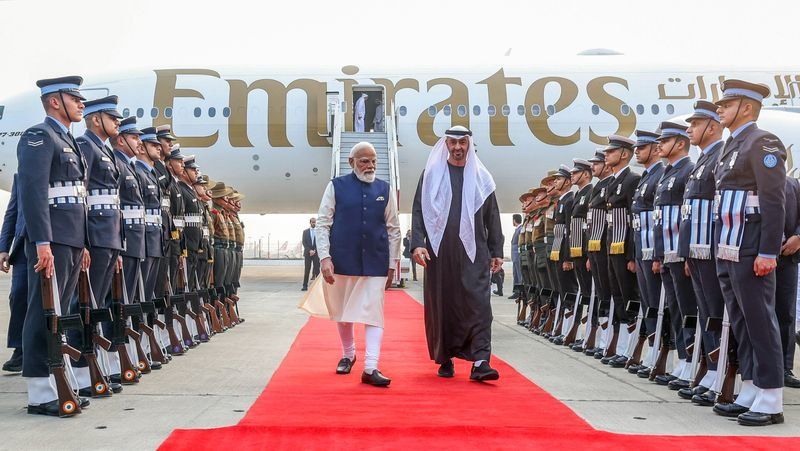
UNITED Arab Emirates President Sheikh Mohamed bin Zayed Al Nahyan, widely known as MbZ, made a flying visit to New Delhi on Monday. The absence of any prior indication about the visit implies that it concerned the rapidly changing geopolitical scenario in the Gulf and West Asia.
The UAE, a coalition of Trucial States formed after the British exit the region in 1971, traditionally followed a status quo-based non-confrontational foreign policy. In 2002, an Indian delegation visited the UAE, when I was the Ambassador, after the terror attack on the Indian Parliament. Then President Sheikh Zayed bin Sultan Al Nahyan, MbZ’s father, received the visitors.
When asked about the foreign military presence in the region, the late leader recounted an old Arab tale. A farmer was frequently losing his sheep to wolves. Someone advised him to keep dogs. He did so, only to discover that he had to kill sheep often to feed the dogs. Sheikh Zayed’s message was that foreign intervention did not benefit the region.
Now MbZ is an English-speaking former air force pilot and the Supreme Commander of the UAE armed forces. He has controlled foreign policy since his father’s death in 2004, even when his brother was President. According to his diplomatic adviser, Anwar Gargash, the UAE’s priorities are to counter extremism and promote regional security. This underscores its opposition to the Muslim Brotherhood, which is seen as an existential threat. The UAE and Saudi Arabia had resented the ouster of former Egyptian President Hosni Mubarak by the Arab Spring protestors in 2011, to which then US President Barack Obama had seemingly turned a blind eye. Both countries supported the Egyptian military to subsequently overthrow the Muslim Brotherhood government.
The Gulf and West Asia have been unstable since US President Trump’s first term. The confrontation between Qatar and its two powerful neighbours, the UAE and Saudi Arabia, began soon after Trump’s visit to Riyadh. Qatar was blockaded (2017-21) for supporting Islamist forces. Trump also abandoned the nuclear deal with Iran, approved by the Permanent-Five plus Germany.
The UAE and Saudi Arabia are the two largest economies in West Asia. MbZ helped Saudi Crown Prince Mohammed bin Salman, widely known as MbS, to consolidate power. When Saudi operatives murdered Saudi journalist Jamal Khashoggi in Turkey in 2018 on MbS’ alleged instructions, it was MbZ who handled the Americans. However, as the Saudis, the custodians of the Two Holy Mosques, consider themselves the apex of the Arab and Muslim world, Saudi-Emirati differences gradually developed and their geopolitical visions came into conflict. In diplomacy, friendship is transitory while interests are permanent.
The UAE broke the regional consensus by signing the Trump-devised Abraham Accords in 2020 and normalising relations with Israel, while the Palestinian issue remained unresolved. It began backing secessionist forces in Yemen, Somalia and Sudan, ostensibly to counter Islamist forces. These three nations lie along the Red Sea, facing Saudi Arabia and the Bab al-Mandab. The UAE’s interests converged with those of Israel and the US.
President Trump’s second term has exacerbated the regional churn, especially since the June 2025 Israel-US air attacks on Iranian nuclear facilities. On September 9, Israel attacked Hamas leaders’ facilities in Qatar. MbZ rushed to meet the Saudi Crown Prince after a noticeable gap marked by the absence of communication.
On September 15, the GCC met to review the situation. Two days later, Saudi Arabia and Pakistan signed the Strategic Mutual Defence Agreement, with a clause mirroring NATO’s Article 5, about an attack on one nation being considered as an attack on both.
Soon enough, Yemen became a flashpoint. Early on till 2019, the UAE had joined Saudi Arabia in military operations in Yemen, but later preferred to support Yemeni rebel factions; the Saudis continued to back government forces. Reportedly, Israeli intelligence was positioned on UAE-controlled Yemeni island Socotra. While in Africa, Israel recognised Somaliland, a breakaway part of Somalia — the Emiratis are developing a port there.
The Saudis retaliated strongly, telling the UAE to withdraw its forces from Yemen and bombing the military equipment sent by UAE. Egypt, the other big Arab power, began to speak in favour of the Saudis — both clearly wanted to restrict Israeli strategic expansion in the Red Sea region.
Essentially, the Saudi and Emirati visions are at odds. The Saudis favour state-to-state engagement to stabilise domestic or regional conflicts. The UAE likes to cultivate dissident and breakaway factions, like in Yemen, if it promotes stability and controls supply routes, minerals and energy.
So as the Saudis attempted to limit Emirati geopolitical play in the Arab world, MbZ made his first visit to Pakistan as President last month. The UAE Sheikhs and Pakistan have been close for decades, but Pakistan had meanwhile signed a defence deal with the Saudis. The Emiratis were seeking to restore a balance in ties with traditional friends against the backdrop of their exposed closeness to Israel and conflict with Saudis.
President Mohamed bin Zayed’s trip to India must be seen in this context. PM Modi’s government has invested heavily in his outreach to ruling families in the Gulf, especially those in Abu Dhabi. The Indian diaspora in the UAE numbers 3.5 million or 35 per cent of the population. As many as one-third are professionals.
The UAE is India’s third-largest trading partner and second-largest export destination. In 2024-25, Indian exports were $36.73 billion, while imports touched $63.64 billion. Despite its small population and the local market, the UAE is the favoured entrepôt for Indian exports to the Gulf, Iran, Central Asia and even Pakistan. The UAE’s cumulative FDI in India is $22.84 billion (2000-25), a mere speck in Abu Dhabi’s nearly $1 trillion sovereign fund. The two signed an economic partnership deal in 2022. Both are members of BRICS and I2U2, a forum that comprises India, Israel, UAE and the US.
Still, the path ahead is not easy. Pathbreaking deals like the 2023 India-Middle East-Europe Economic Corridor (IMEC), which will pass through the UAE, Saudi Arabia, Jordan and Israel, are stymied by the standoff between Iran and Israel-US as well as the Saudis and Emiratis. The competing visions for stability in the Gulf is split between US-Israel-UAE and Saudi Arabia-Egypt-Turkey. Pakistan is playing both sides.
In this fragmented world, here is the opportunity for PM Modi to leverage India’s traditional warmth with all sides and demonstrate that “Vishwaguru” is more than a phrase. India can start bridging some of the divides, beginning with Modi’s substantive relationship with Israeli PM Benjamin Netanyahu. With large-scale protests continuing in Iran and the US moving more ships and aircrafts into India’s extended neighbourhood, the situation remains fragile. President Mohamed bin Zayed’s short visit to India is indicative of the churn in the Gulf and the need for India to be more proactive.