
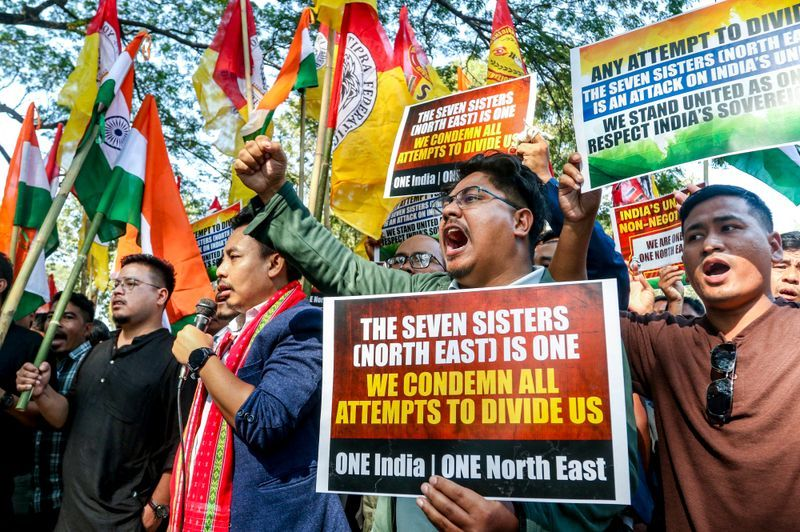
With four Hindu men killed in Bangladesh, the likelihood of internal insurgencies creeping up in our country has risen again, especially in the Northeast. Growing discontent, if not contained, can become a source of major instability in the region, writes former Manipur Governor and J&K ex-DGP Gurbachan Jagat Look to the Northeast. The linking of neighbouring Pakistan, Bangladesh, Myanmar and China is a fact and not a figment of the imagination, he writes. There is an unstable Myanmar; an erstwhile friend but a now hostile Bangladesh, and Pakistan, with the covert help of the Chinese, is with them providing men, material and moral support.
However, despite setbacks in the security arena this year, New Delhi did well on the geopolitical front, says ORF Distinguished Fellow Manoj Joshi in his Edit piece Terror keeps India on its toes. 2026 should be the year in which India must work out a new geopolitical orientation to replace the one lost with the US. Besides emphasising multi-polarity, it also needs to take steps to boost the country’s defence expenditure in keeping with trends around the world. America’s ties with Pakistan and China suggest abundant caution not to rely on the US too much, he writes.
As domain experts continue to rework the definition of the Aravallis, the goddess of Justice, although blindfolded, has demonstrated that it can both ‘see’ and ‘hear’ when it is under vehement, largely justified, attack, writes ex-Secretary, Environment, Forest & Climate Change Ashok Lavasa in his Op-Ed article Aravallis, like old parents, can’t be abandoned. Has the design of vested interests of turning a mountain into a molehill been defeated or have the saviours of the Aravallis succeeded in making a mountain of a molehill? he wonders. Cynics argue how could the court accept a definition without understanding its impact on the ground, both in terms of the extent of actual area covered by the definition and the effect of the permitted activities on the environment.
If the Aravallis are made to conform to the new definition, land degradation will only hasten, writes food and agriculture specialist Devinder Sharma in his Edit Aravallis are vital for food security. There is a dire need to protect the hills that serve as a green wall against desertification. The true economic cost of their ecological and environmental services has not been worked out. Once this cost is known, the nation will realise the economic necessity of keeping the hills intact, he argues.
Talking of Punjab, the Aam Aadmi Party (AAP) had stormed to power in 2022 riding the wave of disillusionment and got a massive mandate from an electorate desperately looking for an alternative. However, power’s intoxicating effect has changed AAP from what it promised to be — a different party, writes senior journalist Nirmal Sandhu in his Op-Ed article Tu Mann na Mann, Punjab is sinking deep in debt, writing exhaustively about what has gone wrong in Punjab’s political hotpot. Punjab has become the second most indebted state in the country after Arunachal Pradesh. Instead of debating this issue, special Vidhan Sabha sessions are called to discuss politically useful matters, he writes. And AAP’s contribution to the fiscal mess is no less significant. AAP had vowed to stop illegal mining and generate revenue, but the problem continues to persist after almost four years in power. Problems kept multiplying. Despite all shortcomings, the Bhagwant Mann-led AAP government has done some good work, but there is more over-projection than concrete results on the ground, he thinks.
From AAP to the BJP, though the BJP government has had two terms of majority rule and it has re-consolidated political power by winning many Assembly elections, it has not moved significantly towards building consensus on crucial issues, writes senior journalist R Jagannathan in his Op-Ed article Why BJP needs dialogue, not deadlock. It does not mean everything has to be done by consensus — the Budget and some economic policies, for example, can be exceptions — but in most other cases, the government should seek as wide a consensus as possible so that there is less internal heartburn. The BJP has to look beyond mere electoral gains, it has to begin discussions with major opposition parties on everything — from electoral and economic reforms to delimitation of constituencies and sharing of resources between the Centre, states and local bodies.
The Higher Education Regulatory Bill, being projected by the government as a decisive break from the failures of the UGC, is being offered as a solution to many ills plaguing education in India. By separating funding, accreditation, regulation and academic oversight into distinct functions, the government claims to eliminate overlap, reduce arbitrariness and introduce transparency, writes ex-PU professor Shelley Walia in his article Illusion of reform in universities. But the Bill is detached from the complex social, caste-based and linguistic realities that shape academia. This contradiction is stark when read alongside the NEP’s commitment to creativity, critical thinking and multidisciplinary exploration, he writes.
Talking about the freedom of speech, The Tribune Editor-in-Chief Jyoti Malhotra writes in her weekly column The Great Game Free speech and media control that Article 19, a fundamental right in the Constitution that guarantees freedom of speech and expression, gives with one hand but takes away with the other. So, for example, while Article 19(1)(a) grants citizens the right to freely express their thoughts, opinions and ideas, “reasonable restrictions can be imposed on this right” in the interest of sovereignty and integrity of India, public order, decency, morality, etc. But the question is, who is to decide what is “public order”?