
Born in an Adivasi tribe, where hunting was a common activity, he was spotted during a hockey by a Subedar Major from the Bihar Regiment
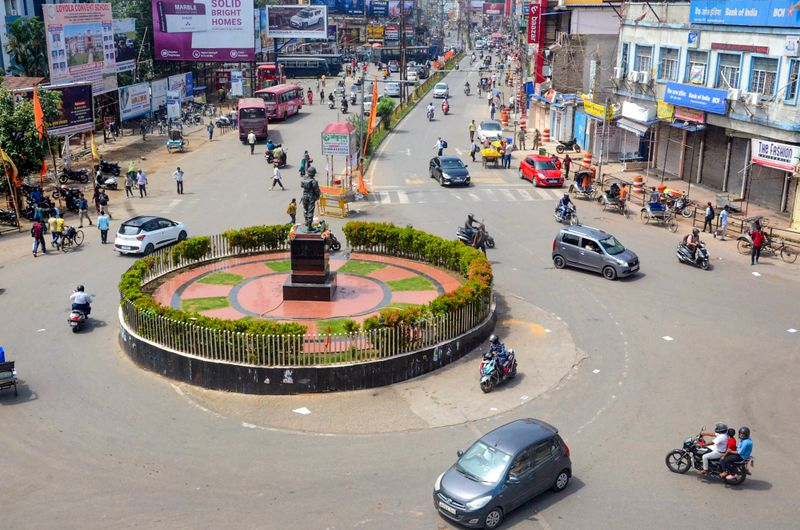
The Albert Ekka Chowk in Ranchi. Photo: Tribune archives
Lance Naik (L/Nk) Albert Ekka was just a few days shy of his 29th birthday when he made the supreme sacrifice on the very first day of the India-Pakistan War of 1971. His actions in the face of the enemy earned him the Param Vir Chakra (PVC), the highest gallantry award in the country.
Despite being wounded in the arm and neck, he charged enemy defence under fire, clearing several bunkers and knocking out two machinegun posts before succumbing to his injuries on the battlefield.
Hailing from Jari village (in the present day Chhattisgarh), Ekka belonged to an Adivasi tribe, where hunting was a common activity. “This helped groom his soldierly instincts from an early age, and he became a marksman with the bow and arrow. He was also quite good in hockey. During a district-level tournament, he was spotted by a Subedar Major from the Bihar Regiment, who helped him join the battalion,” Lt Col Dilbagh Dabas (retd), historian and author of several books on gallantry awards, told The Tribune.
Ekka was enrolled in the Bihar Regiment in December 1962. Later, when 14 Guards was raised, he was transferred to the new battalion in 1968. A little before the war began, he was promoted to the rank of Lance Naik.
As hostilities officially commenced, 14 Guards under 4 Corps was tasked to capture Gangasagar, located in eastern Bangladesh adjoining Tripura. Capturing Gangasagar was crucial for the 4 Corps to advance westwards and the battalion positioned itself south of Gangasagar near the local railway station for further operations and attacked enemy defences along the railway tracks. It was here that L/Nk Ekka, despite being wounded, made his final charge.According to the historical records, L/Nk Ekka was part of a forward company of his battalion during the attack on the enemy defences at Gangasagar on the eastern front. This was a well-fortified position held in strength by the enemy. The assaulting troops were subjected to intense shelling and heavy small-arms fire, but they charged on to the objective and engaged in a bitter hand-to-hand combat.
L/Nk Ekka noticed an enemy light machine-gun inflicting heavy casualties on his company. With complete disregard for his personal safety, he charged the enemy bunker, bayoneted two enemy soldiers and silenced the machine gun. Although he was seriously wounded in this encounter, he continued to fight alongside his comrades, clearing bunker after bunker with undaunted courage.
In the meantime, enemy troops opened a medium machine-gun from the second floor of a well-fortified building, inflicting heavy casualties. Once again, L/Nk Ekka, despite his serious injury and the heavy volume of enemy fire, crawled forward till he reached the building and lobbed a grenade into the bunker killing one enemy soldier and injuring the other.
The machine gun, however, continued to fire. “With outstanding courage and determination L/Nk Ekka scaled a side wall and entered the bunker, bayoneting the enemy soldier who was still firing and silenced the machine-gun, saving further casualties to his company and ensuring the success of the attack. In the process, however, he received serious injuries and succumbed to them after the capture of the objective,” reads the citation for his award.
“L/Nk Ekka had displayed gallantry of the highest order. His determination and grit in the face of grave danger remain unmatched and he made the supreme sacrifice in the finest traditions of the Army,” Brig SS Ahluwalia (retd), a member of the War Decorated India, an association of wartime gallantry award recipients, told The Tribune.
According to army officers, Gumla district of Jharkhand, where L/Nk Ekka’s village is located, has a strong martial tradition. Virtually every household in the district has sent a member to the armed forces or the para-military organisations.
To honour L/Nk Ekka’s legacy, the government issued a commemorative postal stamp on the 50th Republic Day in 2000. A major intersection in Ranchi has been named as Albert Ekka Chowk and bears his statue, while a block in Gumla has also been named after him. There is also a park in Tripura named after him to commemorate his actions in the war.