
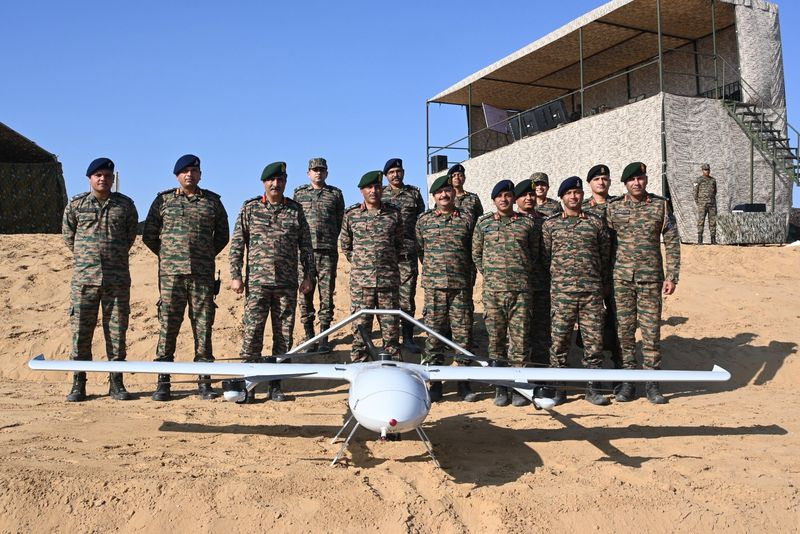
The fixed wing drone, developed jointly developed by Chennai-based startups and Army engineers from the artillery division, has a range of about 100 km
The Army’s Western Command successfully tested a new indigenously developed long-range drone that is resilient to electronic warfare, on Friday. The trails were carried out by the Kharga Corps’s artillery division at Mahajan Field Firing Ranges in Rajasthan.
The fixed wing drone, developed jointly developed by Chennai-based startups and Army engineers from the artillery division, has a range of about 100 km and is designed to resist disruption in the electromagnetic spectrum.
“Witnessed by Lt Gen #ManojKumarKatiyar, PVSM, UYSM, AVSM, #ArmyCommander, the trial marked a key step towards self-reliance in critical drone technologies,” the Army posted on its official X handle.
Electronic Warfare resilient drones are unmanned aerial systems designed to operate effectively in environments where adversaries use jamming, spoofing or other electronic attacks to disrupt radio communication frequencies and GPS navigation links, effectively disabling or blinding the drone of taking over its control.
Such drones employ artificial intelligence based mission control and navigation using on-board computing, visual and inertial navigation systems or pre-programmed routes, enabling them to continue their mission without constant inputs from operators or GPS.
They also feature anti-jamming communications like radio frequency hopping, mesh networking and low-probability-of-intercept signals, along with alternative control methods like fiber-optic tethers that are immune to interception or jamming.
In the contemporary battle space, drones have emerged as a key element for offensive, surveillance, recce, communications and logistics. Operation Sindoor, the brief but intense military engagement between India and Pakistan in May this year, as well as other conflicts such as the Russia-Ukraine war are examples of this.
The Army is also incorporating lessons drawn from Operation Sindoor as well as inputs from global conflicts in its operational doctrines and tactical concepts. Several field exercises involving the employment of drones in different operational environments have been conducted by the Army recently.
The Army, as with the other services, has inducted a range of UAV’s from small tactical hand-held drones to large, long-range systems, and these have been integrated into every arm and service of the Army, including delivery of supplies in high altitude areas.
A lot of focus is being laid on the development and fabrication of drones, both in-house by the Army and in collaboration with industry partners and a great deal of emphasis is being given to drone warfare and strengthening training.