
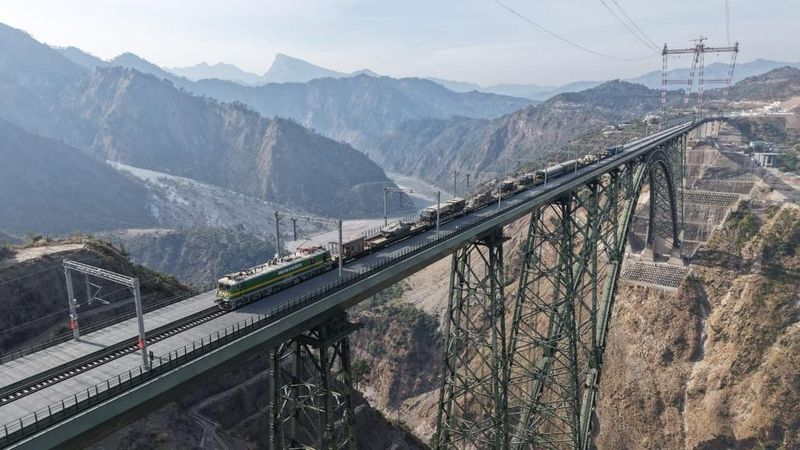
Previously, logistics support relied on road convoys, often disrupted by snow and landslides
The Indian Army achieved a major logistics milestone on December 16 by inducting tanks and artillery guns into the Kashmir Valley via a military special train. This significantly boosts the Army’s operational capability in the northern sector.
As part of the validation exercise, tanks, artillery guns, and dozers were moved from Jammu to Anantnag, showcasing enhanced mobility and logistical capability. The Army stated on X, “This milestone was achieved in close coordination with @RailMinIndia, highlighting the Udhampur-Srinagar-Baramulla Rail Link (USBRL) project’s impact on rapid logistics and operational readiness along the Northern Borders.”
While artillery guns are deployed along the Line of Control (LoC) against Pakistan as well as the Line of Actual Control (LAC) opposite China, tanks at present are primarily positioned along the LAC in some areas of Ladakh. In Kashmir, tanks were first used at Zoji La Pass in 1947-48 against Pakistani raiders, making it the first time that tanks were deployed at such an altitude.
The first freight train ran on September 12-13, carrying 753 metric tonne of Advance Winter Stocking (AWS) load, marking the first winter stocking in the valley by train. This initiative underscores the Army’s efforts to ensure operational preparedness in challenging Himalayan terrain.
Previously, logistics support relied on road convoys, often disrupted by snow and landslides. The rail link will also benefit support to Kargil and Ladakh sectors.
In a unique dual-use logistics demonstration, the return train will transport Kashmiri apples to Indian markets, benefiting local communities and farmers. The Rs 43,780 crore, 272-km USBRL project, inaugurated by Prime Minister Narendra Modi in June, features 36 tunnels (120 km), 8 escape tunnels, and 943 bridges, including the world’s highest railway arch bridge, Chenab bridge.
This project provides all-weather connectivity to Kashmir, enhancing economic relief and livelihood security for farmers, who previously suffered losses due to road blockages.