(Maj Gen Harvijay Singh, SM)
The Eastern Sector of East Pakistan comprised the territory East of the Meghna River, spanning the Districts of Sylhet, Brahmanbaria, Comilla, Chittagong, and the Chittagong Hill Tracts. The approach to Dacca, the capital was via the Meghna, a wide river spanning between 4,000 to 4,500 yards, with the sole crossing point being the railway bridge at Ashuganj, approximately 2,950 feet in length.
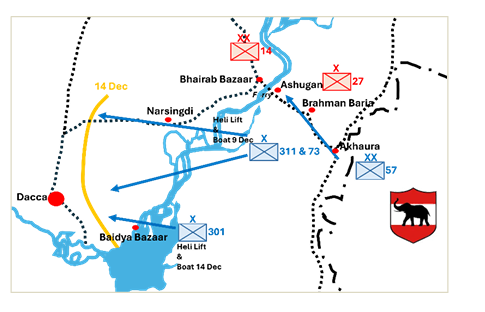
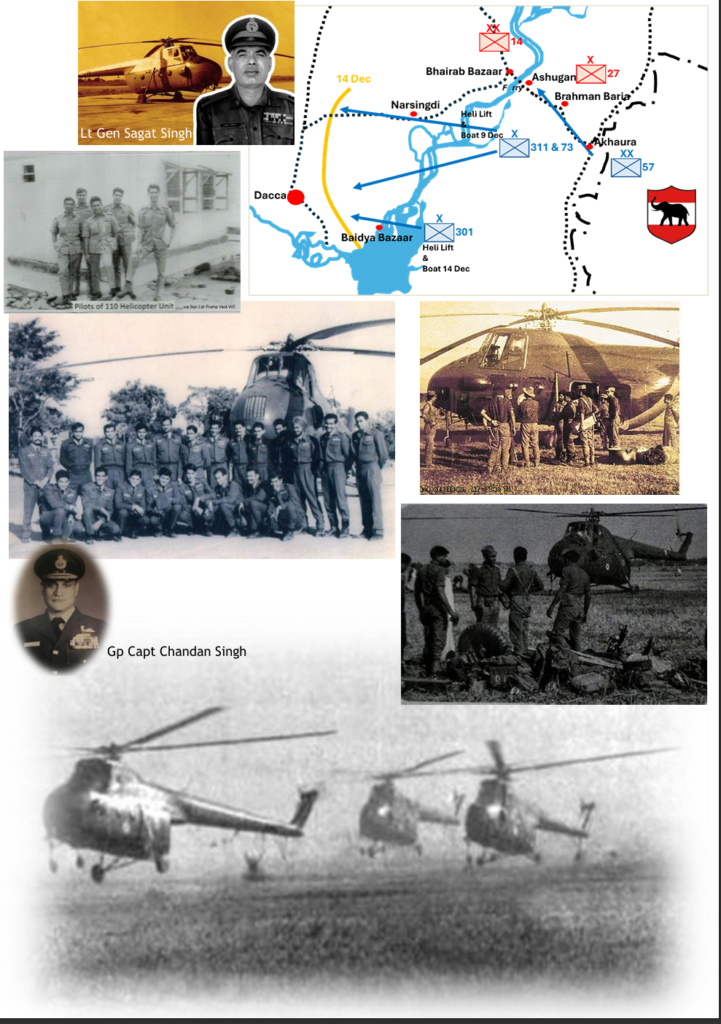
While 57 Infantry Division/4 Corps operations were being conducted in Akhaura, radio intercepts indicated that Pak 14 Division was ordered to withdraw its 313 and 27 Brigades for the defence of Dacca. Lt Gen Sagat Singh GOC 4 Corps who had a penchant for rapid manoeuvre saw this as an opportunity to bypass Pakistani defences at Ashuganj and Bhairab Bazar on the Meghna River accelerating the advance towards Dacca. Meghna is one of three rivers that forms the Ganges Delta, beyond it lay Dacca. Only way across the river was over Ashuganj Bridge – heavily defended, difficult to assault. 313 Pak Brigade from Maulvi Bazar was expected to move by Steamers to Ashuganj on its way to Dacca. It never did, fell back into ‘Sylhet Fortress’ and sat out the war.
Gen Niazi blamed GOC 14 Infantry Division and removed him from command. Possibly, if 313 Brigade had withdrawn to defend Meghna & Narsingdi, ‘The End’ of the war may have been delayed to the advantage of the enemy. Lt Gen Sagat Singh chose an impromptu heliborne operation to begin bypassing Pakistan’s 14 Division that was now falling back to Bhairab Bazar. Anticipating high casualties to take the bridge by force Sagat Singh, decided to airlift 57 Infantry Division troops using helicopters. (Strategic Heliborne Operations (SHBO)) Meghna heli-lift perhaps changed the course of the war and by 9 Dec, Dacca became an achievable objective. On 9 Dec, Gen Sagat Singh during an aerial recce approved a landing site near Raipura village, outside artillery range from Bhairab Bazar. The recce underscored the extraordinary nature of the ops ……. On their way back, the chopper, piloted by Capt (later Lt Gen) GS Sihota, encountered enemy ground fire near Ashuganj but managed to land safely with 38 bullet holes.
On the Night of 9 Dec, 12 Mi-4 helicopters flew from Brahmanbaria stadium across the Meghna and its marshy banks, to a field in Raipur inducting A-Coy 4 GUARDS to hold ground and then the entire battalion. As 4 GUARDS over-ran enemy deployments in Methikanda and Narsingdi, the operations became bolder and landing sites went further forward, towards Narsingdi. The MI-4 helicopter normally carries 14 troops, that day it carried as many as 23; juggad. 311 Infantry Brigade heli lifted 4 GUARDS & 10 BIHAR Regiments the same day. The rear doors were kept open for quick entry and exit, and the engines never switched off; all this while braving dangers associated with a war at night. The enemy too would be at his wits end and scared to death by the continuous noise of the helicopters throughout the night
At the same time, while this operation was on, 73 Infantry Brigade moved across Meghna on boats and riverine crafts. After securing Narshingdi, Indian forces captured Daudkandi and Baidya Bazar towards the south and opposite Comillaon on 14 and 15 Dec respectively, both with helicopter assault. From Narshingdi, the metaled road to Dacca lay undefended for 4 Corps to take. Pakistan’s 14 Infantry Division was siting isolated and useless with the Division HQs and 27 Infantry Brigades at Bhairab Bazaar and Asuganj and 202 and 313 Infantry Brigades in the ‘Sylhet Fortress’. The Pakistani Army had left the roads to Dacca undefended moving their defences at the bridges and defensive strong points. They were expecting to hold the Indian Army at these positions long enough till the UN and international pressure halted the Indian advance. The Meghna Heli bridge along with the Tangail Airdrop on 11 Dec ensured that these positions were by-passed. Dacca now could only be defended by troops available within the city.
The air bridge across the Meghna by 14 Mi-4 (110, 105 & 111 HUs) – 32 Pilots, (2 VrCs), 4 Tech Offrs, 84 SNCOs & Air Men was a remarkable feat. Overcoming logistical challenges from 7 Dec to 15 Dec, the MI-4 helicopters completed a total of 222 sorties without a single mishap between various locations, carrying 2,010 troops and 49,470 kgs of equipment for 57 Mountain Division. Moreover, they conducted 187 sorties from Kalaura and Kailashahar to Sylhet and from Daudkandi to Baidya Bazar, transporting 1,793 troops and 50,600 Kgs of weaponry and equipment. Despite the absence of artillery support for the infantry being airlifted, this audacious plan caught the enemy off guard, marking a bold move against significant odds. The Meghna heli-lift was considered a significant war winning factor. The Indian Air Force’s operation was led by Group Captain Chandan Singh who was awarded the Maha Vir Chakra. Lt Gen Sagat Singh