
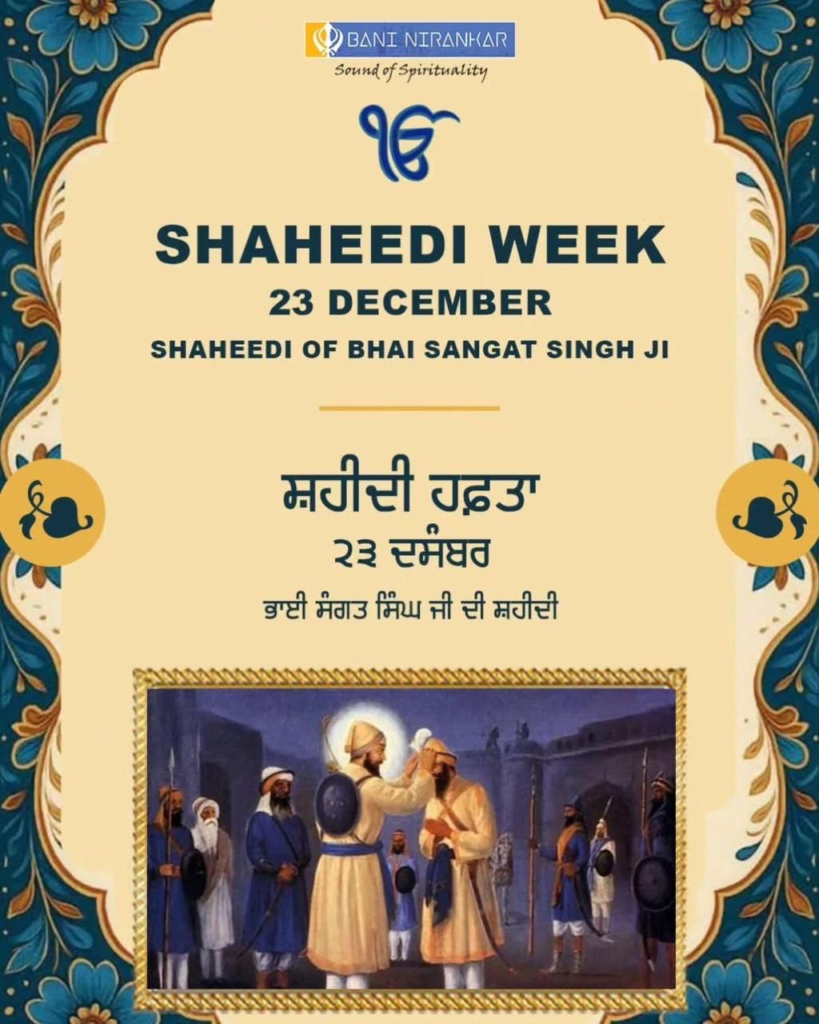
December 23 marks the conclusion of the Battle of Chamkaur (fought around 21-23 December 1704), where Guru Gobind Singh and a small group of 40 Sikhs defended a mud fortress against a massive Mughal army.
Key Martyrs and Details for Dec 23:
- Final Stand: By the morning of December 23, the last remaining defenders, led by Bhai Sangat Singh (who disguised himself to look like the Guru to allow him to escape), were martyred.
- Total Casualties: Approximately 35-40 Sikhs achieved martyrdom in the battle, including three of the Panj Piaras (Beloved Five).
- Elder Sahibzaade: While the battle raged on the 22nd and 23rd, Guru Gobind Singh’s eldest sons, Baba Ajit Singh (18) and Baba Jujhar Singh (14), were martyred on December 22nd.
Contextual Events on Dec 23:
- Following the Guru’s safe exit from the fort on the night of Dec 22-23, the remaining defenders continued to fight until the last breath.
- Younger Sahibzaade: Simultaneously, on December 23, the two younger sons, Baba Zorawar Singh and Baba Fateh Singh, were produced in the court of Sirhind after being captured but kept in Morinda small Jail for one night
- KOOTWALI SAHIB
- Gurdwara at Morinda (Distt Ropar) 15 Km from Chamkour Sahib,as Kotwali sahib.After Gangu Teli (cook of Guru family) handed them over to Mugul Army for greed
- Zafarnama
- Zafarnama or “Epistle of Victory” is a letter that was written by Guru Gobind Singh to the then Mughal Emperor Aurangzeb. Zafarnama vividly describes what happened at Chamkaur, and also holds Aurangzeb responsible for what occurred and promises he broke.
- After his escape from Chamkaur, the exhausted Guru is said to have been carried by two Pathans (Ghani Khan and Nabi Khan) to Jatpur where he was received by the local Muslim chieftain. He later went to Dina, and stayed at Mai Desanji’s house, where he wrote “Zafarnama” in Persian, in 111 verses.[17]
- Dating
- According to Hari Ram Gupta, the battle of Chamkaur was fought on the Bikrami date of Magh Shudi 7 Samvat 1761, which corresponds to 22 December 1704 in the Gregorian calendar. However, according to Pal Singh Purewal, this date conversion by Hari Ram Gupta was an error and the true date of Poh 8 corresponds to 7 December. According to Purewal, Gupta likely converted the date using a modern panchangs rather than a historical one corresponding to that era, historical shifts in calendar dates were not accounted for.[18][19]