(Maj Gen Harvijay Singh, SM)
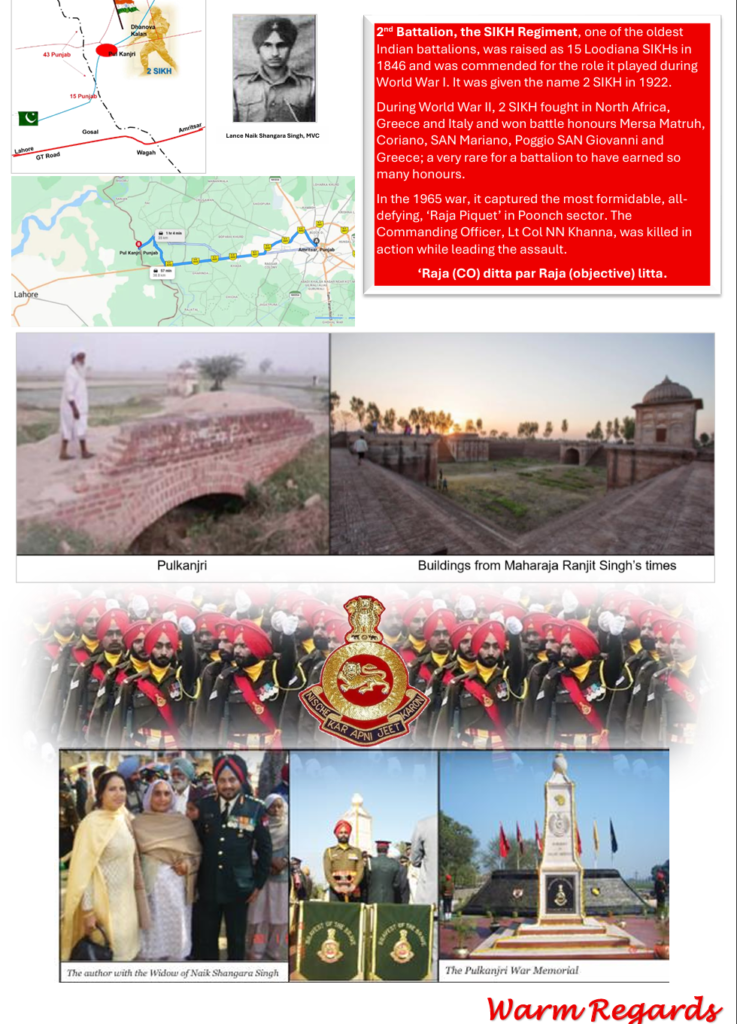
35 Km from both Amritsar and Lahore ia an Indian village Pulkanjri. Maharaja Ranjit Singh, built a baradari (building having twelve gates). He stayed here during his sojourns to Lahore from Amritsar in the 17th century. Arora Sikhs, Hindus and Muslims lived in great harmony. A 12-foot-wide canal ran close by carrying water from Kahnuwan Chammb, a swampy depression along the Beas River in Gurdaspur district, to the Shalimar Gardens Lahore and was built by Emperor Shah Jehan.
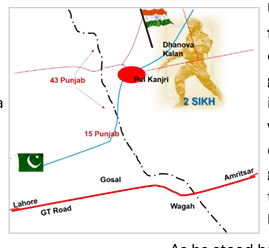
A ‘‘Kanjri’’ (professional dancer) Moran, entertained the Maharaja and was his favourite. One day, as the legend goes, while Moran was on her way to the Baradari for a dance show, her shoe fell into the canal. She got upset and told the Maharaja that she would dance only if he built a ‘‘pul’’ (bridge). The bridge was made and came to be known as Pul Kanjari, it still stands today, a tribute to the legend of Moran (Now called Pul Moran). Pulkanjri was attacked by Kabaili rioters in 1947; almost the entire population was butchered. Pulkanjri located bang on the International Border continued to endure violence and bloodshed during the two wars fought by India and Pakistan. On 3 Dec 1971, Pak 43 Punjab Regiment occupied Pulkanjri in a surprise attack after the BSF Post was tactically withdrawn. It remained in their possession during the entire war. The Pakistanis secured the area well making full use of the built-up area, small bunds and broken ground around the ruins of the Baradari built during the Maharaja’s time. They converted the captured Border Outpost into a strong defended locality supported with automatic weapons. Adequate reserves were also available in the close vicinity to counter any threat. The village was located in the area of responsibility of 2nd Battalion, the SIKH Regiment.
The battalion was anxious to regain the lost post and teach the enemy a lesson. Their persistent requests paid off and orders were finally received at 5.45 PM on 17 Dec to capture Pulkanjri by 8 PM, the announced time of the unilateral cease fire of the war with Pakistan. “Too short a time”, any commander would say, but the spirits were high and the opportunity could not be missed. 2 SIKH would have to use all their fighting skills and tactical diligence to defeat the enemy who was superior in strength, fire power and also well entrenched. Veterans who participated in the battle whisper that orders had to come from the highest leadership at the centre in view of the declaration of Cease Fire; evidently Pulkanjri was considered important to get such attention. Undeterred by the increase in volume of fire, Lance Naik Shangara Singh of the company decided to take on the Machine gunners.
He displayed remarkable gallantry in clearing two machinegun posts, which were holding the attack up. Shangara Singh dashed through a minefield and hurled a grenade at one of the posts. He then charged the second gun and leaping over the loophole snatched it. As he stood holding the gun, he received a fatal burst. The Brother – in – Law of Shangara Singh (he fought alongside Shangara) whom the author met during a memorial service at Pulkanjri states that he had to cut Shangara’s hand that had burnt on the red-hot barrel of the machine gun before his cremation. Shangara accounted for eight Pak soldiers. Lance Naik Shangara Singh was awarded India’s second highest gallantry award, the Maha Vir Chakra. The assaulting troops were soon in the centre of the village surrounded by the enemy. Led by their company commander Major NS Koak they (incl the wounded) kept on shouting and firing trying to depict a much larger force than they were – this aggression both confused and scared the enemy who fell for the ruse de guerre. The Pak army quickly committed their reserves and launched a counterattack using a company of 43 Punjab Regiment and two companies of 15 Punjab Regiment. The 2 SIKH Company stood firm, foiled the counterattacks and inflicted heavy casualties on the enemy; the tactical bluffs played by Maj Koak had paid rich dividends. A small patrol launched a simulated attack for deception while the main assault by Charlie Company went in at 7.20 PM supported by heavy mortar and artillery fire. The deception was well executed and enemy readjusted some of his automatic weapons. The enemy soon regrouped and brought down heavy Machine Gun fire at the assaulting troops.
Undeterred by the increase in volume of fire, Lance Naik Shangara Singh of the company decided to take on the Machine gunners. He displayed remarkable gallantry in clearing two machinegun posts, which were holding the attack up. Shangara Singh dashed through a minefield and hurled a grenade at one of the posts. He then charged the second gun and leaping over the loophole snatched it. As he stood holding the gun, he received a fatal burst. The Brother – in – Law of Shangara Singh (he fought alongside Shangara) whom the author met during a memorial service at Pulkanjri states that he had to cut Shangara’s hand that had burnt on the red-hot barrel of the machine gun before his cremation. Shangara accounted for eight Pak soldiers. Lance Naik Shangara Singh was awarded India’s second highest gallantry award, the Maha Vir Chakra. The assaulting troops were soon in the centre of the village surrounded by the enemy. Led by their company commander Major NS Koak they (incl the wounded) kept on shouting and firing trying to depict a much larger force than they were – this aggression both confused and scared the enemy who fell for the ruse de guerre. The Pak army quickly committed their reserves and launched a counterattack using a company of 43 Punjab Regiment and two companies of 15 Punjab Regiment. The 2 SIKH Company stood firm, foiled the counterattacks and inflicted heavy casualties on the enemy; the tactical bluffs played by Maj Koak had paid rich dividends
. A small patrol launched a simulated attack for deception while the main assault by Charlie Company went in at 7.20 PM supported by heavy mortar and artillery fire. The deception was well executed and enemy readjusted some of his automatic weapons. The enemy soon regrouped and brought down heavy Machine Gun fire at the assaulting troops. The assault was supported by accurate artillery (175 Field Regiment) and 2 SIKH’s 3-inch mortars fire. When the company started running low on ammunition, they exercised fire discipline instinctively – fire one round to kill and then shout ten choicest Punjabi profanities. Wit combined with bravado; such regimental resilience (endure, adapt, and fight on) is the hallmark of Sikh troops. Enemy accepted defeat at 1.30 PM on 18 Dec, the battle had continued for more than 12 hours after Cease Fire. During a flag meeting, Lt Col Mohd Iqbal, CO 43 Punjab Regiment told Lt Col SC Puri CO 2 SIKH “Colonel, one soldier to another, I will like to compliment you on your excellent outfit. Your men fought heroically and were distinctly superior in battle.” One enemy officer and 13 Other Ranks were captured and 25 dead bodies were handed over. Many more wounded and dead were evacuated by the enemy during the conflict. 2 SIKH was awarded one Maha Vir Chakra, two Vir Chakras and four Sena Medals. Five months later, Naib Subedar Gian Singh was posthumously awarded the Vir Chakra when in May 1972 he led a fighting patrol and thwarted another attempt by Pakistan army to capture Pulkanjri.