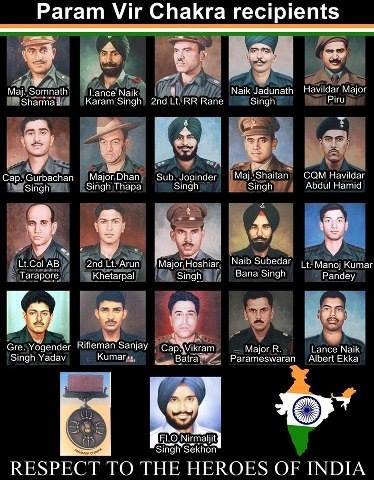
There are about 250 Indian Army officers/JCO/OR who are gallantry awardees ( Chakra Series) whose NOK are father/mother.
These NOKs are entitled to a complimentary railway pass issued by the Indian Railways which entails the NOK to complimentary travel in the Indian Railways for self and a companion .
Many of these NOK might not be aware of this benefit as the earlier rule of the pass being entitled to only the NOK ( Spouse/Child) has now been changed to NOK ( Spouse,Mother and Father ).
I had assisted in the issue of the pass to the parents of my coursemate , Capt R Subramanian , KC ( P) who was unmarried.
The process is very simple as it consists
1.Personal application
2. Authenticated copy of gazette notification of the award
3. Authenticated copy of the service particulars booklet issued by records/MP5/6
4. 3 passport size photographs .
The application needs to be addressed to the General Manager, Railways of the appropriate region ( North/South/Central/Western /Eastern/NE /SC etc ).
The pass is issued in about 48 hours .
I have carried out an open source data analysis of deceased Indian Army Personnel who have been awarded gallantry awards ( Chakra Series) ,
You can reach out to me and I shall provide you with the details of the deceased unmarried solider and his NOK of your unit/regiment/course affiliated personnel
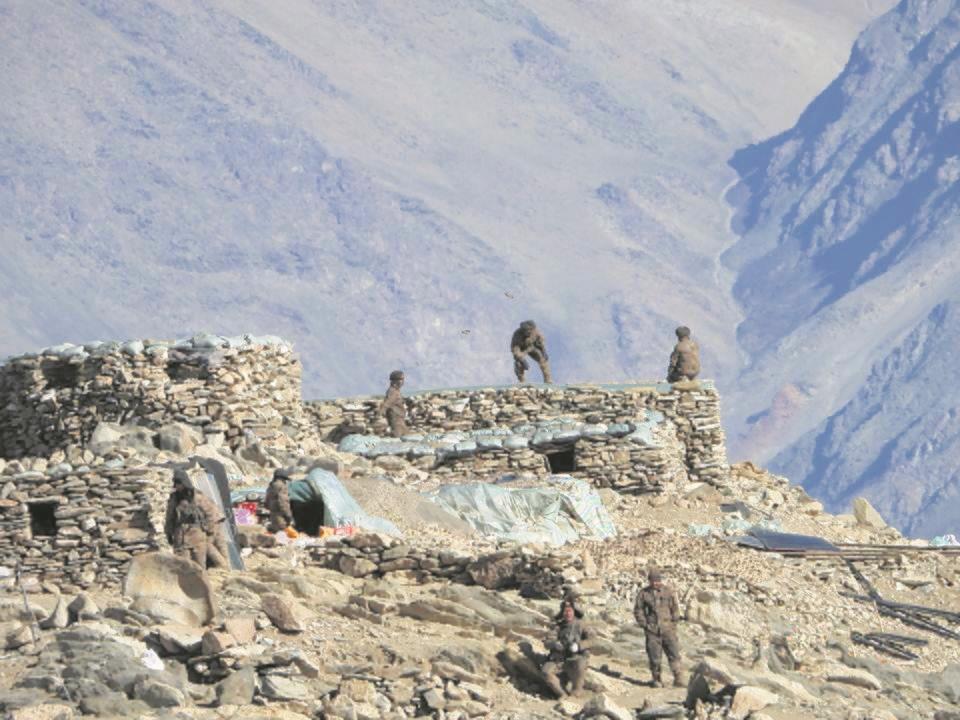
Areas where the Indian military holds a tactical advantage need to be identified and occupied, if required, as a bargaining chip on the negotiating table as was done with respect to Pangong Tso. Conversely, we should be prepared to thwart similar designs by the Chinese where we are at a disadvantage. An improvement of infrastructure in forward areas along the LAC is crucial.
Glaring point: China has always followed the policy of two steps forward, one step back all along the LAC. PTI
Gen Deepak Kapoor (retd)
Former Chief of the Army Staff
The hope that withdrawal by the Chinese and Indian forces from the north and south of Pangong Tso lake, respectively, to status quo as existing in April-end 2020 would lead to a similar resolution at Gogra, Hot Springs and Depsang Plains appears to be gradually fading. This belief is further strengthened not only by a lack of progress during subsequent talks, but also by the statement of Chinese Foreign Minister Wang Yi on March 7.
At his annual press conference, while blaming India for the standoff, Wang stated that the border issue was not the ‘whole story’ of the bilateral relationship and seemed to suggest that the Ladakh issue should be left on the backburner while moving on to ‘business as usual’ in other fields. Thus, the ‘salami slicing’ strategy was sought to be shifted out of focus and glossed over in quest of ‘normalisation’ of mutual relationship.
Some aspects of the Ladakh imbroglio stand out. The policy of two steps forward, one step back has been followed by China all along the 3,488-km Line of Actual Control (LAC) while gradually creeping forward over the last 50 years. This is unlikely to stop, considering the aggressive and expansionist approach adopted by China as its power grows. Its actions in the South China Sea (SCS), East China Sea (ECS) and towards Taiwan are clear examples.https://a81aff2a5c4d46695228d6af8c6855e5.safeframe.googlesyndication.com/safeframe/1-0-37/html/container.html
Secondly, while healthy competition between the two regional powers is welcome, the reality of such competition harbouring inherent seeds of conflict cannot be wished away.
Sources of raw material and markets for finished products intensify this economic competition, invariably leading to discord. Efforts to retard India’s economic growth by forcing it to divert its limited resources towards defence are a good reason, besides others, to prolong the Ladakh standoff.https://a81aff2a5c4d46695228d6af8c6855e5.safeframe.googlesyndication.com/safeframe/1-0-37/html/container.html
It is interesting to note that India has spent a whopping Rs 20,776 crore on emergency purchases to meet the Ladakh challenge. The possibility of further such purchases to guard the entire LAC remains strong with no end to the standoff in sight.
Thirdly, Covid-19 has been a major factor in checking India’s growth trajectory. On the other hand, China has come out relatively unscathed from the pandemic, thus resulting in its economy rapidly bouncing back. Obviously, it felt this was the opportune time to strike a weakened India and achieve a resounding victory, perhaps without even firing a shot.
That subsequent events proved this appreciation wrong is indeed a tribute to India’s defence forces and their ability to defend the nation at all costs. However, loss of face is hard to digest by a Chinese mind, thus increasing the chances of the faceoff continuing.
Lastly, India, having occupied important features on the Kailash Range south of Pangong Tso, had bargaining chips on the negotiating table to ensure the Chinese withdrawal from features north of Pangong Tso as part of quid pro quo.
Disengagement having happened on both sides of Pangong Tso, India now has no such bargaining leverage to make the Chinese withdraw from other friction points in east Ladakh. This aspect heightens the likelihood of the Chinese not moving back from these friction points, thus prolonging the faceoff.
In such a scenario, India has to orchestrate its actions both at the international and domestic levels. At the international level, a consensual approach with like-minded nations is essential to thwart Chinese expansionist designs. Thus, the impetus being given to Quad and its deliberations are a step in the right direction. The Quad’s consensus on observing the rule of law in the Indo-Pacific region and resisting any unilateral actions to change quo would be keenly watched.
Likewise, a number of ASEAN countries are affected by arbitrary Chinese expansionist designs in the SCS. They need to come together and collectively resist any subversion of the UN Convention on Law of the Seas (UNCLOS) by China. That China has refused to implement the International Court of Justice (ICJ) decision on Scarborough Shoal is indicative of a clear breach of the rule of law.
Collective pressure through forums like the SCO, BRICS, EU and UNSC would also help in keeping the Chinese aggressive approach in check.
At the domestic level, experience has shown that a firm stance against China has always paid dividends. Wang Dung, Chumar, Demchok and Doklam are examples. The need to resist every attempt at grabbing territory cannot be overemphasised.
Areas where the Indian military holds a tactical advantage need to be identified and occupied, if required, as a bargaining chip on the negotiating table as was done with respect to Pangong Tso. Conversely, we should be prepared to thwart similar designs by the Chinese where we are at a disadvantage.
An improvement of infrastructure in forward areas along the LAC, matching those existing in Tibet on the Chinese side, is crucial to enabling troops on the forward line to defend the territorial integrity of the nation successfully.
Finally, Pakistan taking advantage of an Indian confrontation with China cannot be ruled out. Its past defeats have left it thirsting for revenge. This raises the possibility of a two-front threat to India. It is, therefore, important to prepare for such an eventuality by raising the defence budget to at least three per cent of the GDP. Important committees in the past have made this recommendation to the government. The sooner it is implemented, the better.
Protesting farmers raise structures at Singhu, booked
Case against Bathinda farmer for digging borewell in Kundli | Protesters say firm on repeal of laws
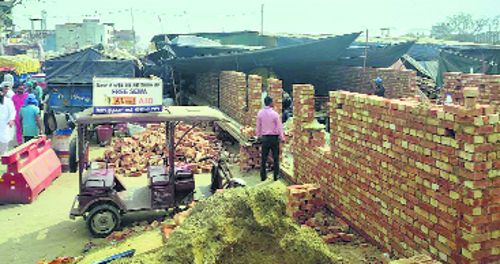
Farmers construct a concrete structure along the NH-44 near the Singhu border. Tribune Photo
Mukesh Tandon
Tribune News Service
Sonepat, March 13
The police have booked agitating farmers for allegedly constructing concrete structures at the Singhu border along the National Highway No-44 and digging a borewell in the Kundli area despite a ban. The police have registered two cases against the farmers under various sections of the IPC and the National Highways Act.
Farmers are protesting at Delhi borders against the three farm laws for more than three months. They have now started constructing concrete structures along the highway at the Singhu border, where they are camping since November 26.
Some farmers have constructed permanent structures with iron bars and bamboos while others are using bricks to construct pucca structures at various spots along the highway. Masons and labourers can be seen working at various spots on the roadside building permanent structures.
“We are staying at the Delhi borders for the past over 100 days, but the Central Government does not want to pay heed to our demand of repealing the three farm laws. That’s why we have decided to construct special structures and have also brought solar panels. We are ready to stay here for a long time,” said Gurpreet Singh Sahabana, a farmer leader from Ludhiana.
“We have constructed a permanent structure for our union office and are ready to fight till our last breath. We will go back only after winning the fight,” said Gian Singh Mand, block president of the BKU (Lakhowal), Ludhiana.
“The farmers have no option but to build concrete structures to stay for a long fight and save our protesting brethren from the summer,” said Harinder Singh Lakhowal, general secretary of the BKU (Lakhowal)
“We are prepared for a long haul and will not go back till the government repeals the laws. We have come at the Centre’s door to save our land and our future generations,” he said.
“Not only permanent structures, but we have also installed solar panels. We are also constructing offices at the site,” he added.
Anand Sharma, Project Director, National Highways Authority of India (NHAI), in a complaint to the police, said that constructions were underway along the NH-44. “Unidentified people have erected illegal structures along the NH-44 in front of Malwa Motors. These illegal constructions are causing damage to the NH-44”. The NHAI officials also sent pictures of the illegal constructions to the police.
Following the complaint, the Kundli police registered a case under the National Highways Act and Sections 283 and 431 of the IPC.
In another complaint, Pawan Kumar, Secretary of the Municipal Committee, Kundli, said despite a ban, Karam Singh, a protesting farmer from Bathinda, was digging a borewell in a field near KFC Mall, near the NH-44. The Municipal Engineer had tried to stop the digging but it was still “continuing”. The police have booked Karam Singh under the National Highways Act and Section 188 of the IPC.
Inspector Ravi Kumar, SHO, Kundli, said two cases had been registered against the farmers for constructing illegal structures and digging a borewell, on the complaints of the Project Director, NHAI, and the Secretary, Municipal Committee, Kundli. A probe into the matter was underway, he added.
Soldier’s bullet-pierced helmet is his prized possession
Maj Gen Balwinder Singh (retd) has a special memoir at the entrance of his house. This is the helmet of an Indian soldier, who was killed by the Chinese troops in 1962 with two bullet marks in it. A Tribune Photograph, with Deepkamal Story
Deepkamal Kaur Tribune News Service Jalandhar, March 13
Enter the house of Maj Gen Balwinder Singh (retd) in Seth Hukum Chand Colony here and one finds a special memoir that he has displayed right at the top of his main door to the drawing room.
This is the helmet of an Indian soldier, who was killed by Chinese troops in the 1962 war. The helmet has two bullet marks slightly on its left side. It perhaps were these marks, which led to his killing in the Indo-China war.
The ex-serviceman discloses as to how he collected it and what makes it so special for him. “The Indian Army deputed me at Dhola post in Arunachal Pradesh in 1986. Dhola post was a border post set up by the Indian Army in June 1962, in the Namka Chu river valley area disputed by China and India. During the Sino-Indian war, Chinese troops attacked the Indian side. Many Indian soldiers lost their lives. So, 24 years later when Army sent me to this posting, I realised that the bodies of many soldiers could not even reach homes and we could seldom spot their skeletal remains. There during a routine recce, I found this helmet with a part of the skull in it and I picked it,” said Maj Gen Balwinder.
“I went on moving with this helmet to all my postings. I have always kept it with me and displayed it well wherever I got posted. After my retirement, this was one thing that I brought back home, maybe out of respect for that soldier who died fighting on the front. This remembrance of the ‘unknown soldier’ has become my biggest prized possession,” he concluded, pointing to the black special memoir which he has got nicely juxtaposed on a black oval background on the front elevation of his house.
SKM’s Balbir Singh Rajewal says PM Modi bigger threat to India than Pakistan
In Nandigarm, farmer leader appeals to voters to vote for anyone but BJP
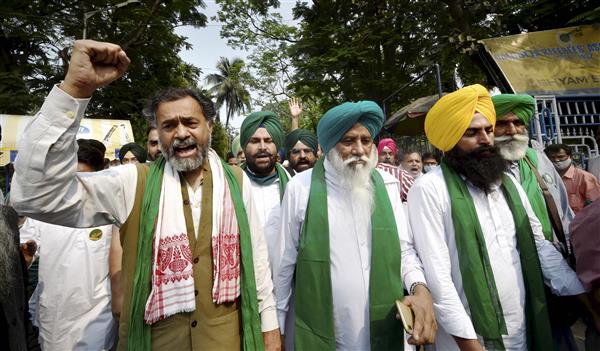
Swaraj India chief Yogendra Yadav (L), farmers leader Bilbar Singh Rajewal (C) and others during a protest rally against the farm laws, in Kolkata, Friday. PTI
Tribune News Service
New Delhi, March 13
The farmers’ agitation that began with an apolitical agenda, one to get the three farm laws repealed, has turned “political” with senior most leader of the Samyukta Kisan Morcha (SKM) Balbir Singh Rajewal targeting Prime Minister Narendra Modi.
Rajewal, the most respected face of the SKM, the umbrella unit of over 40 Kisan Unions, has kicked off a political storm after saying Prime Minister Narendra Modi was a bigger threat to India than Pakistan.
Rajewal, who was addressing a gathering at Nandigram, which will see a pitched battle between West Bengal Chief Minister Mamata Banerjee and former TMC MLA and now BJP’s firebrand leader Suvendu Mukherjee, also asked the voters to vote for anyone but the Bharatiya Janata Party.
“BJP only knows vote ki Rajniti. You possess a great weapon called a vote. Please don’t give that vote to Modi. Give your vote to anyone, rather give it to a winning candidate but please don’t vote for Modi,” 77-year-old said addressing the Kisan Mahapanchayat in Nandigram on Saturday.
“Modi is the biggest threat to our country. We are not threatened by Pakistan or any other country. But Modi is our biggest threat,” he added.
Bhartiya Kisan Union (BKU) national spokesperson Rakesh Tikait had also requested the voters to not vote for the BJP ahead of the SKM’s three-day campaign in West Bengal. Ironically, Tikait’s faction is called BKU (Arajnaitik).
Rajewal also touched the topic of Electronic Voting Machine (EVM) from the same stage. “There is another issue of the EVM. We are thinking of doing something about it once the Kisan Andolan gets over,” he added.https://676e0fff2ee4ec5904c42c5b851706ce.safeframe.googlesyndication.com/safeframe/1-0-37/html/container.html
Rajewal’s outburst is part of the anti-BJP campaign currently being undertaken by the SKM in poll-bound states. On Friday, the SKM had issued an open letter to the farmers and citizens of West Bengal asking them to teach ‘arrogant government’ a lesson.
Yogendra Yadav read the open letter that would be circulated in all of the 294 constituencies in West Bengal.
“…The BJP government without consulting the farmers brought the three laws which will not only destroy our produce but also our next generations. They called us brokers, anti-nationals and even terrorists. We were peppered with water cannons, we were lathicharged and were framed in false cases. Because of all these atrocities I want your help. Elections are being held in Bengal. BJP does not bother about good or bad, constitutional or unconstitutional acts. It only understands one language that is of vote, seat and power,” the letter stated.
“Shaheed Bhagat Singh had once said we need a bomb to shake up the British. Similarly, to wake the BJP out of its slumber we need to hurt them with votes. Please do this job for me. BJP is desperate to win in Bengal. If farmers of Bengal punish them in these elections, it will teach them a lesson. If BJP loses in Bengal then it will bring down their arrogance and Modiji will be forced to hear farmers. I am hopeful that you will keep my request in mind when you go to vote,” the letter added.
Farmers’ protest: Women at Tikri vow to fight to end
Women protesters make chapatis at the Tikri border on Saturday. Tribune photo
Sameer Singh
Tribune News Service
Mansa, March 13
Buoyed by being featured on the cover page of US-based ‘Time’ magazine recently, the spirits of women protesters at the Tikri border are quite high who have now vowed to “fight the battle with renewed vigour and take it to its logical end”.
Protesters from Talwandi Aklia village in Mansa said: “It’s not only an honour to feature on the cover page of one of the top magazines in the world, but it also a morale booster to continue our fight against the farm laws with renewed vigour.”
Kiranjit Kaur, who is taking part in the agitation along with her two daughters (five years and five months old), said: “Sadly, our own government has failed to see what an international magazine could see from thousands of miles away. They interviewed us regarding our understanding of the farm stir and our contribution to it.”https://28384feb16b62b15b3872cd9f1098961.safeframe.googlesyndication.com/safeframe/1-0-37/html/container.html
Mahinder Kaur, another protester, said: “They wanted to know if we are aware about the matter or just protesting by following our men folk. But after interviews running for hours, I am confident that they would be certain about our genuine resolve to fight this battle out of our own will. We also urge other women to visit protest venues and take part in the agitation.”
Kuldeep Singh, a farmer leader and resident of Talwandi Aklia village, said, “As many as 13 women from our village alone have been photographed and given space in the ‘Time’ for their invaluable contribution to the farmers’ stir. Khalsa Aid, a social service organisation, has also made announcement of helping farmers of our village.”
Seminar on farm laws organised
Chandigarh: The Kirti Kisan Forum, a platform represented by former civil servants, Armymen and other officers, on Saturday organised a seminar, ‘Kisan Andolan: Challenges and Possibilities’. The seminar was attended by scholars and legal luminaries. TNS
Farmer takes poison
Sangrur: A young farmer allegedly attempted suicide over the central farm laws at Sunam by consuming poison. Avtar Singh was referred to PGI, Chandigarh, in a serious condition. TNS
Pakistani drone spotted in Punjab’s Bamial, returns after BSF opens fire
A Pakistani drone entered the Indian territory on Sunday but was forced to return as BSF jawans spotted it and opened fire in its direction in Pathankot district, a police official said.
“The drone which came from the Pakistani side was sighted at Dinda post close to Bamial along the Indo-Pak international border,” Pathankot Senior Superintendent of Police Gulneet Singh Khurana told PTI over phone.
He said the BSF opened fire in its direction after which it returned to the neighbouring country.https://5689023431c42998f02578c5d12ca295.safeframe.googlesyndication.com/safeframe/1-0-37/html/container.html
Asked if the drone dropped anything inside the Indian territory before flying back, Khurana said, “A thorough search operation was carried out at the site, but nothing was found.”
In December 2020, 11 hand grenades dropped by a drone flying in from Pakistan were recovered from a field near the International Border in Punjab’s Gurdaspur district.
The consignment was found in Salach village, located about one km from the border.
The box of hand grenades had been attached to a wooden frame which was lowered from the drone onto the ground with a nylon rope, police had then said.
The first incident of dropping of arms and weapons through drones from Pakistan came to light in Punjab in September 2019 when police recovered AK-47 rifles, magazines and rounds of ammunition, hand grenades, fake currency and other items in Tarn Taran district. —PTI
Farmers’ stir may continue till December: Rakesh Tikait
BKU spokesperson claims three central laws will lead to closure of all small-time neighbourhood shops
Spokesperson of Bharatiya Kisan Union Rakesh Tikait garlands the statue of late farmer leader Mahendra Singh Tikait in Prayagraj, on Sunday, March 14, 2021. PTI
Allahabad, March 14
The Bhartiya Kisan Union-led farmer agitation against the three central farm laws may continue till December this year, the outfit national spokesperson Rakesh Tikait said here on Sunday.
Tikait made the statement while talking to reporters here after his recent visit to the poll-bund West Bengal.
“This agitation possibly will stretch up to November or December this year,” he said.
Talking about his West Bengal visit, Tikait said during their poll campaigning there, the central government people have been asking farmers to give them one fistful of rice.
“I have advised Bengal farmers to ask grain seekers to fix an MSP of Rs 1850 per quintal for paddy before giving them a single grain of rice,” Tikait told reporters here.
He said after Bengal, he was planning to visit other parts of the country to press for the enactment of a law guaranteeing an MSP for various crops.
“In Bihar, the paddy is currently being bought by traders at an abysmally low rate of Rs 750 to Rs 800 per quintal. I want a law guaranteeing the minimum support price for various crops,” said Tikait.
He said he was not going to sit in Delhi alone but was planning to visit all over the country, including Madhya Pradesh on March 14 and 15, Ganga Nagar in Rajasthan on March 17, Ghazipur’s UP Gate border in Delhi on March 18, Odisha on March 19 and Karnataka on March 21 and 22.
During his visit here, Tikait also garlanded a statue of his late father and farmer leader Mahendra Singh Tikait at Tikait Park in Jhalwa near here.
The BKU spokesperson claimed the three central laws will lead to the closure of all small-time neighbourhood shops, leaving only big commercial malls to survive.
“These farm laws will ruin traders and lead to the closure of small business utilities and the collapse of small industries. These laws will bring in big multinational firms like Wallmart,” claimed Tikait.
“Had this government belonged to a political party, it would have talked to farmers and resolved the matter,” Tikait said.
“But this government is being run by big business houses. It is bent upon selling the entire country,” he alleged. PTI
Refer from ECHS to Private Hospital Changed|अब ECHS रेफरल सिस्टम हो गया आसान | Latest ECHS Rules
New Delhi: India is mulling a new national strategy to strengthen the country’s cybersecurity amid allegations that Chinese intrusions may have affected operations at a key stock exchange and supply of electricity in the country’s commercial capital.
The plan will coordinate responses across ministries including Home Affairs, Information Technology, Defense and the National Critical Information Infrastructure Protection Centre in case of an attack and set audit procedures, former Lieutenant General Rajesh Pant, India’s National Cyber Security Coordinator said in an interview. It will be approved by the cabinet committee on security headed by Prime Minister Narendra Modi.
Authorities are investigating a series of recent suspected cyber intrusions which could have led to a power outage in Mumbai, crippled systems at banks and caused a glitch at the country’s premier National Stock Exchange, he said. A report is expected in about a fortnight.
“We also want to know what happened,” said Pant, who served in the Indian army and now coordinates India’s cyber intelligence and reports to the Prime Minister’s Office. He said the breaches were likely malware and couldn’t be classified as attacks without a proper investigation.
At least one connection opened by Chinese state-sponsored hackers into the network system of an Indian port was still active, as authorities blocked attempts to penetrate the South Asian nation’s electrical sector, the U.S.-based research firm Recorded Future said last week. The attempts by the Red Echo group have been occurring since at least the middle of last year, around the time a bloody skirmish between Indian and Chinese soldiers started in the remote Himalayan region, the firm said.
“India will have to work at breakneck speed to put in place stringent security for critical infrastructure,” said Sandeep Shukla, who runs a state-funded cybersecurity project at the Indian Institute of Technology, Kanpur, and has advised the federal government in the past. “There may also be a need for state financial backing to help smaller companies that are part of the grid. Because if one is hacked, entire systems can be compromised.”
The new strategy will lay down protocols for prevention and audit to secure the government’s digitally connected water, health and education systems that are all being treated as critical infrastructure, he said. Infrastructure like nuclear, power and aviation will be considered supercritical.
“In my view, if internet-connected computers are infected by malware, I won’t say it’s an attack but an infection unless it jumps from IT systems to other operation systems,” Pant said. “It’s like a crank caller. Can you stop someone from dialing your number?”-Bloomberg